
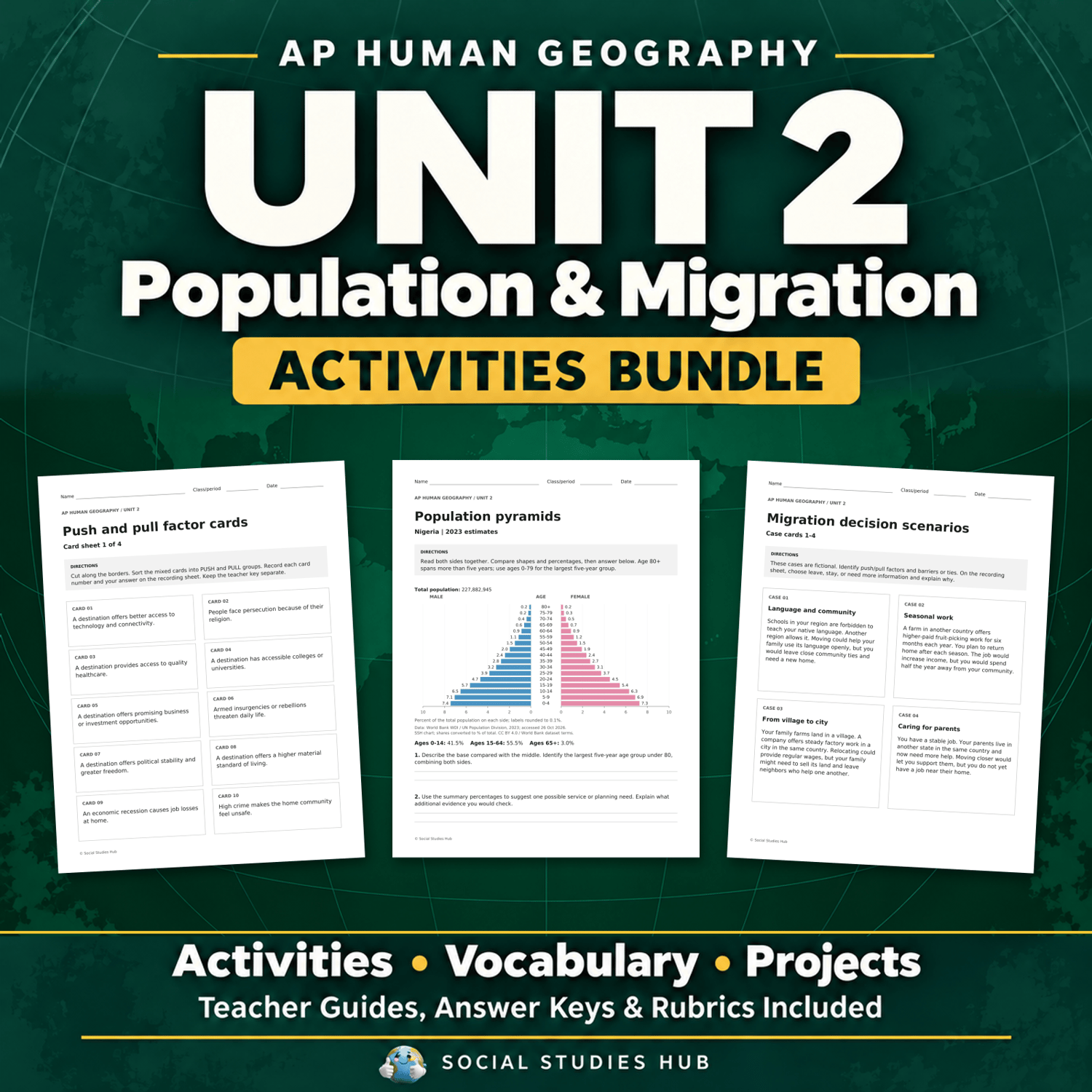
AP Human Geography Unit 2 Activities Bundle: Population & Migration
Give students one activity for each AP Human Geography Topic 2.1–2.12. Use the supplied data, population pyramids and fictional cases to practice calculation, interpretation and geographic explanation after instruction.
The topic sequence gives you a clear place to start. Choose optional vocabulary review, games, discussion, research or documentary work when it fits your lesson. Teacher preparation pages identify prerequisites, materials, print ranges, collection and assessment.
WHAT YOU RECEIVE
12 core topic activities, 10 optional resources and a six-page start-here guide. The collection has 193 unique pages: 128 student-facing pages and 65 teacher/guide pages. Student-facing pages include 30 different bingo boards, card sheets and optional work; that count does not mean 128 separate assignments.
The ZIP contains 26 PDFs: 22 individual activity files, the start-here guide and three convenience packets. The complete print packet combines the same 193 pages once. The core student packet has 37 pages, including one optional research page; the teacher packet has 65 pages. A separate copy of the complete print PDF is also available without unzipping. Convenience copies repeat material and do not add new activities.
ONE CORE ACTIVITY FOR EACH TOPIC
2.1 · Explain Population Distribution: Calculate and compare three density measures, then explain population patterns at different scales.
2.2 · Plan for Population Pressure: Use service demand, water supply and a limited budget to justify an investment.
2.3 · Read Population Pyramids: Interpret four dated country pyramids, compare age-sex composition and analyze subnational sex ratios.
2.4 · Calculate Population Change: Calculate natural increase and doubling time, account for migration and explain demographic change.
2.5 · Trace Demographic Transitions: Analyze birth/death rates, changing mortality and the limits of demographic models.
2.6 · Test Malthusian Arguments: Compare population and food capacity, evaluate critiques and distinguish production from access.
2.7 · Evaluate Population Policies: Classify policy intent and explain effects, time lags and evidence of success.
2.8 · Analyze Women and Demographic Change: Connect changing opportunities with fertility, mortality and migration using clearly defined measures.
2.9 · Plan for an Aging Population: Calculate age shares and dependency ratios, then evaluate responses to aging.
2.10 · Explain Migration Decisions: Weigh push/pull factors, intervening opportunities, obstacles and destination budgets.
2.11 · Classify Migration Patterns: Use case evidence to distinguish protection categories and overlapping movement patterns.
2.12 · Trace the Effects of Migration: Explain uneven effects at origins and destinations, with a dated historical comparison.
TEN OPTIONAL RESOURCES
Vocabulary Matching: 61 selected terms across six worksheets, with a complete key.
Push and Pull Factor Cards: 40 cards with a recording sheet, reflection and separate key.
Migration Decision Scenarios: 16 fictional cases, recording pages and response guidance; choose a smaller set for a shorter lesson.
Population and Migration Crossword: 26 entries, clues, optional word bank, solved grid and answers.
Population and Migration Bingo: 30 different boards, 38 terms and teacher caller clues.
Global Population Summit Mixer: 16 roles, structured conversations and reflection; five contacts by default. Modern cases are fictional and historical perspectives are paraphrased.
Global Migration Project: Nine bounded topic choices, research organizers, source and vocabulary trackers, a contribution log and a 100-point rubric.
Modern Human Migration Cases: Eight dated case readings with analysis and comparison; the included readings support an offline assignment. WebQuest and Google Earth options are optional.
The People Paradox Documentary Guide: 16 questions and response guidance for Hour 1 of NOVA World in the Balance (2004), with an official PBS transcript option.
God Grew Tired of Us Documentary Guide: 30 prompts, response criteria and a shorter official-source option for selected questions.
CLASSROOM USE
Designed for high school AP Human Geography, typically grades 9–12. Use the core activities after teaching the relevant concepts. Most core tasks are estimated at 30–45 minutes; larger tasks may need more time. Projects and films need longer. Times are estimates, not measured classroom results. Matching, crossword and bingo activities are retrieval practice rather than full topic assessments.
IMPORTANT MEDIA REQUIREMENTS
Full documentaries and film licenses are not included. The People Paradox is the first hour of World in the Balance (2004); the official PBS transcript can replace viewing. The full God Grew Tired of Us guide requires separately obtained authorized media. Selected questions can use the official National Geographic sources identified in the teacher guide. Confirm access before scheduling. Film-era figures are historical, not current country profiles.
FORMAT AND MATERIALS
Printable, read-only PDFs; U.S. Letter, 8.5 × 11 inches. They are not editable documents or fillable forms. Open with a standard PDF reader. Start at Actual Size/100%; use Fit if your printer clips. Directions have a solid gray background. The country pyramids use labeled blue and pink bars that also work in grayscale. Core tasks use supplied evidence and need no live website; calculators are needed for numerical work. Optional cards need scissors, bingo needs counters or pencils, and research needs accessible sources or teacher-prepared print readings. No presentation templates are supplied.
CHECK BEFORE BUYING
This is the November 2026 revision of the Unit 2 activities collection, with a topic-based core sequence and retained activities. If you already own the earlier Social Studies Hub collection or a corresponding earlier Unit 2 purchase, many underlying activities overlap. The revised Topic 2.4 activity builds on the Doubling Time resource available in the Social Studies Hub free resource library; its underlying activity is not exclusive to this paid collection.
The set provides original practice for all twelve Unit 2 topics. It is an activities collection, not a complete daily curriculum or official AP exam assessment. Slides, guided notes, study guides, tests, editable source files and media licenses are not included.
USE AND SUPPORT
One teacher’s classroom use. Do not resell, redistribute or post complete files publicly. Questions: mike@socialstudieshub.com.
AP is a trademark of College Board, which does not sponsor or endorse this resource.