
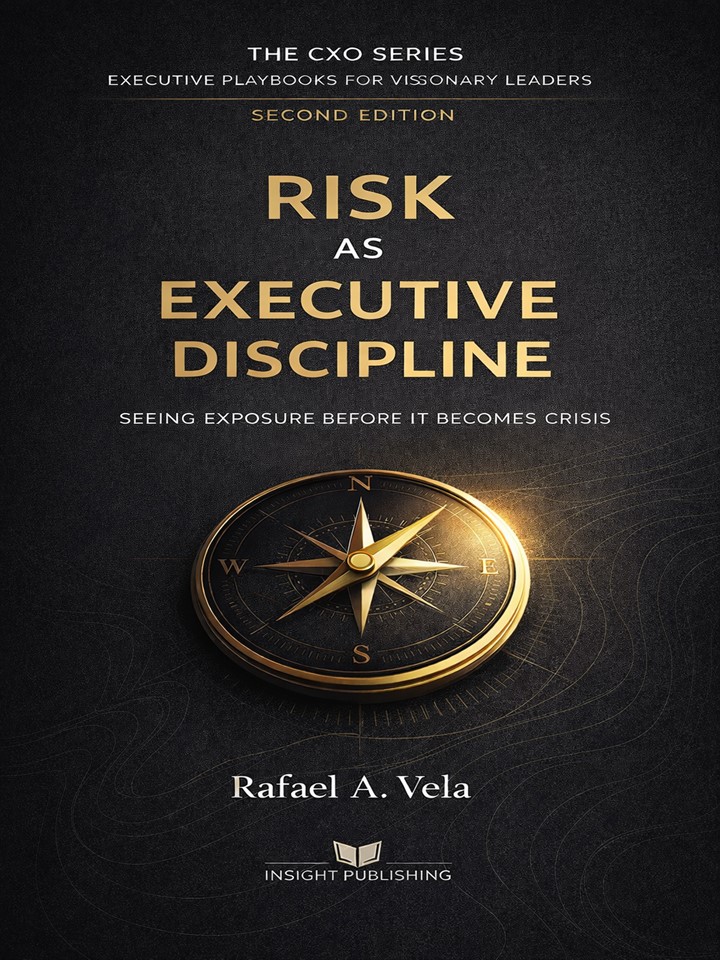
Risk as Executive Discipline Seeing Exposure Before It Becomes Crisis
At the executive level, risk rarely appears as a surprise. It appears as something noticed too late.
Most crises are not caused by unknown threats, but by known exposures that were misunderstood, minimized, or deferred. This book reframes risk not as a technical function or compliance exercise, but as an executive discipline rooted in judgment, attention, and responsibility.
It examines how exposure accumulates quietly through decisions, incentives, governance structures, and delayed trade-offs, long before it is labeled a crisis. The focus is not prediction, but interpretation. Not controls, but clarity.
Written for CEOs, COOs, CFOs, CIOs, board members, and senior leaders operating in complex and volatile environments, this book helps executives recognize weak signals, surface uncomfortable truths, and act before damage becomes unavoidable.
There is no risk theater and no abstract frameworks. Only disciplined executive logic, realistic governance thinking, and a clear view of how organizations actually fail to see what is already visible.
Risk as Executive Discipline is part of the CXO Series, a collection of executive literature focused on judgment, authority, risk, and decision architecture at the top.
Strong leaders do not eliminate risk. They learn to see it clearly, early, and without illusion.
TABLE OF CONTENTS
Part I — Why Executives Fail to See Risk
Chapter 1 — Risk Is Not the Problem. Perception Is - 17
• Why exposure accumulates silently - 17
• The difference between reported risk and real risk - 19
• Why executives often see signals but fail to interpret them - 20
• Perception as an Executive Discipline - 22
Chapter 2 — The Fragmentation of Risk in Modern Enterprises - 25
• How risk becomes diluted across functions - 25
• Finance, operations, compliance, and the illusion of coverage - 27
• Why ownership disappears when risk is everywhere – 29
• Manager vs. Steward - 31
Chapter 3 — When Metrics Create Blindness - 33
• The danger of dashboard confidence - 33
• Why indicators lag behind exposure - 34
• How measurement replaces judgment at the wrong moment - 35
Part II — Reframing Risk at the Executive Level
Chapter 4 — Risk as Exposure, Not Probability - 39
• Why likelihood-based thinking fails executives - 40
• Understanding accumulation, interaction, and amplification - 42
• Seeing risk as a system, not an event - 43
Chapter 5 — Latent Risk in Structure, Culture, and Incentives - 47
• How operating models create hidden exposure - 47
• Cultural signals that normalize risk - 49
• When incentives quietly override controls - 51
Chapter 6 — Risk Trade-Offs Are Strategic Decisions - 55
• Why risk cannot be eliminated, only chosen - 55
• The cost of avoiding visible risk while creating invisible exposure - 57
• Making trade-offs explicit before they harden into crises - 59
Part III — Executive Ownership and Accountability
Chapter 7 — Why Risk Committees Rarely Own Risk - 63
• The limits of delegated oversight - 63
• Why governance structures fail without executive judgment - 65
• Clarifying where ultimate responsibility truly sits - 67
Chapter 8 — Accountability Without Blame - 71
• Why fear-driven cultures hide exposure - 71
• Designing accountability that surfaces risk early - 72
• Separating responsibility from punishment - 73
Chapter 9 — Escalation, Silence, and Executive Signals - 75
• Why bad news slows as it moves upward - 75
• The cost of delayed escalation - 78
• What executives unintentionally signal about risk tolerance - 80
Part IV — Governing Risk Without Paralyzing the Organization
Chapter 10 — Governing Without Slowing the Enterprise - 85
• Why excessive controls increase fragility - 85
• Designing minimal, effective risk governance - 87
• Balancing protection, speed, and accountability - 89
Chapter 11 — From Early Warning to Early Interpretation - 91
• Why signals are useless without judgment - 91
• Building executive sensing mechanisms - 93
• Detecting weak signals before they become strong shocks - 95
Chapter 12 — Building a Durable Executive Risk Discipline - 97
• Embedding risk awareness into leadership routines - 97
• Aligning risk discipline with strategy and change - 98
• Why mature organizations see crises earlier and respond faster - 100
Conclusion — Risk as Executive Stewardship - 103
• Appendix A: Executive Risk Exposure Diagnostic - 107
• Appendix B: Risk Accumulation Map - 113
• Appendix C: Executive Risk Governance Checklist – 118