
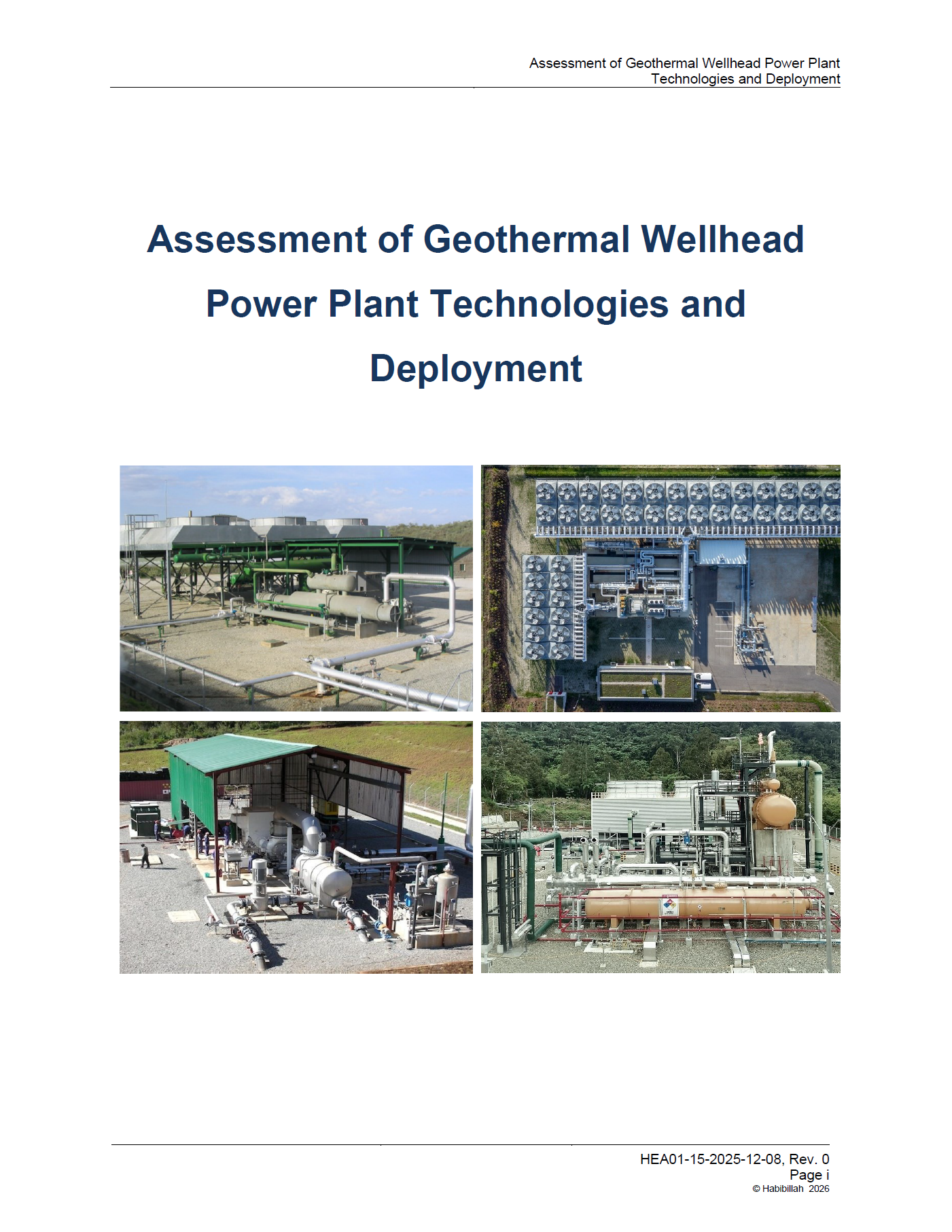
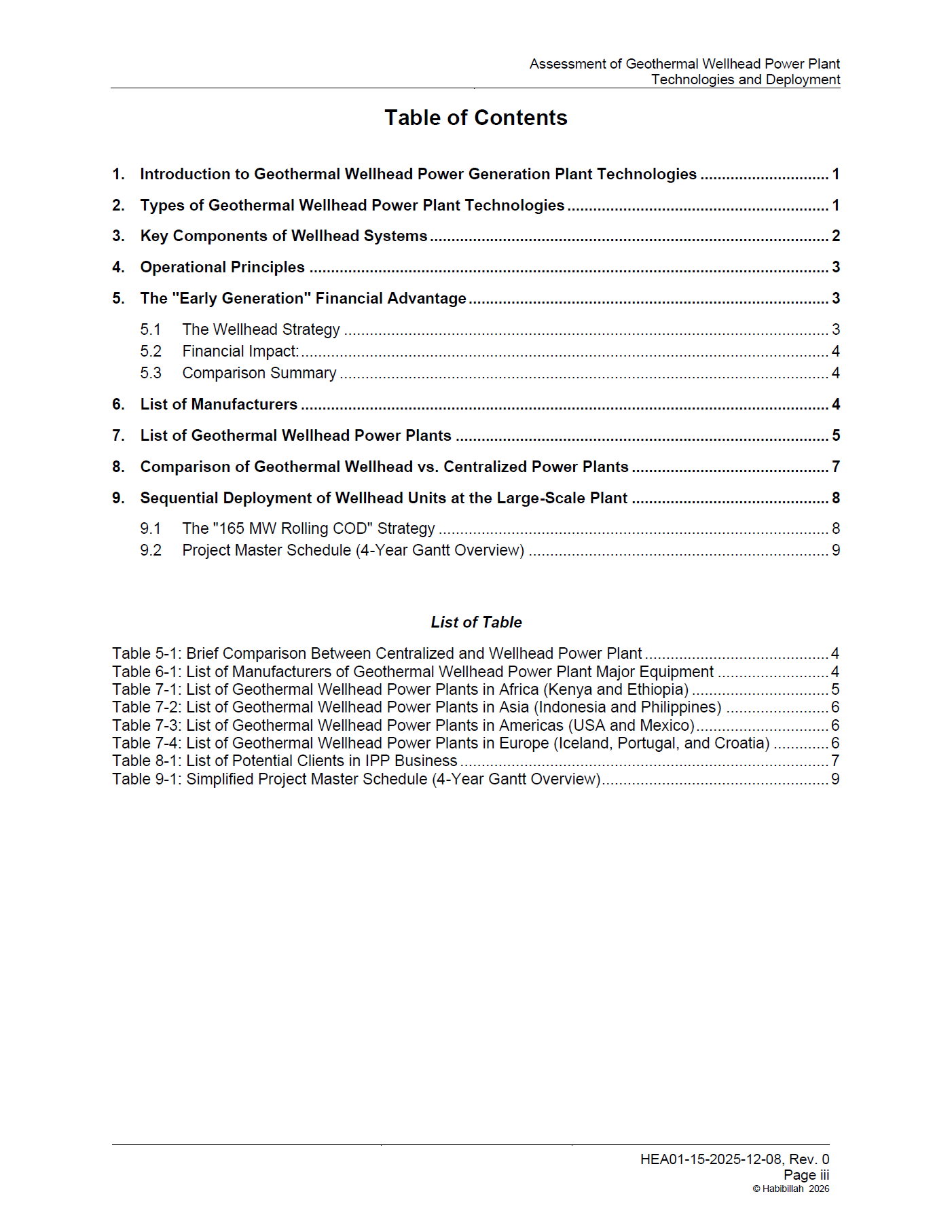
Assessment of Geothermal Wellhead Power Plant Technologies and Deployment
In the rapidly evolving landscape of renewable energy, where the global push for sustainable power sources is intensifying, geothermal energy stands out as a reliable, baseload option that harnesses the Earth's natural heat to generate electricity without the intermittency issues plaguing solar or wind. Yet, within this sector, one innovation is revolutionizing how projects are developed, financed, and deployed: geothermal wellhead power plants. If you're an engineer, project developer, investor, or business leader eyeing opportunities in geothermal power generation, imagine unlocking a treasure trove of insights that could propel your ventures forward, mitigate risks, and maximize returns. That's precisely what our groundbreaking report, "Assessment of Geothermal Wellhead Power Plant Technologies and Deployment," offers, a comprehensive, forward-looking analysis, designed specifically for the 2026-2034 horizon. This isn't just another technical document; it's your strategic blueprint for capitalizing on the next wave of geothermal innovation. And now, we're making it available for purchase online, empowering professionals like you to stay ahead in a market projected to grow exponentially as nations commit to net-zero goals.
This report distills years of industry knowledge into actionable intelligence. The report isn't merely descriptive; it's prescriptive, guiding you through the intricacies of wellhead systems that promise faster deployment, lower upfront costs, and early revenue streams, advantages that traditional centralized plants simply can't match. Whether you're scouting for investment opportunities, optimizing existing fields, or launching new projects, this report equips you with the tools to make informed decisions that could save millions and accelerate your timeline to profitability.
Let's dive into why this report is indispensable. Starting with the fundamentals, it provides a crystal-clear introduction to geothermal wellhead power generation technologies. These compact, modular systems are installed directly at or near the wellhead, converting geothermal fluids, be it steam, hot water, or two-phase mixtures, into electricity on a per-well or small-cluster basis. Unlike cumbersome central plants that require aggregating resources from multiple wells via miles of piping, wellhead units slash infrastructure needs, enabling rapid setup in remote or phased developments. The report highlights capacities ranging from 0.5 to 15 MW per unit, making them ideal for idle wells, high-risk drilling sites, or as temporary solutions that can be relocated. Key advantages? Faster construction timelines, months instead of years, reduced capital expenditure, and unmatched flexibility. Sure, they may carry higher unit costs and slightly lower efficiencies due to the absence of economies of scale, but the financial upside, as detailed in the report, far outweighs these trade-offs, especially in emerging markets where speed to market is everything.
Delving deeper, the report meticulously classifies wellhead technologies based on resource characteristics like temperature, pressure, and fluid type. It covers dry steam cycles for vapor-dominated reservoirs, where superheated steam drives turbines without flashing, though rare in wellhead setups due to erosion risks. Then there's the flash steam cycle, single or double flash, for high-temperature liquid-dominated resources, where hot water is throttled to produce steam, with modular designs facilitating quick installation. For medium-to-low temperature fields, binary cycles like Organic Rankine Cycle (ORC) shine, using secondary fluids such as isobutane or other organic compounds in closed loops to minimize emissions and scaling. Hybrid flash-binary options are also explored, optimizing output by combining high-temp steam flashing with residual brine heat recovery. Portable and modular units get special attention for their ease of transport and maintenance, perfect for temporary operations in challenging terrains. This section alone is a goldmine for engineers and developers, offering precise guidance on selecting the right cycle for your reservoir, backed by operational principles that explain pressure balancing, entropy management, and corrosion mitigation from elements like H2S or silica.
But what truly sets this report apart, and what will convince you to invest in it, is its emphasis on the "Early Generation" financial advantage. Traditional geothermal projects often bleed capital for 3-5 years during drilling, with no revenue until the central plant is built. Wellhead units flip this script entirely. The report outlines a four-step strategy, it demonstrates how, despite potentially higher nominal Levelized Cost of Electricity (LCOE), wellhead projects boast superior Net Present Value (NPV) because revenue kicks in 3-4 years earlier. A comparative summary contrasts centralized flash plants (low CAPEX, efficient steam use, but delayed revenue in Years 5-7) with modular wellhead options, backpressure (lower efficiency but quick start) and condensing/binary (medium efficiency, early revenue). Notes on "wasted" reservoir potential and environmental penalties add nuance, ensuring you understand the full economic picture. This analysis is transformative; it arms investors with data to pitch to stakeholders, showing how wellhead deployment can de-risk investments and bootstrap larger developments.
The report doesn't stop at theory, it grounds everything in real-world applications. A curated list of manufacturers features industry leaders like Ormat Technologies with their air-cooled Ormat Energy Converter (OEC) units, Toshiba Energy and their compact Geoportable turbines, Exergy International for radial outflow designs, Green Energy Geothermal for modular flash plants, Mitsubishi Heavy Industries with Geo-Pack portable systems, and Turboden for scalable ORC turbines. Each entry includes country of origin, product lines, and key features, making it effortless to identify partners for your next project. This isn't generic information; it's based on global industry data, positioning you to negotiate better deals or select technologies tailored to your needs.
Even more compelling are the extensive lists of existing geothermal wellhead power plants, segmented by regions to highlight global deployment trends. Each entry details location, year, capacity, technology, owner, and status, providing case studies that illustrate best practices, challenges overcome, and pathways to scalability. For market assessors and business developers, this data is invaluable for benchmarking and identifying untapped opportunities.
A dedicated comparison of wellhead versus centralized power plants further sharpens your strategic edge. Environmental impacts are weighed, emphasizing wellhead's faster low-carbon transition and minimal infrastructure footprint. This side-by-side analysis, drawn from industry benchmarks, helps you decide which approach fits your project phase, resource profile, or economic incentives, crucial for IPP (Independent Power Producer) business models.
Finally, the report visionary outlines sequential deployment for large-scale plants, targeting a 165 MW capacity in just four years via a "Rolling COD" strategy, using 11 units of 15 MW each. A simplified 4-year Gantt overview maps activities like production drilling, engineering, procurement, manufacturing, shipping, civil works, and grid interconnection, with COD milestones ensuring revenue from Month 14. This isn't hypothetical; it's a proven pathway inspired by global successes, tailored for developers seeking to scale without the delays of central plants.
Now, why should you buy this report today? In a world where geothermal capacity is expected to double by 2030, driven by policies like the Paris Agreement and incentives in regions like the US, Indonesia, and any other geothermal resources rich countries, knowledge is power, literally. This report delivers ROI from day one.