
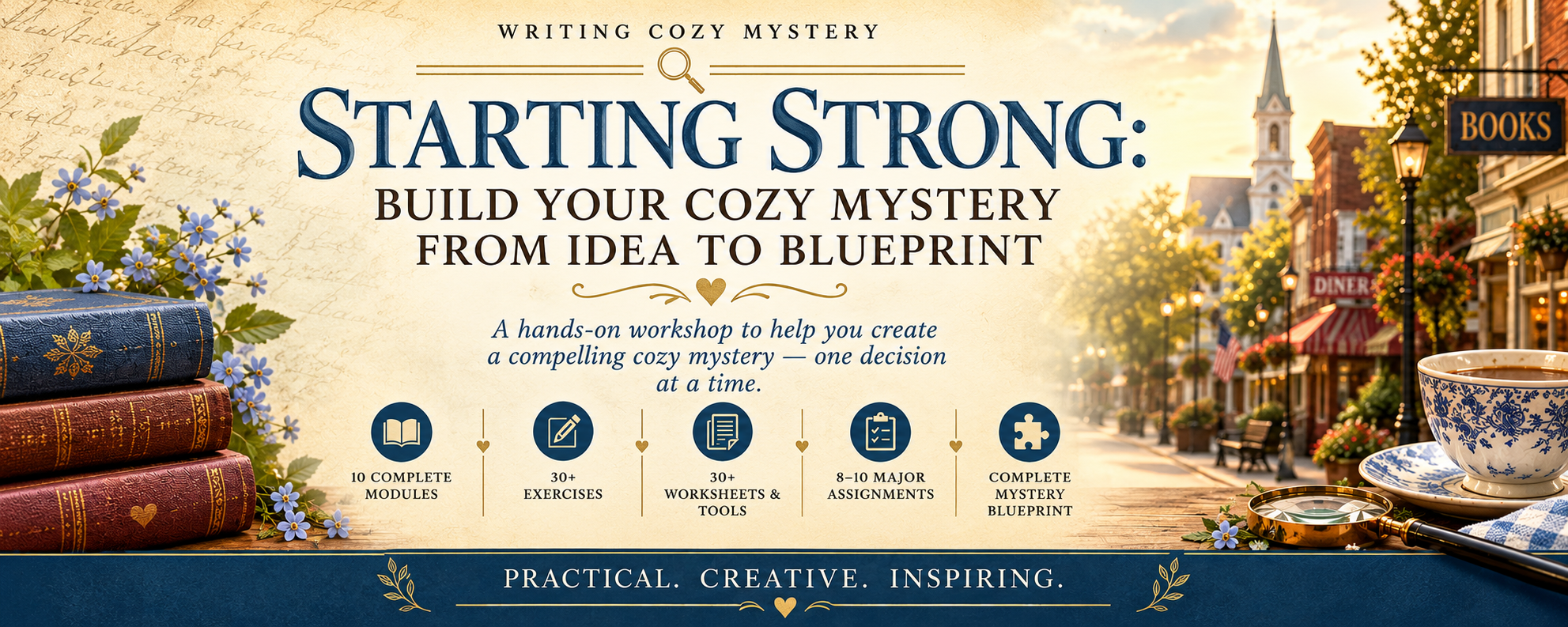
STARTING STRONG
Build the Foundation for a Cozy Mystery Readers Will Want to Solve
Stop staring at a blank manuscript.
Build your mystery first.
You have an idea for a cozy mystery.
Maybe you have a sleuth.
Maybe you have a charming town, a murder, a handful of suspicious characters, or one really good opening scene.
But somehow, all those pieces aren't yet a book.
That's where Starting Strong comes in.
This is a hands-on workshop designed to take you from cozy mystery idea to complete story blueprint—one decision at a time.
You won't just learn what makes a cozy mystery work.
You will build your own.
YOU DON'T NEED ANOTHER BOOK ABOUT WRITING MYSTERIES.
You need to know what to do with your mystery.
You need to know:
- Who your sleuth is
- Why she gets involved
- What makes her uniquely qualified to investigate
- What makes your community memorable
- Who the victim is
- Why the victim was killed
- Who the suspects are
- What each suspect is hiding
- Who actually committed the crime
- Why they did it
- What clues the reader will see
- Which clues are red herrings
- When each clue appears
- How the investigation changes
- What happens at the midpoint
- Where the false solution occurs
- How your sleuth discovers the truth
- How the final reveal works
- And how the story ends
By the time you finish Starting Strong, you will have answers to all of those questions.
And you'll have them organized into one complete mystery blueprint you can use while writing your novel.
WHAT IF YOU COULD STOP ASKING...
"What happens next?"
...and start writing with a clear understanding of where your story is going?
That's what we're going to build.
Starting Strong takes you through the major building blocks of a cozy mystery:
CONCEPT
Turn your initial idea into a workable mystery premise.
SLEUTH
Create an amateur sleuth readers can follow from book to book.
COMMUNITY
Build a cozy world with recurring places, people, history, secrets, and personality.
CRIME
Design a crime that gives your story something worth investigating.
SUSPECTS
Create suspects with believable motives, secrets, opportunities, and reasons to look guilty.
CLUES
Build a fair-play clue system that lets readers play along.
STRUCTURE
Turn your mystery pieces into a story that moves from crime to investigation to reveal.
OPENING
Build a first chapter that introduces the sleuth, setting, conflict, and mystery while giving readers a reason to continue.
BLUEPRINT
Bring everything together into a complete plan for your novel.
THIS IS NOT JUST A COURSE.
IT'S A MYSTERY-BUILDING WORKSHOP.
You aren't going to sit back and watch someone talk about writing.
You are going to do the work.
Every module contains lessons followed by practical exercises and worksheets designed to move your own mystery forward.
You will make decisions.
You will test those decisions.
You'll identify problems.
You'll strengthen weak areas.
And you'll keep building on what you've already created.
By the end, you won't have a pile of unrelated notes.
You'll have one interconnected mystery.
WHAT YOU'LL GET
10 COMPLETE MODULES
You'll work through the entire foundation of a cozy mystery from initial concept through finished blueprint.
MODULE 1 — Understanding the Cozy Mystery
Establish the foundation of the genre and understand the elements that make a mystery feel cozy rather than simply placing a murder in a small town.
MODULE 2 — Finding the Story: From Spark to Mystery Premise
Turn an idea into a workable mystery concept with a clear hook, central question, and story direction.
MODULE 3 — Creating an Amateur Sleuth Readers Want to Follow
Build a sleuth with personality, motivation, strengths, flaws, a unique skill, personal stakes, and a reason to investigate.
MODULE 4 — Building a Cozy World Readers Want to Return To
Create the community, recurring locations, history, relationships, secrets, events, and hidden layers that make your setting feel like a real place.
MODULE 5 — Building the Crime
Design the victim, killer, motive, method, opportunity, timeline, and underlying truth of the crime.
MODULE 6 — Creating Suspects Readers Can Suspect
Build a cast of plausible suspects with motives, means, opportunities, secrets, alibis, relationships, and suspicious behavior.
MODULE 7 — Building the Clues
Create a fair-play clue system with true clues, red herrings, clue chains, misdirection, information control, and a satisfying path to the solution.
MODULE 8 — Structuring the Mystery
Turn your crime, suspects, clues, and sleuth into a complete story structure with investigation, discoveries, reversals, midpoint movement, escalation, false solution, breakthrough, and reveal.
MODULE 9 — Writing a First Chapter That Works
Build an opening that introduces your sleuth and world while establishing conflict, genre expectations, mystery questions, and forward momentum.
MODULE 10 — Building Your Complete Mystery Blueprint
Bring everything together into one comprehensive working blueprint you can use while drafting your novel.
AND THIS IS WHERE THE WORKSHOP GETS MEATY.
You won't simply receive ten modules of reading.
You'll work through your own mystery as you go.
MORE THAN 30 EXERCISES
You'll generate ideas, test your story, develop characters, construct your mystery, examine your clues, troubleshoot problems, and make the decisions necessary to move your novel forward.
Exercises include work such as:
- Mystery premise development
- What-if brainstorming
- One-sentence mystery pitch
- Sleuth motivation testing
- Sleuth strengths and flaws
- Unique-skill development
- Community personality building
- Recurring-location development
- Community history
- Hidden layers
- Community fault lines
- Crime development
- Victim development
- Killer motivation
- Killer timeline
- Suspect development
- Motive and opportunity testing
- Clue construction
- Clue chains
- Red-herring development
- Fair-play testing
- Investigation mapping
- Midpoint development
- False-solution development
- Reveal construction
- Chapter planning
- Continuity testing
- Mystery stress testing
- Final story summary
And more.
30+ WORKSHEETS AND PLANNING TOOLS
Instead of trying to keep everything in your head, you'll have dedicated worksheets for the major components of your mystery.
You'll work through tools such as:
Story Foundation
- Mystery Premise Builder
- One-Sentence Mystery
- 25-Word Mystery
- Story Core Worksheet
Sleuth
- Sleuth Profile
- Motivation Test
- Strengths & Flaws
- Want vs. Need
- Personal Stakes
- Sleuth Arc
Community
- Community Personality Profile
- Community Boundaries
- Recurring Location Builder
- Community Relationship Web
- Community History
- Hidden Layers
- Community Calendar
- Community Fault Lines
- Sleuth + Community
- Setting + Crime Connection
Crime
- Victim Profile
- Crime Blueprint
- Killer Profile
- Killer Timeline
- Crime Logic Test
Suspects
- Master Suspect Grid
- Motive/Means/Opportunity Worksheet
- Suspect Secret Builder
- Alibi Builder
- Suspect Fairness Test
Clues
- Master Clue Map
- Clue Chain
- Clue Timeline
- Red Herring Map
- Fair-Play Audit
- Reader Knowledge Test
Structure
- Seven-Act Mystery Map
- Investigation Ladder
- Turning Point Map
- False Solution Worksheet
- Breakthrough Worksheet
- Reveal Blueprint
Opening
- First Chapter Blueprint
- Opening Hook Worksheet
- First Chapter Checklist
Final Blueprint
- Complete Mystery Blueprint
- Chapter Roadmap
- Information Timeline
- Continuity Tracker
- Drafting Roadmap
- Mystery Stress Test
8–10 MAJOR ASSIGNMENTS
This isn't busywork.
The major assignments are designed to produce actual pieces of your novel.
You'll progressively build:
- Your mystery premise
- Your sleuth
- Your cozy community
- Your crime
- Your suspect system
- Your complete clue system
- Your mystery structure
- Your opening chapter
- Your complete story blueprint
- Your final drafting roadmap
Each assignment builds on the work you've already completed.
YOUR FINAL PRODUCT
A COMPLETE COZY MYSTERY BLUEPRINT
This is the biggest difference between Starting Strong and simply reading a book about mystery writing.
You don't finish with:
"I learned a lot."
You finish with:
"I know what I'm writing."
Your final blueprint will contain:
STORY CORE
Your title, premise, central mystery, and central question.
SLEUTH
Your protagonist's personality, motivation, skill, flaws, personal stakes, goals, needs, and arc.
COMMUNITY
Your setting, recurring locations, history, relationships, traditions, secrets, and conflicts.
CRIME
The victim, killer, motive, method, opportunity, timeline, and killer's mistake.
SUSPECTS
Your complete suspect roster, including motives, means, opportunities, secrets, alibis, and suspicious behavior.
CLUES
Your primary clues, clue chains, placement, meanings, and payoffs.
RED HERRINGS
The false trails and the explanations behind them.
INVESTIGATION
The discoveries, changing theories, reversals, midpoint revelation, setback, false solution, and breakthrough.
STRUCTURE
The complete story progression from opening through resolution.
FIRST CHAPTER
Your opening hook, sleuth introduction, setting, conflict, mystery, first clue, and chapter-ending hook.
FINAL REVEAL
Who did it, why, how, what mistake they made, how the sleuth figured it out, and how the confrontation works.
RESOLUTION
What happens to the killer, suspects, community, and sleuth.
DRAFTING ROADMAP
Your chapter roadmap, continuity information, information timeline, and writing plan.
YOU'LL ALSO GET A FINAL ONE-PAGE MYSTERY BLUEPRINT
Because sometimes you need the whole book at a glance.
Your final condensed blueprint puts the essentials on one page:
Sleuth.
Community.
Victim.
Killer.
Motive.
Suspects.
Clues.
Red herring.
Midpoint.
False solution.
Breakthrough.
Reveal.
Resolution.
Sleuth's personal arc.
Keep it beside you while you write.
BUILT-IN TROUBLESHOOTING
Because sometimes the problem isn't that you don't know how to write a mystery.
The problem is that your particular mystery isn't working yet.
That's why the workshop includes troubleshooting throughout the modules.
You'll learn how to diagnose problems such as:
- My premise feels too generic.
- My sleuth has no reason to investigate.
- My sleuth is too perfect.
- My town feels like a collection of cute shops.
- I have too many locations.
- My crime could happen anywhere.
- My victim isn't interesting.
- My suspects aren't convincing.
- Everyone has the same motive.
- My clues are too obvious.
- My clues aren't fair.
- My red herrings don't work.
- My middle is dragging.
- I don't know what should happen at the midpoint.
- My false solution feels forced.
- My reveal comes out of nowhere.
- I don't know how the sleuth figures it out.
- My ending feels rushed.
- I have too many ideas and no story.
You're not just being told what a strong mystery looks like.
You're being given tools to fix yours.
THE WORKSHOP BUILDS ONE MYSTERY ALL THE WAY THROUGH
This is important.
You aren't creating a random sleuth in one lesson, a random town in another, and a random murder somewhere else.
Everything connects.
Your:
Premise
↓
creates your
Sleuth
↓
who belongs in your
Community
↓
which creates opportunities for your
Crime
↓
which produces your
Suspects
↓
which leads to your
Clues
↓
which drives your
Investigation
↓
which creates your
Structure
↓
which culminates in your
Reveal
↓
and finally your
Resolution.
By the end, all of those pieces belong to the same mystery.
THIS IS FOR YOU IF...
You have a cozy mystery idea but don't know how to develop it.
You have the spark. Now you need a roadmap.
You have started mysteries and gotten stuck in the middle.
We'll work on the structure and investigation before you get there.
You struggle with plotting.
You'll build the mystery from the crime outward and create a complete story roadmap.
You struggle with clues.
You'll create a deliberate clue system rather than dropping random hints into the manuscript.
You aren't sure how to make red herrings work.
You'll learn how to create false trails that have legitimate explanations.
Your characters feel flat.
You'll develop a sleuth, victim, suspects, relationships, secrets, motivations, and personal stakes.
Your setting feels generic.
You'll build a community with history, personality, recurring locations, social connections, and hidden layers.
You have trouble knowing when your mystery is actually ready to write.
The final blueprint and drafting-readiness tests are designed specifically for that problem.
THIS IS PROBABLY NOT FOR YOU IF...
You want someone else to write the mystery for you.
This is a working workshop.
You'll be making the creative decisions.
You don't need to have everything figured out before you begin.
That's the point.
But you do need to be willing to sit down and build your story.
WHAT YOU'LL HAVE WHEN YOU FINISH
Before Starting Strong, you may have had:
An idea.
After Starting Strong, you'll have:
A mystery.
You'll have a developed amateur sleuth.
A community.
A victim.
A killer.
A suspect roster.
A motive.
A crime timeline.
A clue system.
Red herrings.
A complete investigation.
A story structure.
A first chapter plan.
A final reveal.
A resolution.
And a blueprint that puts it all together.
More importantly, you'll know why those pieces belong together.
YOU DON'T HAVE TO PLAN YOUR ENTIRE LIFE.
JUST YOUR MYSTERY.
You don't need to become a master plotter.
You don't need to outline every scene before you write.
You don't need to know exactly what every character will say.
You simply need enough foundation to stop wandering around in the dark.
That's what Starting Strong is designed to give you.
A strong foundation.
YOUR INVESTMENT
STARTING STRONG: BUILD THE FOUNDATION FOR A COZY MYSTERY
10 complete modules
30+ exercises
30+ worksheets and planning tools
8–10 major assignments
Multiple troubleshooting sections
Complete clue and red-herring system
Complete suspect system
Complete mystery structure
First-chapter planning tools
Complete Mystery Blueprint
Final one-page Mystery Blueprint
Chapter Roadmap
Continuity Tracker
Drafting Roadmap
All designed to work together as one complete mystery-building system.
THE RESULT
You won't simply finish a workshop.
You'll finish with something you can actually use.
A working document you can open tomorrow morning when you sit down to write.
A document that answers:
Who is my sleuth?
What happened?
Who did it?
Why?
Who looks guilty?
What are the clues?
Where are they planted?
What does my sleuth discover?
What changes at the midpoint?
What's the false solution?
How does she figure it out?
How does the mystery end?
And when you can answer those questions, you can stop planning...
...and start writing.
BUILD YOUR MYSTERY ONE DECISION AT A TIME.
START STRONG.
BUILD THE FOUNDATION.
WRITE THE BOOK.
[ START THE WORKSHOP ]
Frequently Asked Questions
Do I need to have a mystery idea before I start?
No.
The workshop begins with developing the story idea, so you can start with nothing more than a spark.
Having an idea already is helpful, but it isn't required.
Is this only for beginners?
No.
The workshop is especially useful for writers who know how to write but want a more reliable process for constructing the mystery itself.
If you've written mysteries before but still find yourself getting stuck on suspects, clues, structure, or endings, the exercises are designed to help with those problems.
Do I have to outline my entire book?
No.
The goal is to give you enough structure to understand your story before drafting.
Your blueprint is a guide, not a contract.
You can change your story when you discover something better.
Is this about publishing or marketing?
No.
Starting Strong is about writing the mystery.
There are no lessons on advertising, newsletters, social media, launch strategy, or selling books.
The focus is the craft of building a better cozy mystery.
Will I write my whole novel during the workshop?
No.
You'll build the foundation and blueprint for your novel.
The goal is to leave with a story you understand well enough to draft.
What kind of cozy mystery can I write with this?
The framework can be adapted to many cozy settings and subgenres.
Bookshops, bakeries, cafés, craft stores, libraries, farms, small towns, villages, resorts, historical settings, hobby-based mysteries, and many others can use the same fundamental mystery-building principles.
What if my mystery doesn't fit a traditional small-town cozy?
That's okay.
The important elements are the mystery structure, amateur sleuth, community, suspects, clues, fair play, and satisfying resolution.
Your community can take many forms.
What if I don't like outlining?
You don't have to become an obsessive outliner.
The workshop is designed to answer the important questions before you draft.
That gives you freedom where you want it while preventing major story problems from appearing 40,000 words into the manuscript.
YOUR MYSTERY IS ALREADY IN THERE.
Maybe it's buried in a notebook.
Maybe it's in a Scrivener file with twenty different versions.
Maybe it's a character you've been thinking about for months.
Maybe it's just:
What if a woman finds a dead body in the back room of her bakery?
You don't need to know everything yet.
You just need to start asking the right questions.
Starting Strong will walk you through those questions.
One decision at a time.
One piece at a time.
Until the pieces become a story.
START STRONG.
BUILD YOUR COZY MYSTERY.
THEN WRITE IT.
Course curriculum
-
1Module 1: What Makes a Cozy Mystery a Cozy Mystery?
-
2Module 2: Finding the Story — From Spark to Mystery Premise
-
3Module 3: Creating an Amateur Sleuth Readers Want to Follow
-
4Module 4 - Building a Cozy World Readers Want to Return To
-
5Module 5 - Build the Crime Before You Build the Plot
-
6Module 6 - Suspects, Secrets & Suspicion
-
7Module 7 - Clues, Red Herrings & Playing Fair
-
8Module 8: Structure Your Mystery Without Killing the Fun
-
9Module 9 - Your First Chapter: The Reader's Invitation
-
10Module 10: Put It All Together: Your Cozy Mystery Blueprint