


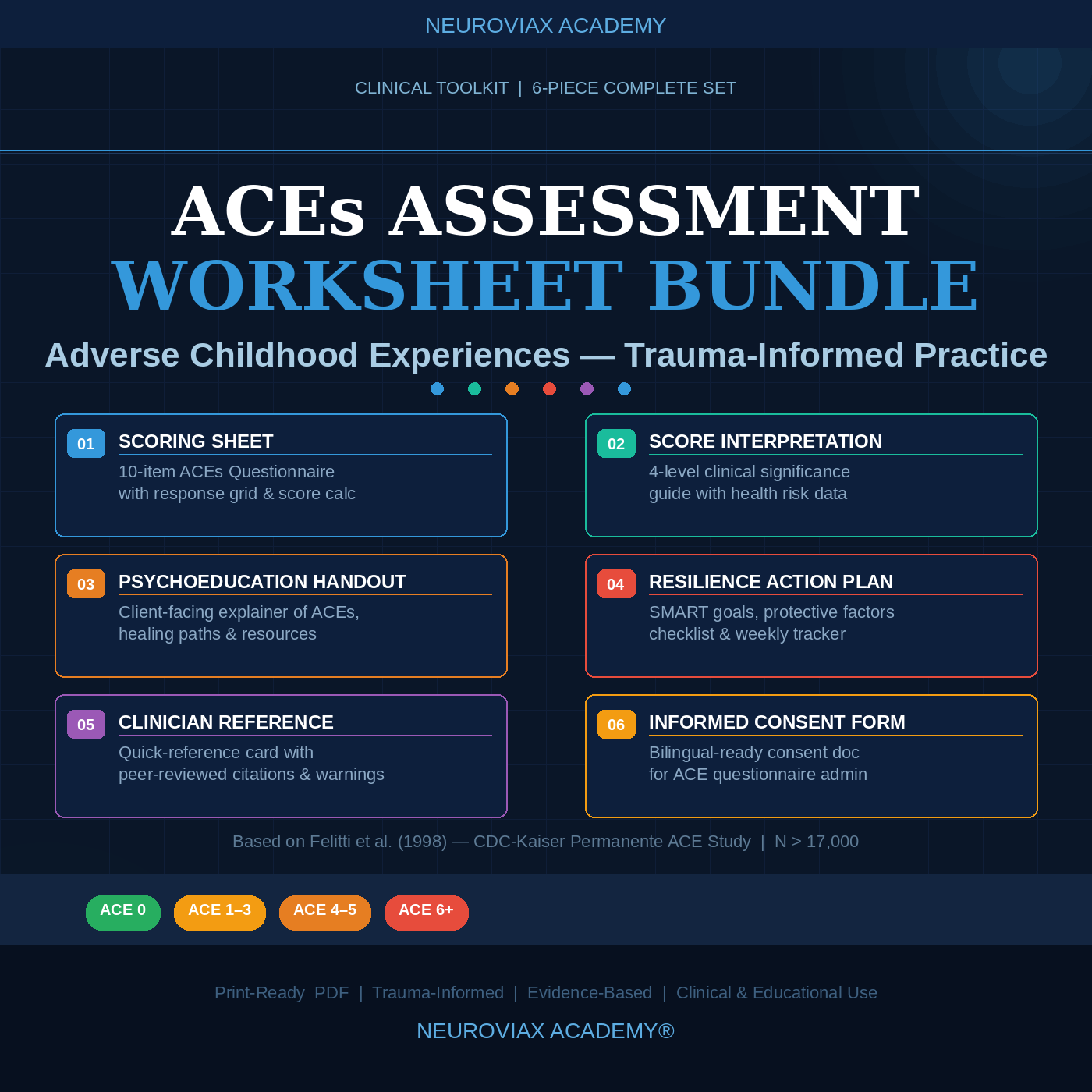
ACEs Assessment Worksheet Bundle — Complete Trauma-Informed Clinical Toolkit (6 Worksheets)
Stop Administering the ACEs Questionnaire Without the Clinical Infrastructure to Support It
Most clinicians recognize the power of ACE screening — but handling the full workflow with consistency and clinical integrity takes more than just printing the 10 questions. Without proper consent, structured scoring, clear interpretation guidance, and a client-facing recovery roadmap, ACE screening risks becoming an unsupported experience for the client and a liability gap for the practitioner.
The ACEs Assessment Worksheet Bundle is a complete, trauma-informed clinical toolkit built around the landmark Felitti et al. (1998) CDC-Kaiser Permanente ACE Study. It covers every stage of the ACE screening workflow — from informed consent through resilience planning — in six professionally structured, print-ready documents.
What's Inside the Bundle
Worksheet 01 — ACEs Scoring Sheet: The full 10-item questionnaire in a clean, structured response grid covering all three ACE domains — Abuse, Neglect, and Household Dysfunction. Includes score calculation section and a four-level interpretation reference table. Ready for session use with client name, date, age, and clinician fields.
Worksheet 02 — Score Interpretation Guide: Detailed clinical interpretation across all four risk levels (0, 1–3, 4–5, 6+), including population-level health risk data drawn directly from the original CDC study. Covers protective factors, neuroplasticity research, resilience pathways, and clinical referral guidelines with crisis resource listings.
Worksheet 03 — Psychoeducation Handout: A client-facing document that explains what ACEs are, what the score means (and does not mean), and how healing is possible. Written in plain, accessible language that respects the client's agency and avoids pathologizing language. Includes evidence-based healing pathways and free support resources.
Worksheet 04 — Resilience Action Plan: A structured, fillable planning worksheet clients complete with their clinician. Includes a protective factors checklist, a SMART goal-setting section for recovery, a weekly well-being tracker, and a personalized support resource directory. Designed to shift the conversation from risk to recovery.
Worksheet 05 — Clinician Reference Card: A concise back-pocket card for practitioners covering instrument metadata, scoring method, score interpretation, clinical use best practices, peer-reviewed citations (including 10 independent validation and meta-analysis studies), and a detailed limitations and cautions section.
Worksheet 06 — Informed Consent Form: A professionally structured consent document that explains the purpose, scope, potential risks and benefits, confidentiality policy, and voluntary nature of the ACEs questionnaire. Includes signature fields for both client and clinician and 24/7 crisis resources. Legally and ethically aligned with trauma-informed best practices.
Who This Bundle Is For
This toolkit is designed for licensed mental health clinicians, therapists, counselors, social workers, and psychologists who administer or plan to administer the ACEs questionnaire in individual or group clinical settings. It is also appropriate for training supervisors building intake workflows, health educators delivering trauma-informed programming, and clinical training programs incorporating ACE screening into their curriculum.
This bundle is not designed for self-diagnosis. The documents are intended for use under the guidance of a qualified healthcare professional.
Clinical Foundation
All content is grounded in the original Felitti et al. (1998) study and cross-referenced with peer-reviewed validation research, systematic reviews, and published implementation guidelines. The interpretation guide draws on population-level data from more than 17,000 adult participants. Clinician-facing documents include full citations and explicit warnings against diagnostic misuse.
Format
Six PDF worksheets. Print-ready at standard letter size. Clean, professional layout suitable for direct clinical use or integration into existing intake and assessment workflows. No software required.
If you are building a trauma-informed intake process, standardizing ACE screening across your practice, or looking for ready-to-use clinical documents grounded in evidence — this bundle gives you everything you need in one complete set.