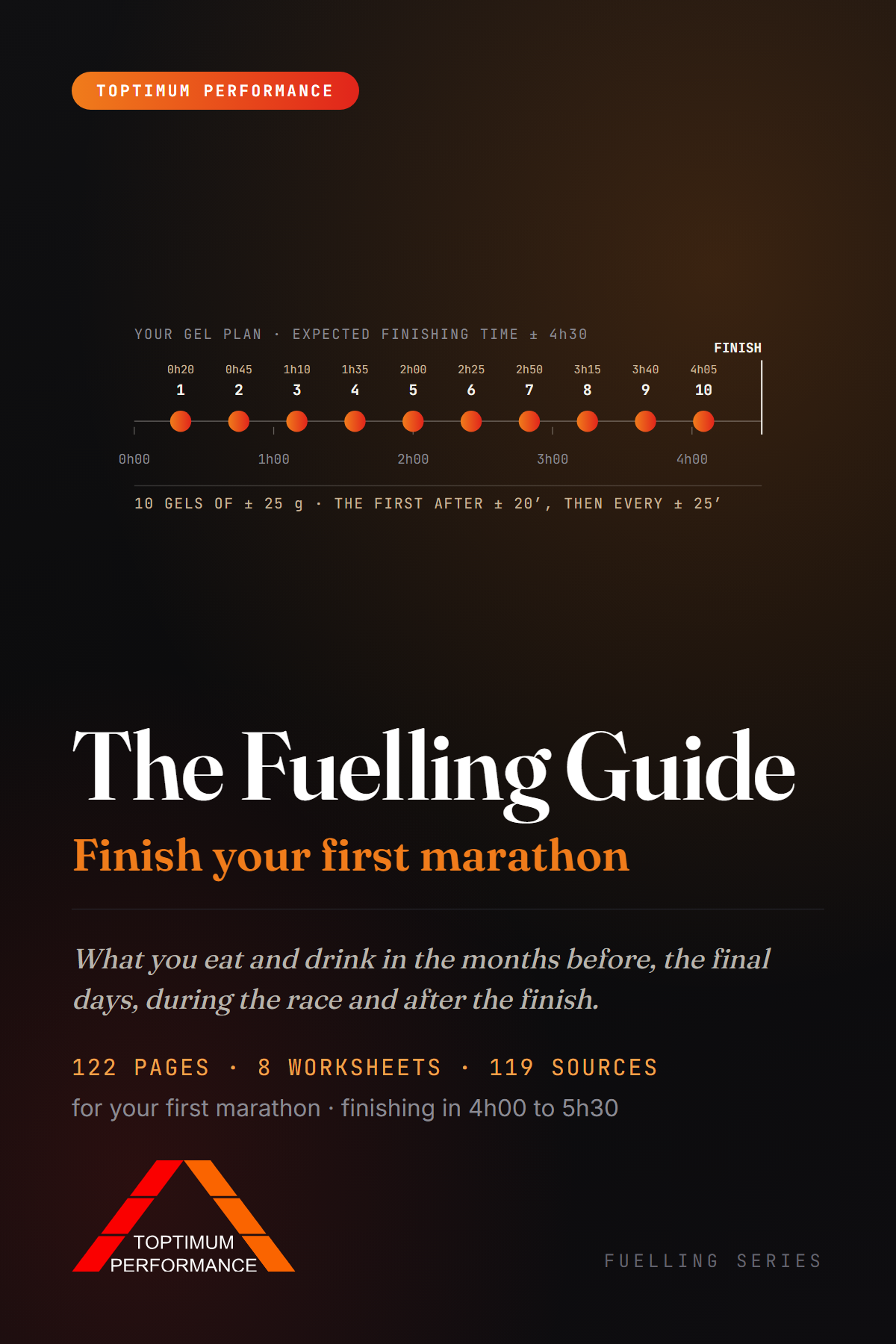
The Fuelling Guide · Finish your first marathon
Without topping up, your carbohydrate stores run low after about 2h00 to 2h30, and a marathon takes longer. For many runners things go wrong around kilometre 30, or their stomach plays up. A dose your gut has never had before is a risk here. With a plan you try out in training beforehand, you limit what can go wrong.
This guide follows the steps of the training package “Finish your first marathon” and of the heart-rate plan with the same goal: your gut training in four steps, your dress rehearsal, your half marathon as a loading test and your race plan for race day. At each step you can read why it is in your plan and what it means for your body weight and your expected finishing time. The tables are calculated using the same rules as the package, so the numbers match everywhere. You can also use the guide on its own.
In eight chapters, a box (a table in chapter 16) sets out what is well supported, what mostly comes from practice and what is still open. For each trial the guide explains, you can read who took part: runners, cyclists or other endurance athletes.
What’s inside
- What your marathon asks of you: what a marathon costs, what your body stores and where things go wrong for many runners.
- The months before: eating enough for your training, eating around your key sessions, your gut training in four steps (from ± 30 to ± 60 g of carbohydrate per hour, with ± 75–90 g as an option) and your dress rehearsal.
- The final days: carb loading with a table for your body weight, race week day by day and the breakfast that suits your start time.
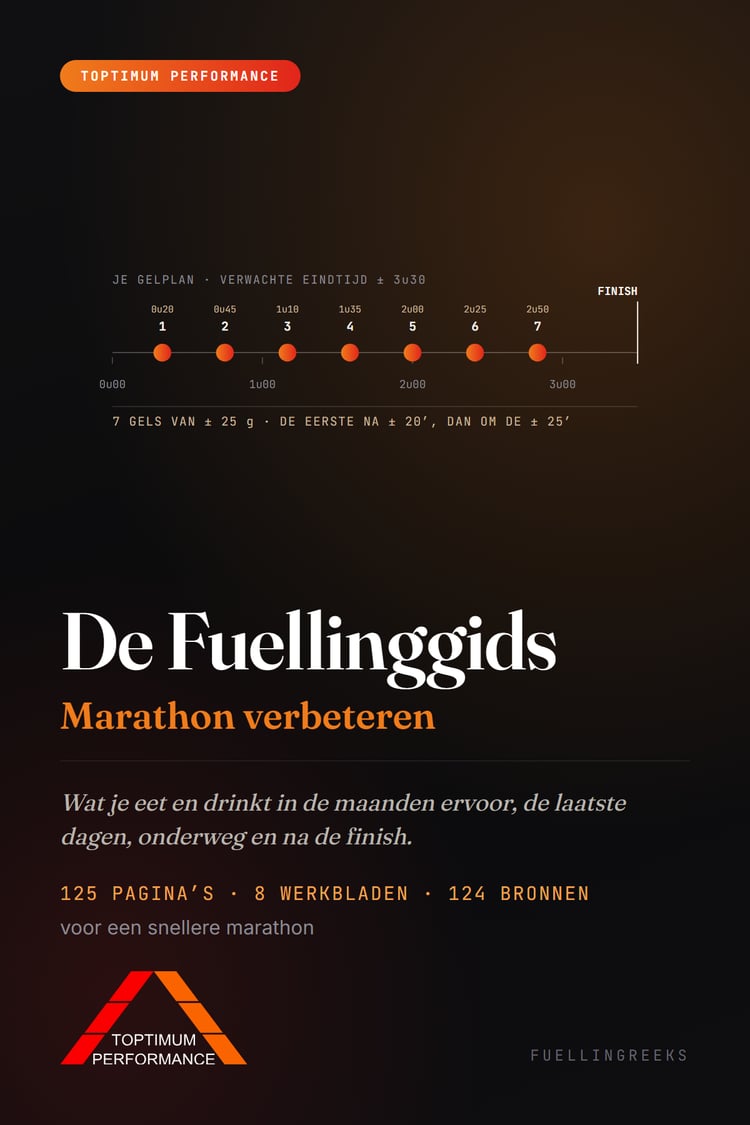
- Race day: your gel plan for your finishing time, drinking to thirst with an upper limit from your own weigh-in test, salt, caffeine, hot, cold or wet weather, and an emergency plan if things still go wrong.
- After the finish: what you eat and drink in the first hours, and how to get going again gently in the week after.
- Good to know: what research has shown so far about women and older runners, and which new products you don’t need (yet) for your first marathon.
With eight worksheets to print (your race plan, your weigh-in test, your gut-training ladder, a 48-hour loading planner, a breakfast planner, a test log, a supporter card and an emergency plan), a reference list and a glossary.
Who it is for
Anyone running their first marathon, with or without the training package or the heart-rate plan “Finish your first marathon”. No prior knowledge needed. The tables assume an expected finishing time of ± 4h00 to 5h30.
With the training package
If you buy the training package “Finish your first marathon” (on Payhip: “Trainingspakket · Je eerste marathon finishen”, with one or two lactate field tests on the track and a tailored training-plan dossier in Dutch), you get this guide free.
Size
122 pages · 20 figures · 20 tables · 8 worksheets · 119 scientific sources (with a DOI where available) · glossary of 25 terms.
This guide gives general information on nutrition for endurance runners. It is not a substitute for advice from a doctor or dietitian.