
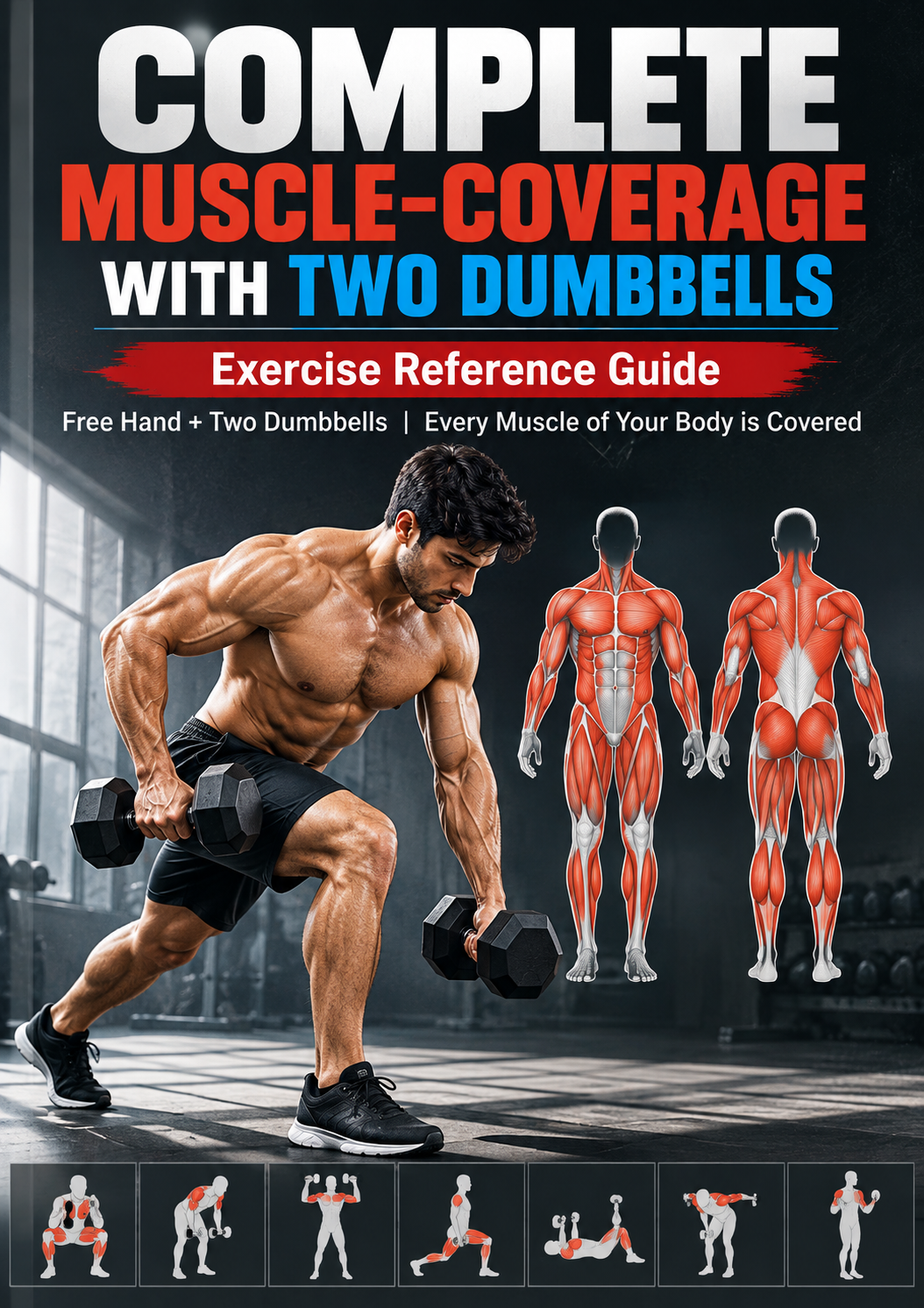
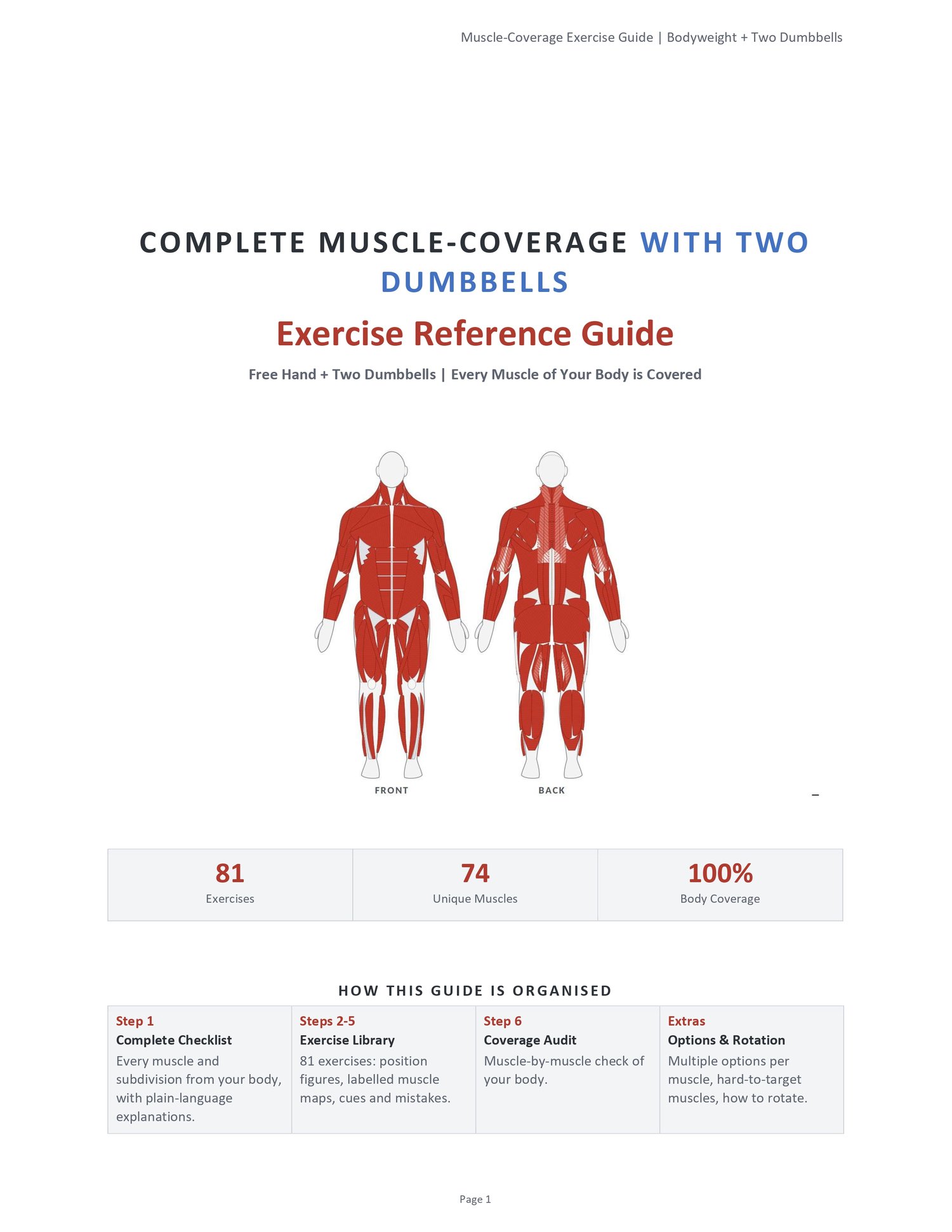
Full Body Exercise with Just Two Dumbbells: The Illustrated Home Exercise Reference Guide
Use code TWODUMBBELLS for a special discount. Happy Lifting!
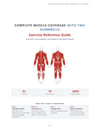
74 muscles. 81 exercises.
Two dumbbells and your floor, plus a checklist that shows you, muscle by muscle, that you haven't skipped one.
If that's most of your home routine, you're training the muscles you can see in the mirror. The rest (your rotator cuff, your inner thighs, the short head of your hamstrings, your shins, your forearm rotators, and your neck) get trained by accident, if at all.
With two dumbbells, your bodyweight, and your floor, you can train every one of them. This guide shows you how, one muscle at a time.
You have the dumbbells. What you don't have is the full picture.
You chose to train at home for good reasons: no commute, no membership, no waiting for equipment, and training on your own schedule. And the basics work, for a while.
Then the questions start. Is your back getting as much work as your chest? What do you do for rear delts without a cable machine, for hamstrings without a leg-curl machine, and for upper chest without an incline bench? Is your routine balanced, or does it just feel that way because you're tired at the end?
Most people answer the same way: another search, another video, another "10 best dumbbell exercises" list that looks a lot like the last one.
Why home routines end up with gaps
It isn't a discipline problem. It's an information problem, and it comes from three places:
- Exercise content is organized by workout, not by muscle. It tells you what to do today. It doesn't tell you what you've been missing.
- The muscles you can't see get skipped. Your biceps show up in the mirror. Your subscapularis, your tibialis posterior, and your deep neck flexors don't, so they rarely make it into a routine.
- Standard advice assumes a gym. When the textbook answer is "use the cable machine" or "use the leg-curl machine," home trainees quietly drop that muscle, because nobody hands them the dumbbell-and-floor alternative or tells them its limits.
The fix: start with the muscles, then choose the exercises.
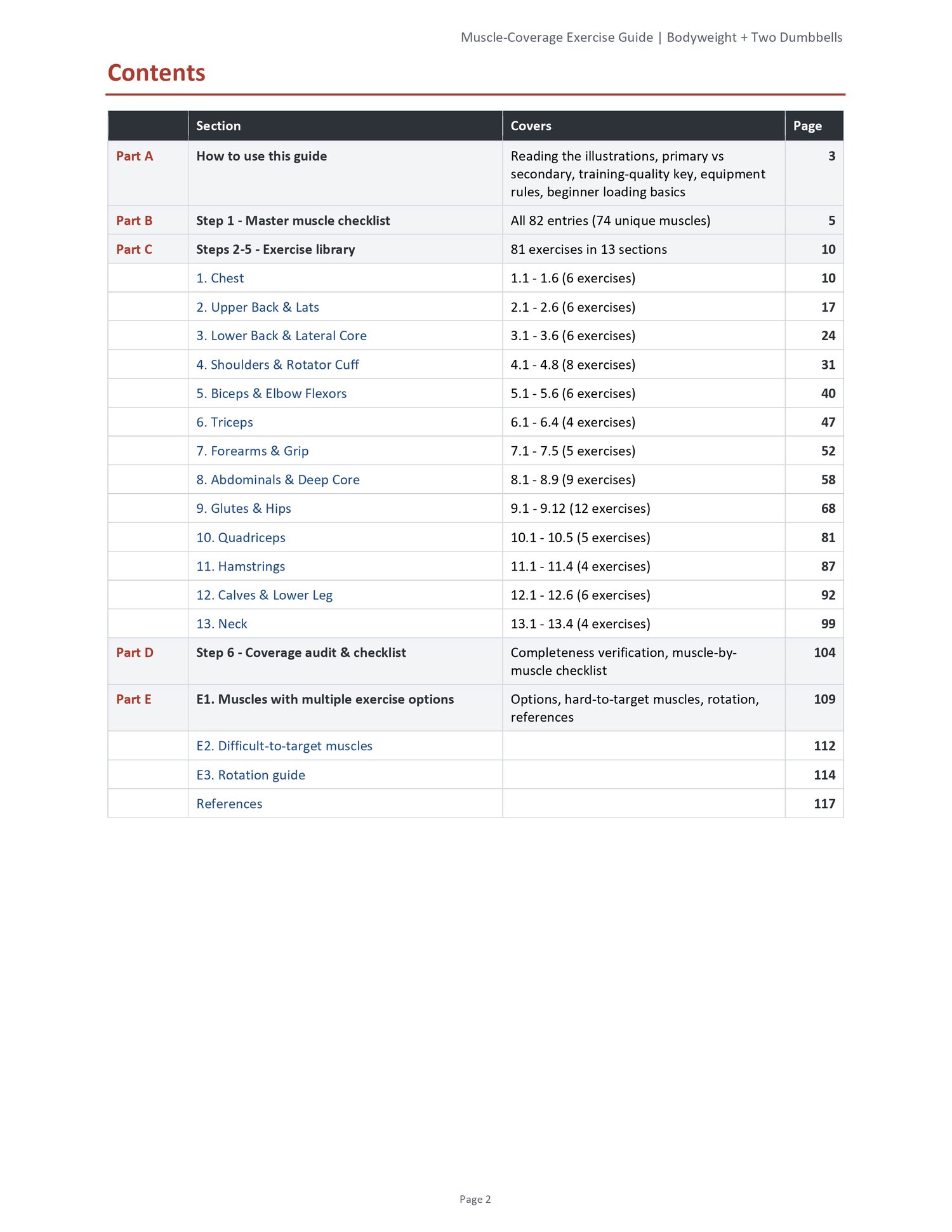
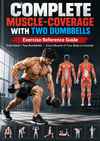
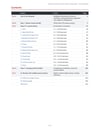
Complete Muscle Coverage with Two Dumbbells is a 116-page illustrated reference guide that works the other way round from most programs. It starts with a master checklist of 74 muscles (82 entries across 13 body regions, because muscles like the quadratus lumborum belong to more than one region) and explains each one in plain language.
Then it matches every entry to exercises that use only your bodyweight, the floor, a wall, and your two dumbbells. No bench, bands, cables, bars, or machines.
Then it audits itself. A muscle-by-muscle coverage checklist shows, for every entry, which exercises train it directly and which train it as a helper. All 82 entries are covered, and 79 have at least one exercise where they are a primary target. The other three (anconeus, tensor fasciae latae, and plantaris) always work alongside larger muscles, and the guide explains why that's anatomy, not a gap.
What it's like to use
Picture your next training day. You open the rotation guide and see your training laid out as movement slots (horizontal push, hip hinge, rotator cuff, and shin and ankle stabilizers), each with interchangeable options. You pick one exercise per slot and turn to its page.
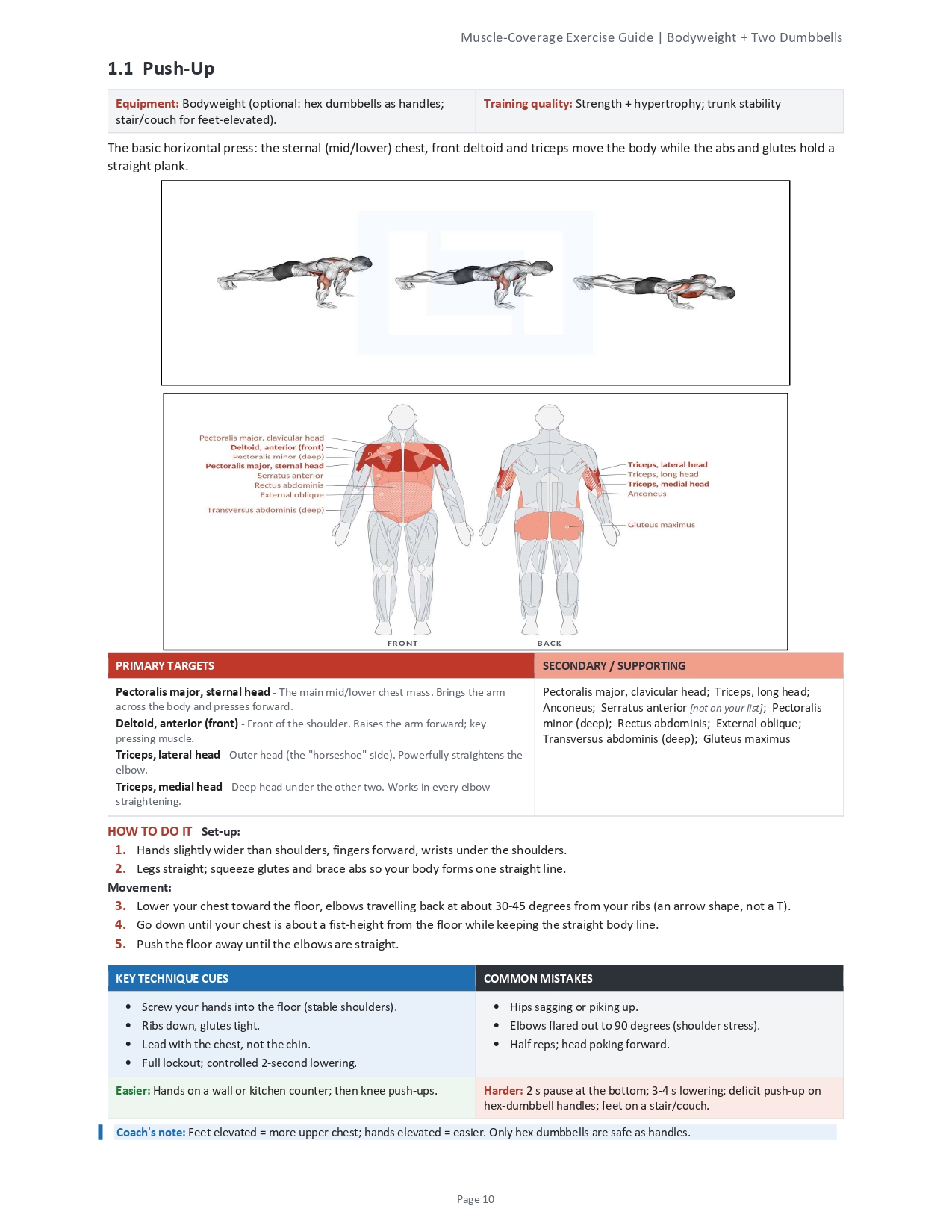
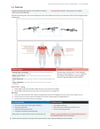
Two pictures show you what's about to happen: a position figure showing the start and finish and a front-and-back muscle map with every working muscle colored and labeled. Below them are the setup, the movement step by step, the cues to hold onto, and the mistakes to avoid. You know what should be working before your first rep.
At the end of the week, you run down the checklist and tick each muscle as it's covered. And when your heaviest pair starts to feel light, you're not stuck. You climb the six-step progression ladder (more reps, an extra set, slower lowering, a pause, and single-arm or single-leg work) before you need a heavier pair.
Inside, you'll discover:
- The floor-only way to emphasize your upper chest without an incline bench, and the EMG study behind it (exercise 1.3)
- How to train the short head of your hamstrings, which hip hinges barely touch, with a pair of socks and a smooth floor (11.3)
- Why the long head of your triceps grows best when you train it overhead, and the 2023 study that measured about 1.5 times more long-head growth (6.1)
- Why "VMO isolation" isn't supported by research, and which exercises train your inner quad anyway (Part E)
- How toes-out and toes-in calf raises shift the work between the two heads of your calf (12.2)
- The "tailor lift": a standing exercise that matches all four actions of the longest muscle in your body (9.8)
- How to train your neck in every direction using nothing but your own hand (13.4)
- The one rule for when dumbbells are safe to use as push-up handles, and what to do if yours are round (Part A)
This guide is for you if:
- You train at home with dumbbells and want to know your routine covers everything, not just the muscles you can see.
- You've been repeating the same handful of exercises and want more options without losing structure.
- You're a beginner who wants to start properly, with plain-language explanations and an easier version of every exercise.
- You're experienced and want to fill the gaps: rotator cuff, adductors, shins, forearm rotators, and neck.
- You like knowing why an exercise works: which muscle, which head, which angle.
- You coach people who train at home with minimal equipment and want a well-organized exercise reference to draw from.
Think about what the alternative costs: more months repeating the same exercises while other muscles go untrained, more hours searching for the right move, or paying a trainer to answer questions this guide answers on the page.
You already own the equipment. What's been missing is the map.
Complete Muscle Coverage with Two Dumbbells gives you 81 exercises, 74 muscles, and a checklist that shows you, muscle by muscle, exactly what your training covers. Download it today, open it next to your dumbbells, and start training the muscles you've been skipping in your very next session.