
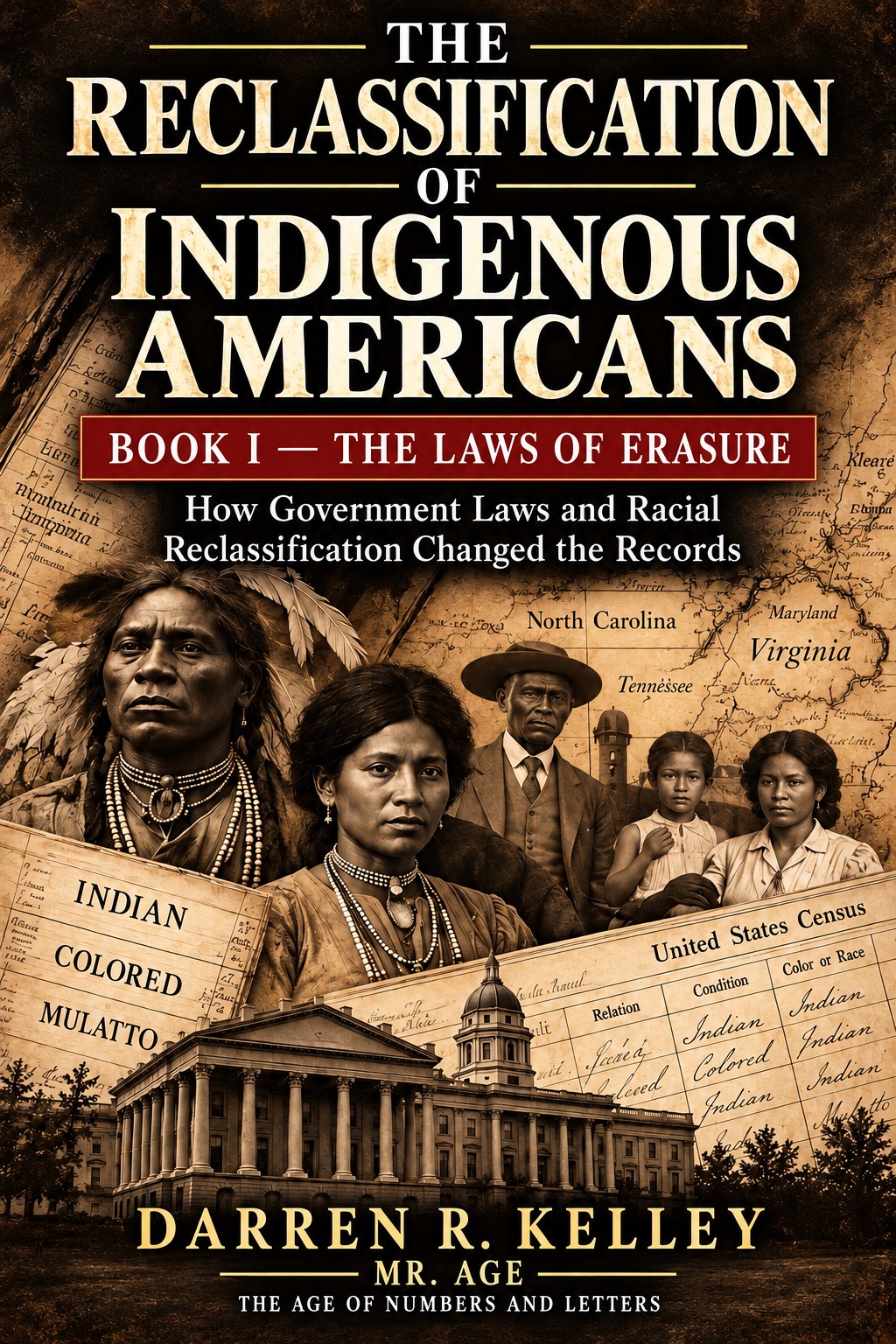
Reclassification of Indigenous Americans
The Reclassification of Indigenous Americans
Book I — The Laws of Erasure
How Government Laws and Racial Reclassification Changed the Records
Can a government change a person's identity simply by changing what is written on paper?
Throughout American history, laws, court decisions, census records, and government policies have determined how people were classified by race. But what happens when those classifications change from one generation to the next?
In The Laws of Erasure, author Darren R. Kelley (Mr. Age) investigates how government authority influenced the recorded identities of Indigenous Natives and families across America.
Through 13 chapters of historical investigation, this book examines:
- Early American laws establishing racial classifications and legal restrictions.
- The 1833 Norfolk County, Virginia, court certificates recognizing Indigenous ancestry.
- Census records showing individuals recorded under different racial categories.
- The case of Milly Wilkerson of North Carolina, whose reported classifications changed across historical records.
- The relationship between racial reclassification, Indigenous identity, and government authority.
- The lasting consequences of official records for families attempting to recover their ancestral histories.
Drawing on historical legislation, archival references, published transcriptions, and genealogical research, Kelley questions how government classifications became accepted as statements of ancestral identity.
A classification can be changed on paper. An ancestor cannot.
This first volume challenges readers to look beyond the labels and examine the historical records for themselves.
114 pages | 13 chapters | Historical nonfiction
Book I of The Reclassification of Indigenous Americans series.
Written by Darren R. Kelley — Mr. Age
The Age of Numbers and Letters