
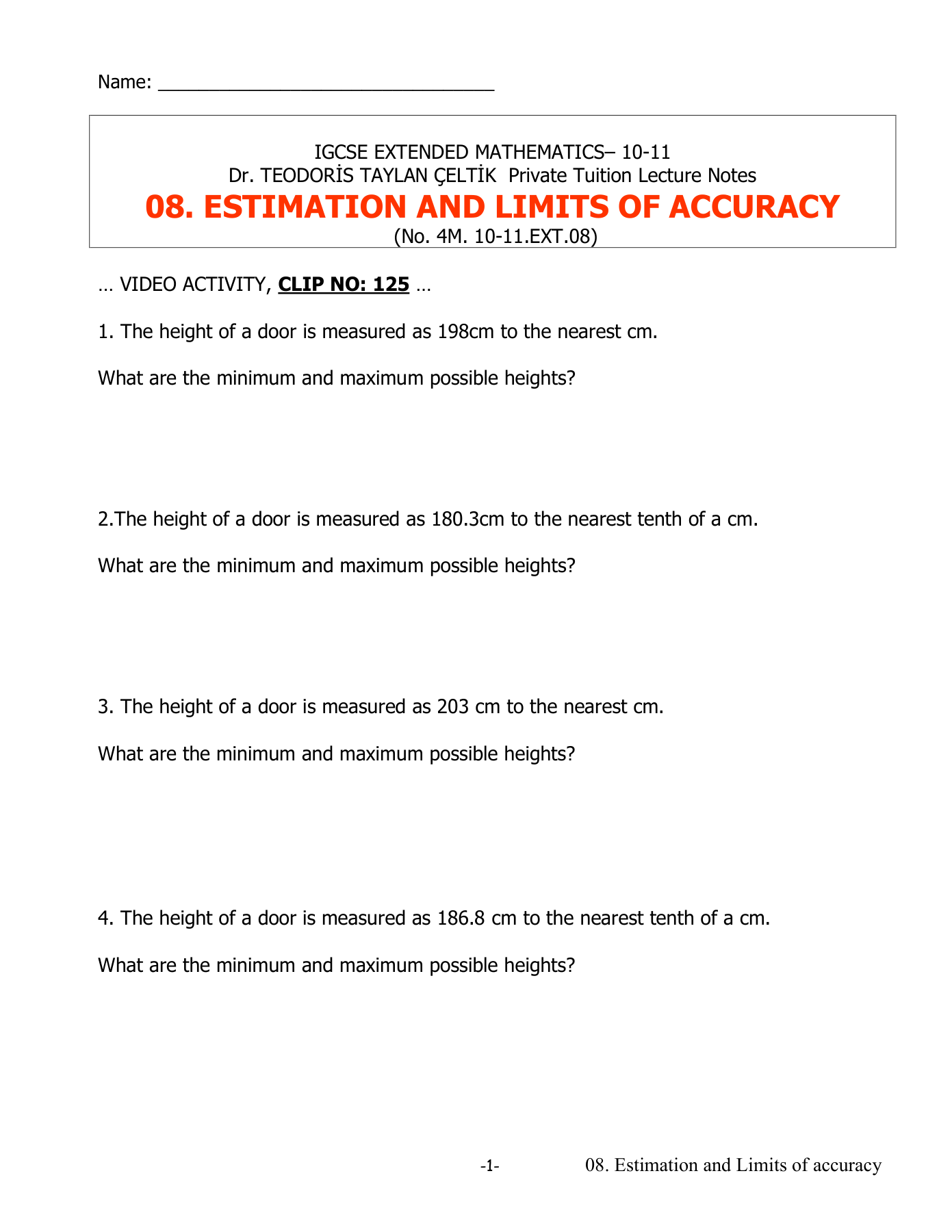
IGCSE Booklet 08 – Estimation and Limits of Accuracy | Original 17-page PDF
Download Dr Taylan Çeltik’s unchanged original 17-page booklet, preserving the historical questions, diagrams, original page and exercise numbers, and included worked scans.
Rounding, significant figures, decimal places, standard form, estimation, upper and lower bounds, and combining measured quantities in geometry, speed and formula calculations. Selected printed answers are included. Digital PDF download only. This is the historical teaching original, rather than a newly authored complete solutions pack.
Original-edition clarifications:
• Page 8, 9: An upper endpoint under ordinary rounding is excluded. For example, a length rounding to 5.3 m to 2 significant figures satisfies 5.25 ≤ L, with L less than 5.35 m; 5.35 m is its upper bound, not an attained maximum. In the page 9 explanation, 0 and 20 are adjacent one-significant-figure values, while the actual rounding bounds for 10 are 5 and 15.
• Page 10: Use the unrounded endpoints when writing tight inequalities: radius endpoints 14.5/(2π) and 15.5/(2π), diameter endpoints 14.5/π and 15.5/π. The displayed rounded lower bounds 2.31 and 4.62 are approximations, not exact lower endpoints. The symbol R in the printed diameter answer denotes the requested diameter, not the radius.
• Page 11, 16, 17: Treat rounded endpoint answers as approximations; do not tighten an exact interval by rounding its lower endpoint upwards or its upper endpoint downwards. For Q15 the exact radius endpoints are √(9.5/π) and √(10.5/π); for Q26 the exact speed endpoints are 99.5/10.35 and 100.5/10.25; for Q30 they are 78/4.7 and 130/4.5.
• Page 17: The given side lengths are in centimetres. The answer unit is cm, not the printed m. The unrounded endpoint values for b are √(12.05² − 4.35²) and √(12.15² − 4.25²), approximately 11.2374 cm and 11.3824 cm.
• Page 17: The printed 16.6 and 28.9 endpoints use 3 significant figures, despite the question requesting 2 significant figures. The unrounded endpoints are 16.5957447… m and 28.8888889… m; their 2-significant-figure approximations are 17 m and 29 m. Use the unrounded values for a tight inequality.
The original historical cover and footer labels are retained. Where the cover says Week, it is catalogued as a Booklet for channel consistency. Each recording may cover only part of this complete original; its description identifies the actual questions taught.