

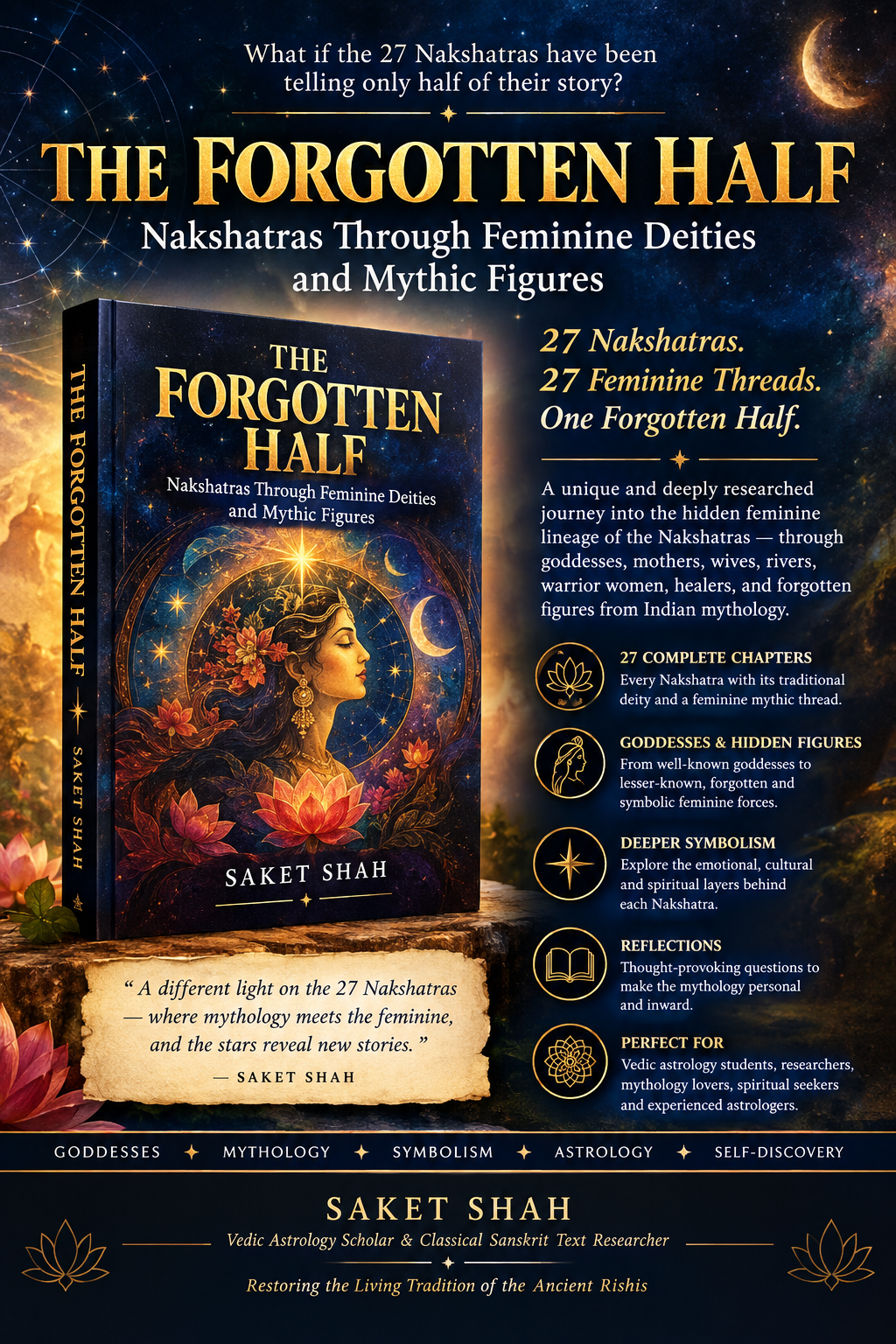
The Forgotten Half Nakshatras Through Feminine Deities and Mythic Figures
THE FORGOTTEN HALF
Nakshatras Through Feminine Deities and Mythic Figures
By SAKET SHAH
What if the 27 Nakshatras have been telling only half of their story?
For centuries, students of Vedic astrology have encountered the Nakshatras through their traditional deities, symbols, planets and mythological associations.
But beneath those familiar names lies another lineage.
A feminine lineage.
A world of mothers, wives, goddesses, rivers, healers, warrior women, ancestral figures, grieving women, independent women and forgotten feminine forces whose stories illuminate the Nakshatras from an entirely different direction.
The Forgotten Half explores this hidden dimension.
This is not simply another Nakshatra reference book.
It is an invitation to look again.
A DIFFERENT LIGHT ON THE 27 NAKSHATRAS
The traditional Nakshatra system introduces us to figures such as Agni, Yama, Indra, Rudra, Vishnu and other powerful masculine deities.
But the mythology surrounding the stars is larger than the conventional lists suggest.
Behind these stories stand women whose experiences reveal another symbolic language:
- Flight
- Birth
- Grief
- Nourishment
- Desire
- Protection
- Independence
- Transformation
- Devotion
- Loss
- Power
- Destruction
- Healing
- Legacy
- Renewal
- Completion
This book places those feminine threads at the center.
The introduction explains the purpose clearly: this work does not discard classical Nakshatra astrology. Instead, it stands beside the traditional system and reads the same 27 stars "by a different light."
27 NAKSHATRAS. 27 FEMININE THREADS.
Every Nakshatra receives its own chapter.
The journey begins with Ashwini and Saranyu, the Sun's runaway bride, and moves through the entire Nakshatra wheel until Revati, the final star of the cycle.
Among the figures explored are:
ASHWINI
Saranyu — The Sun's runaway bride
A story of flight, transformation and the birth of the Ashwini twins.
BHARANI
Yami — Sister of Yama and keeper of the threshold
A feminine perspective on boundaries, birth, death and consequence.
KRITTIKA
The Six Krittikas — Star Mothers of Skanda
Collective motherhood, protection and fierce maternal strength.
ROHINI
Rohini — The Moon's favorite wife
Beauty, desire, favoritism, fertility and the complicated cost of being loved excessively.
MRIGASHIRA
The Doe — A feminine story of pursuit and searching
A darker reading of the familiar deer mythology through the experience of the hunted.
ARDRA
Rudrani/Bhairavi — The fierce grieving feminine
Grief and fury become forces of transformation rather than weaknesses.
PUNARVASU
Aditi — Mother of the gods
Homecoming, restoration and the return of what was thought lost.
PUSHYA
Kamadhenu — The wish-fulfilling cow-mother
Nourishment, abundance and the feminine power that sustains others.
The book continues through all 27 Nakshatras, including Manasa, the ancestral mothers, Lakshmi, Savitri, Anasuya, Chitrangada, Draupadi, Shachi, Radha, Jyeshtha Devi, Nirriti, Apas, Bhumi Devi, Shravana's mother, Nandini, the unnamed healer-women, Kali, Ganga and Revati.
THIS BOOK LOOKS WHERE OTHER BOOKS OFTEN DON'T
Some feminine figures in this book are famous.
Others are barely remembered.
And some chapters deliberately explore absence itself.
The chapter on Magha, for example, turns attention toward the unnamed ancestral mothers—the grandmothers and foremothers whose names disappeared from family histories even though lineage itself could not exist without them.
The chapter on Shatabhisha goes even further, exploring the symbolic idea of the hundred unnamed healer-women whose knowledge could be transmitted through generations without ever being formally recorded.
This is where the book becomes more than mythology.
It becomes an exploration of what was remembered—
and what was forgotten.
THE FEMININE NAKSHATRA AS A DIFFERENT KIND OF POWER
The book does not present femininity as a single archetype.
Instead, each Nakshatra reveals a different expression.
A woman who runs.
A woman who waits.
A woman who protects.
A woman who argues with Death.
A woman who refuses silence.
A woman who destroys.
A woman who heals.
A woman who carries an entire lineage.
A woman whose story survives only as an absence.
This creates a fascinating second layer beneath the traditional Nakshatra framework.
MYTHOLOGY THAT BECOMES PERSONAL
Each chapter concludes with a Reflection.
These are not conventional horoscope predictions.
They are questions designed to make the mythology turn inward.
For Ashwini:
Where in your life are you running not from fear, but toward air you can finally breathe?
For Bharani:
What boundary are you guarding, and what would it cost you to hold it a little longer?
For Rohini:
Has being someone's favorite ever asked more of you than you wanted to give?
These reflections transform mythology from something merely studied into something experienced.
WHY READ THE FORGOTTEN HALF?
Because a Nakshatra can be more than a deity.
More than a symbol.
More than a planetary ruler.
More than a memorized mythology.
Sometimes the deepest meaning appears when you ask:
Who else was standing inside the story?
Who was the mother?
Who was the wife?
Who was the daughter?
Who was the woman who refused?
Who was the woman who endured?
Who was the woman who disappeared from the record?
And what does her story reveal about the star?
WHAT YOU WILL DISCOVER
Inside this book you will encounter:
✓ All 27 Nakshatras
✓ Traditional deity and symbolism
✓ Planetary rulership
✓ A feminine mythological thread for every Nakshatra
✓ Goddesses and women from Hindu mythology
✓ Lesser-known feminine figures
✓ Ancestral and symbolic feminine forces
✓ Mythological reinterpretations
✓ Psychological reflections
✓ Themes of grief, power, desire, devotion and transformation
✓ A closing reflection connecting the entire 27-star journey
The book's contents span the complete Nakshatra sequence from Ashwini through Revati.
NOT A REPLACEMENT FOR CLASSICAL JYOTISH
This distinction matters.
The Forgotten Half does not claim to replace traditional Nakshatra doctrine.
It deliberately approaches the Nakshatras as a companion volume—a different interpretive light placed beside the classical framework.
That makes it particularly interesting for readers who already know the traditional Nakshatras and want to explore their mythology from another perspective.
FOR READERS WHO WANT MORE THAN TEXTBOOK DEFINITIONS
This book is especially suited for:
Vedic Astrology Students
For those who want to understand the Nakshatras beyond lists of keywords.
Astrology Researchers
For readers interested in mythology, symbolism and the cultural layers behind Jyotish.
Mythology Enthusiasts
For anyone fascinated by the women and feminine forces hidden within Indian mythology.
Spiritual Readers
For readers who enjoy using mythology as a mirror for personal reflection.
Experienced Astrologers
For astrologers who want another symbolic lens through which to contemplate the 27 Nakshatras.
THE JOURNEY ENDS WITH REVATI
The final chapter explores Revati, daughter of King Kakudmi and wife of Balarama.
Her story carries a particularly powerful theme for the final Nakshatra:
What happens when time moves forward and the world you expected to return to no longer exists?
Revati travels to Brahma's realm, returns to Earth, and discovers that enormous spans of time have passed. Her former world has disappeared, and she must build a life within a new age.
It is an appropriate ending for a book about forgotten stories.
Because sometimes what is lost cannot be recovered exactly as it was.
It must be encountered again—
in a new form.
ONE QUESTION TO CARRY WITH YOU
The closing reflection of the book leaves the reader with a simple but powerful question:
Whose story is not being told here?
Twenty-seven Nakshatras.
Twenty-seven feminine threads.
One forgotten half.
THE FORGOTTEN HALF
Nakshatras Through Feminine Deities and Mythic Figures
By Saket Shah
A different journey through the 27 Nakshatras begins here.
Read the stories beneath the stars.
SEO Keywords
Vedic astrology, Nakshatra mythology, 27 Nakshatras, Nakshatra deities, feminine astrology, Hindu mythology, Vedic astrology ebook, Jyotish Nakshatras, Nakshatra symbolism, Hindu goddesses, goddess mythology, feminine divine, Indian mythology, astrology mythology, spiritual astrology, Nakshatra research, Vedic astrology book, Saket Shah, Ashwini Nakshatra, Bharani Nakshatra, Rohini Nakshatra, Revati Nakshatra, Hindu goddess stories, ancient Indian mythology.