
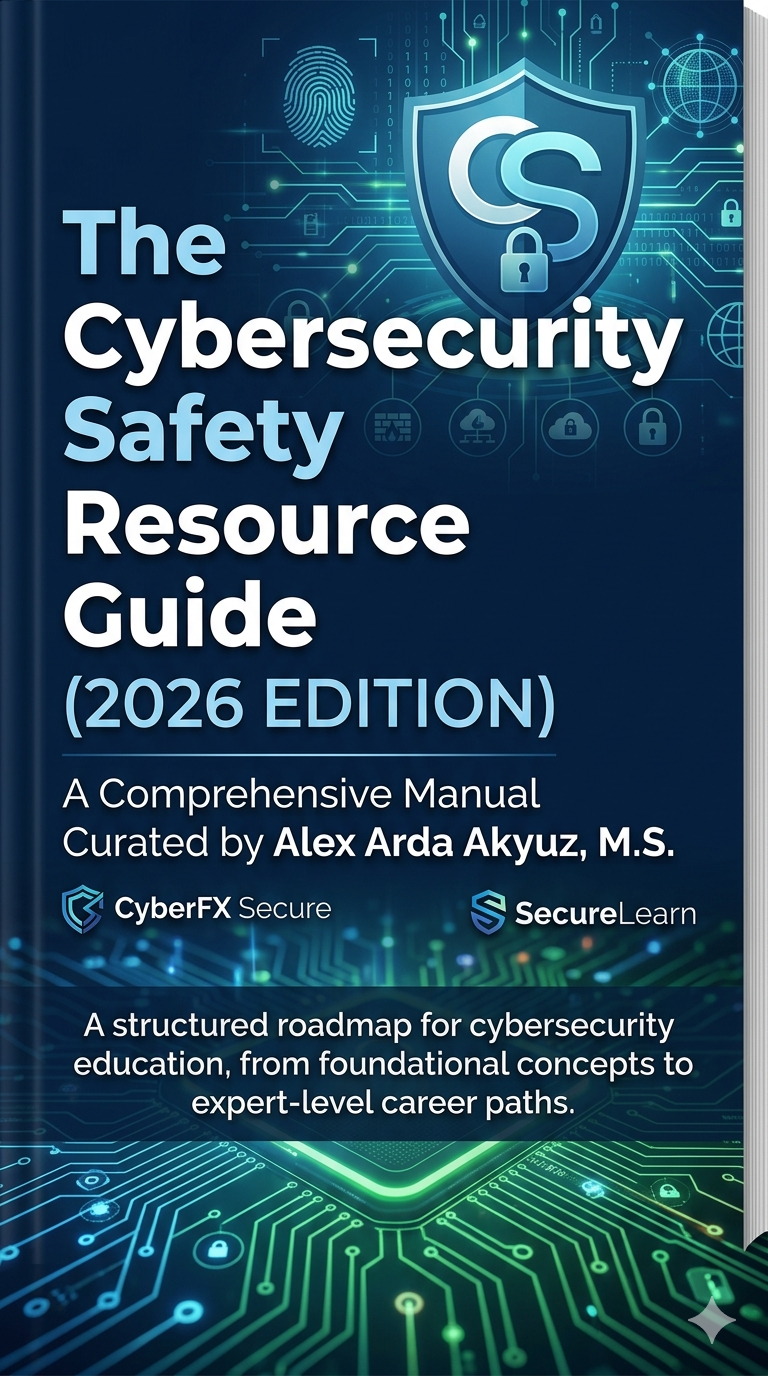
Cybersecurity Safety Resource Guide (2026 Edition)
The Cybersecurity Safety Resource Guide (2026 Edition) is a comprehensive manual curated by Alex Arda Akyuz, M.S., representing CyberFX Secure and SecureLearn. This 10-page guide provides a structured roadmap for cybersecurity education, ranging from foundational concepts to expert-level career paths.
1. Fundamentals and Frameworks
The guide establishes the CIA Triad (Confidentiality, Integrity, and Availability) as the core of security. It highlights AES-256 as the gold standard for data encryption. Key frameworks mentioned include:
- NIST CSF 2.0: A six-function framework (Govern, Identify, Protect, Detect, Respond, Recover).
- Zero Trust: The principle of "never trust, always verify" for all access requests.
- MITRE ATT&CK: A knowledge base of adversary tactics used for threat modeling.
2. The 2026 Threat Landscape
The guide identifies several critical threat categories and their impact:
- Phishing & BEC: Ranked as the #1 threat to Small and Medium-sized Businesses (SMBs), with Business Email Compromise costing over $3 billion annually.
- Ransomware: Characterized by high severity (97%) and frequency (92%), often targeting healthcare and critical infrastructure.
- AI-Powered Attacks: Including deepfake voice/video fraud and LLM-generated phishing.
- Zero-Day Exploits: Marked with the highest severity rating of 98%.
3. Security Best Practices
Top recommendations for organizations and individuals include:
- Multi-Factor Authentication (MFA): Blocks over 99.9% of automated attacks; the guide recommends app-based TOTP or hardware keys over SMS.
- Patch Management: Recommends applying critical patches within 24–72 hours.
- Password Standards: A minimum length of 16+ characters is advised, prioritizing length over complexity.
- Data Backup: Following the 3-2-1 rule (3 copies, 2 different media, 1 offsite).
4. Education and Career Roadmap
The guide outlines a career ladder with corresponding salary expectations and certifications:
- Entry-Level (0–2 years): Roles like Junior SOC Analyst; focus on Security+ and Google Cybersecurity certs ($45K–$70K).
- Mid-Level (2–5 years): Roles like Incident Responder; focus on CySA+ or CEH ($75K–$110K).
- Senior (5–10 years): Roles like Penetration Tester; focus on OSCP or CISSP ($115K–$155K).
- Expert/Lead (10+ years): Roles like CISO or Founder; focus on CISM and CRISC ($160K–$300K+).
5. Practical Resources and Tools
Recommended hands-on training platforms include TryHackMe (Beginner), Hack The Box (Intermediate/Expert), and the SANS Institute (Gold Standard). Essential free tools for a security toolkit include Wireshark (network analysis), Nmap (port scanning), Burp Suite CE (web app testing), and Kali Linux.