
Early Autism Signs in Toddlers: The 101Autism Guide for Parents
On Sale
$5.00
$5.00
Transition from "Wait and See" to an "Empowered Observer" While the early signs of autism typically unfold from 9 to 16 months, the average age of diagnosis remains between 4 and 5 years. This detailed tutorial is designed to help parents close this opportunity gap, allowing for earlier intervention that can guide a child's success.
Because there is no blood test for autism, diagnosis relies entirely on observed behavior. This guide provides a factual, scenario-based breakdown of what to look for in your toddler's development.
Key Concepts Covered in This Guide:
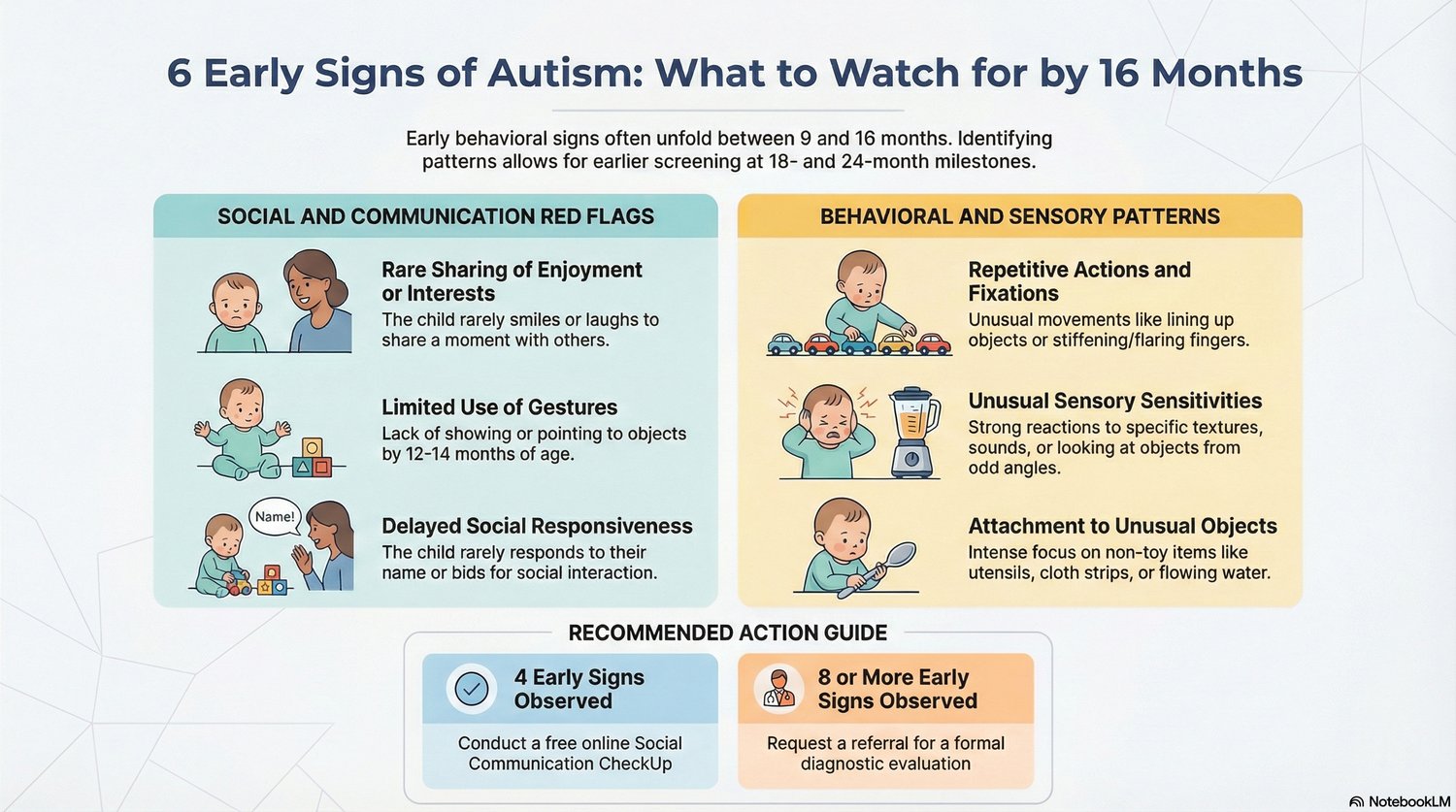
- The Core Mechanism of Joint Attention: Understand how the "Triangle of Attention" works between the adult, the child, and an object, and why deficits in this area are the strongest marker of autism risk. * The 3 Pillars of Autism Presentation: * Social Communication Red Flags: Learn to identify a lack of response to the child's name, limited eye contact, and the "Hand as a Tool" phenomenon where a child uses a parent's limb mechanically to operate an object.
- Repetitive Behaviors (Stimming): Differentiate functional play from self-stimulatory behaviors used for sensory regulation, such as posturing, flapping, or rhythmic movement.
- Sensory Processing Differences: Identify the distinct triggers of hypersensitivity (avoiding textures, distress at lights/sounds) versus hyposensitivity (seeking intense movement, indifference to pain).
- Playtime Patterns & Gestures: Recognize specific scenarios, such as a child prioritizing parts of a toy over the whole, an obsession with non-toys (vacuums, vents), and the absence of foundational gestures like pointing to share an experience (declarative pointing).
- The Gender Gap & Masking: Understand why autism is diagnosed roughly four times more frequently in boys, and learn how girls often utilize the "Masking Effect" to mimic social behaviors and hide their deficits.
- Evaluating Regression: Learn why the loss of previously acquired milestones—most commonly occurring around 20 months—is a critical red flag that must be taken seriously.
- The Path Forward: Clear next steps regarding standard developmental screening (M-CHAT) and comprehensive evaluation by specialists.
Catching these signs early provides a clear roadmap to support.