
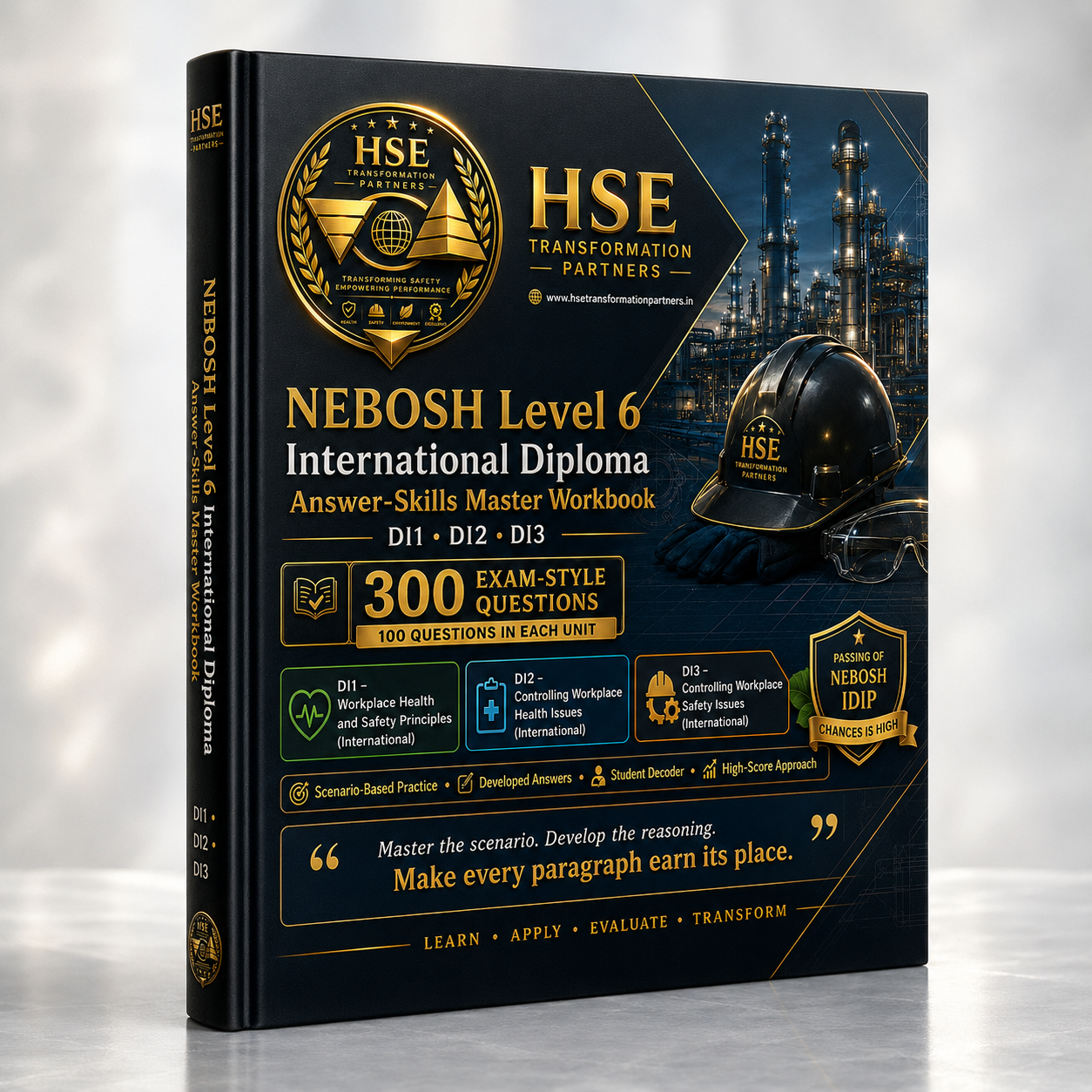



NEBOSH INTERNATIONAL DIPLOMA -SKILL MASTER ANSWER WORKBOOK
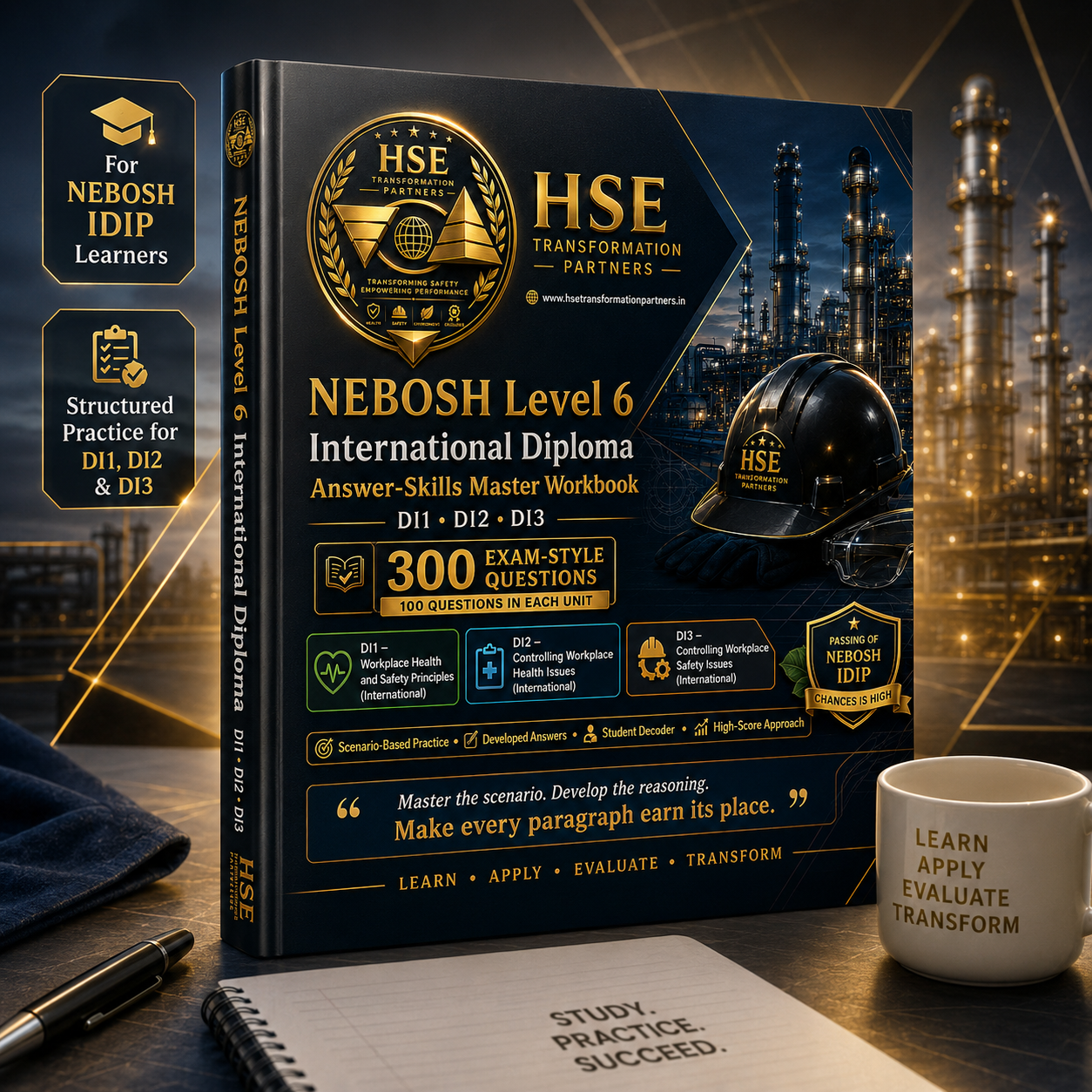
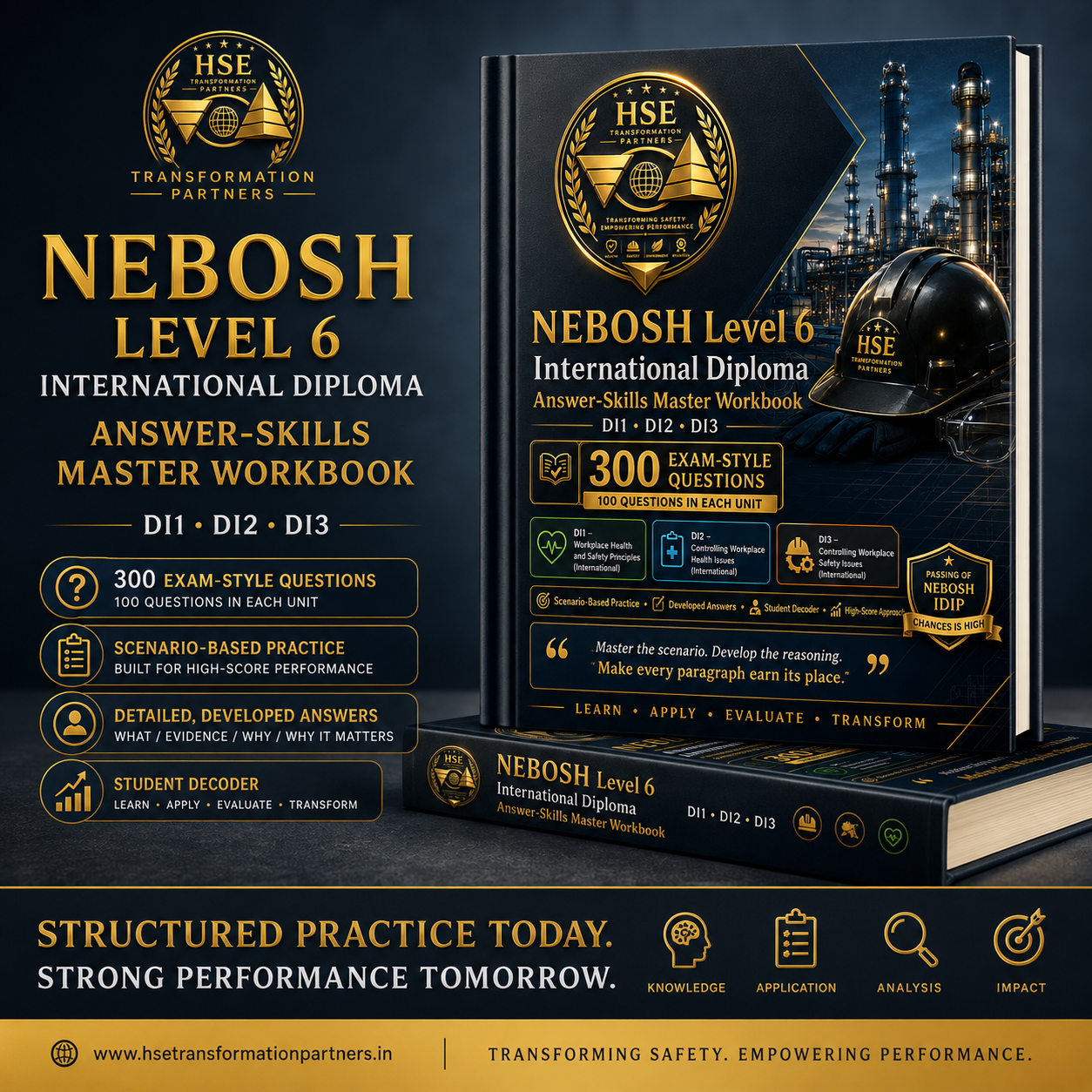
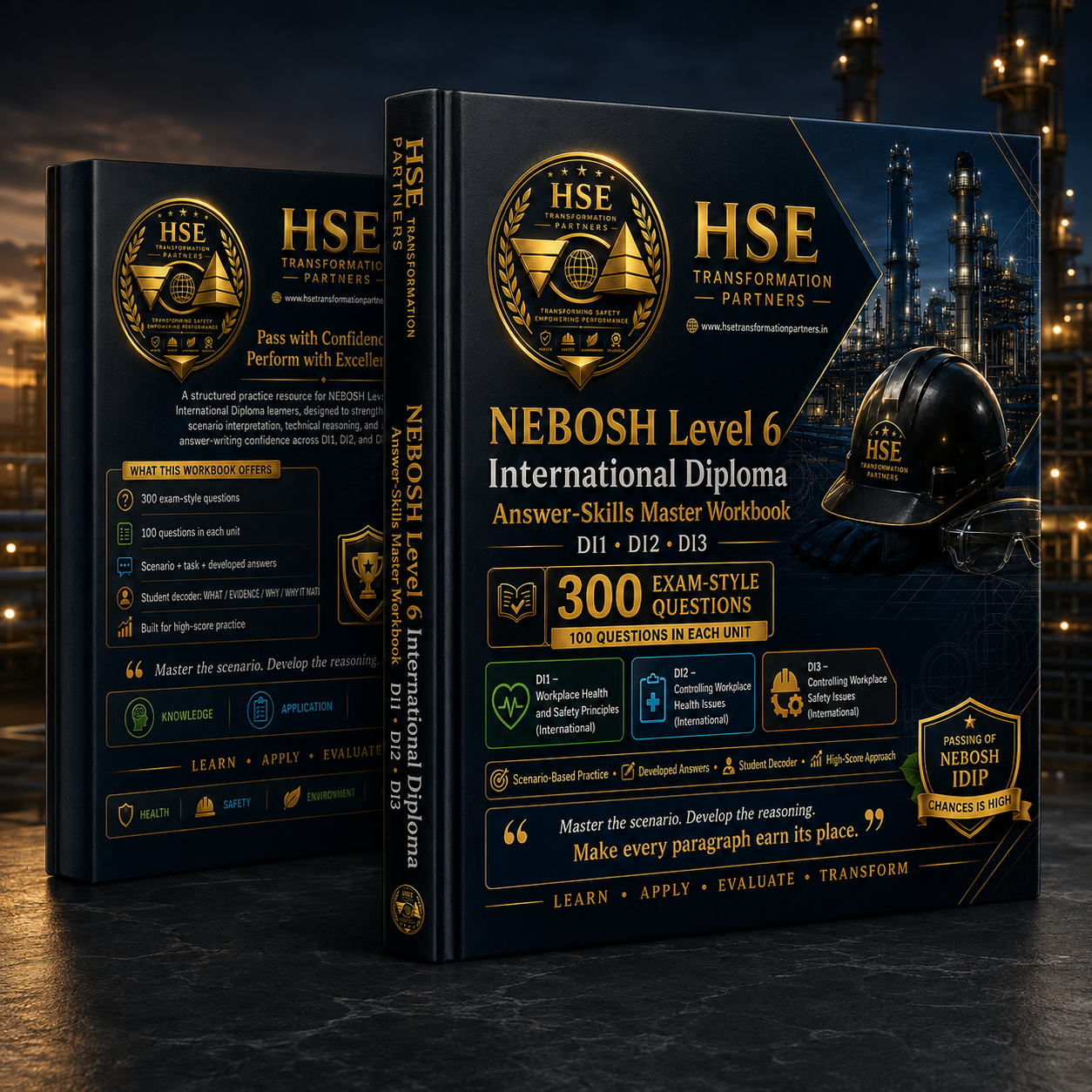
NEBOSH Level 6 International Diploma Answer-Skills Master Workbook
DI1 • DI2 • DI3 | 300 Exam-Style Questions | 100 Questions per Unit
From Knowing the Syllabus to Thinking Like a Level 6 Health and Safety Professional
Passing the NEBOSH Level 6 International Diploma is not simply a matter of reading more textbooks, collecting more notes, or memorising health and safety definitions.
The real challenge begins when the learner is presented with an unfamiliar workplace scenario and asked to comment, explain, evaluate, justify, recommend, advise, compare or prioritise.
At that point, knowing the subject is only the starting point.
The real question is:
Can you take what you know, identify what matters in the scenario, analyse the evidence, and turn your professional knowledge into a clear, developed and relevant Level 6 answer?
This book was created to address that exact challenge.
Why This Book Was Developed
As a NEBOSH International Diploma content creator, deeply involved in developing and structuring Diploma learning material, I have seen a recurring difficulty among learners.
Many candidates possess substantial health and safety knowledge. Some have years of practical HSE experience. They understand risk assessment, leadership, occupational health, hazardous substances, machinery safety, fire, lifting, construction and many other areas of the syllabus.
Yet, when confronted with an unfamiliar assessment scenario, they can struggle to demonstrate that knowledge effectively.
They know what the subject is.
But they struggle with:
- identifying the important evidence in the scenario;
- understanding exactly what the question is asking;
- selecting the relevant technical knowledge;
- developing individual points;
- explaining why something matters;
- connecting theory to workplace evidence;
- making professional judgements;
- avoiding generic textbook answers;
- avoiding repetition;
- and producing an answer that demonstrates the level of thinking expected at Diploma level.
This book was developed from that practical observation.
It is also informed by close engagement with the structure and expectations of current NEBOSH International Diploma learning and assessment guidance, including the latest Learning Partner guidance available during its development.
The objective was never simply to create another collection of questions.
The objective was to create a training system for answer development.
This Is More Than a Question Bank
There are already many sources of health and safety questions, notes and revision material.
What learners often need is something different:
A way to understand how to think before they write.
That is the central philosophy behind the NEBOSH Level 6 International Diploma Answer-Skills Master Workbook.
The workbook contains 300 exam-style practice questions, divided equally across:
DI1 – 100 Questions
Workplace health and safety principles, including leadership, organisational structure, consultation, safety culture, behavioural change, human factors, competence, risk management, monitoring, auditing, professional skills, organisational change, contractor management, business risk and proactive safety management.
DI2 – 100 Questions
Workplace health issues, including occupational health, hazardous substances, toxicology, occupational hygiene, exposure assessment, health surveillance, biological agents, noise, vibration, radiation, ergonomics, musculoskeletal risks, thermal environment and workplace health controls.
DI3 – 100 Questions
Workplace safety issues, including fire, explosion, dangerous substances, maintenance, machinery, work equipment, lifting operations, workplace transport, electricity, construction activities, excavations, demolition and work-related driving.
But the number 300 is not the most important feature of this book.
The important feature is what learners are expected to learn from those 300 opportunities to practise.
The Core Method: WHAT → EVIDENCE → WHY/HOW → WHY IT MATTERS
Throughout the workbook, learners are encouraged to develop a structured way of thinking:
WHAT?
What is the technical health and safety issue?
EVIDENCE
What information in the scenario supports this point?
WHY / HOW?
Why does that evidence demonstrate the issue, and how does it affect the situation?
WHY IT MATTERS
What is the significance, consequence, weakness, risk, benefit or potential improvement?
This approach moves the learner away from isolated statements such as:
"Management should provide training because training is important."
Instead, the learner learns to develop the point by asking:
What training is missing?
Who requires it?
What evidence in the scenario demonstrates the gap?
Why is the gap important?
How could the lack of competence affect the work?
What should the organisation do?
That is the transition from recalling knowledge to applying knowledge.
And application is one of the most important skills a Diploma learner needs to develop.
The Student Decoder
One of the defining features of this workbook is the Student Decoder.
A conventional question bank may show a question followed by an answer.
This workbook goes further by helping the learner understand the thinking behind the answer.
The learner is repeatedly encouraged to identify:
WHAT is the point?
What EVIDENCE supports it?
WHY is it relevant?
HOW does it affect health and safety?
WHY DOES IT MATTER?
This is particularly valuable for learners who say:
"I know the answer in my mind, but I don't know how to write it."
The Student Decoder makes that invisible thinking process more visible.
The Book Is Not Designed for Memorisation
This distinction is critical.
The purpose of this workbook is not to encourage learners to memorise 300 model answers.
A live Diploma assessment can present unfamiliar circumstances. Memorising prepared paragraphs therefore does not develop the underlying skill required to deal with new situations.
Instead, this workbook encourages learners to recognise patterns of reasoning.
The goal is not:
"I remember this question."
The goal is:
"I have never seen this scenario before, but I know how to analyse it."
That is a much more valuable capability.
Learn. Practise. Simulate.
The workbook can be used progressively through three stages.
STAGE 1 – LEARN
Read the scenario.
Read the question carefully.
Study the demonstration answer.
Then study how and why the answer was developed.
The initial objective is understanding, not speed.
STAGE 2 – PRACTISE
Hide the model answer.
Read the question again.
Identify the scenario evidence.
Create your own answer structure.
Write your response.
Then compare your answer with the demonstration.
Ask yourself:
- Did I identify the right issues?
- Did I use the scenario evidence?
- Were my points too generic?
- Did I develop each point sufficiently?
- Did I explain why the issue matters?
- Did I repeat myself?
- Did I answer the actual task?
STAGE 3 – SIMULATE
Select questions you have not recently studied.
Work without looking at the model response.
Plan your answer according to the task and available marks.
Write independently.
Review your response.
Then compare your reasoning with the demonstration.
This is where practice begins to become assessment confidence.
Designed for Different Types of Learners
This workbook is intended to support a wide range of Diploma learners.
It may be particularly valuable for:
- current NEBOSH Level 6 International Diploma learners;
- candidates preparing for DI1, DI2 or DI3;
- learners who understand the syllabus but struggle with scenario-based questions;
- experienced HSE professionals progressing into Level 6 academic work;
- learners preparing for a resit;
- international learners seeking to strengthen written-answer technique;
- learners who struggle to develop points beyond short statements;
- and tutors looking for additional structured scenario-based practice.
It can also be useful for experienced safety professionals who have extensive practical knowledge but want to improve how they analyse, structure and communicate that knowledge in a formal Level 6 assessment environment.
The Bigger Learning Philosophy
The philosophy behind this workbook can be summarised in four stages:
LEARN
Build sound technical knowledge.
APPLY
Connect that knowledge to the scenario.
EVALUATE
Analyse the evidence and make a professional judgement.
TRANSFORM
Turn that reasoning into a clear, relevant and developed professional response.
This is why the book is called an Answer-Skills Master Workbook.
It is not intended to replace formal tuition, the NEBOSH syllabus, Learning Partner support, recognised references or independent study.
It is intended to sit alongside them and provide something that learners often need but find difficult to practise systematically:
the repeated development of answer-writing and scenario-analysis skills.
300 Questions. Three Units. One Objective.
The objective is simple.
To help learners move from:
"I know this topic."
to:
"I understand how this topic applies here."
and ultimately to:
"I can analyse this unfamiliar scenario and explain my professional judgement clearly."
When that thought process becomes habitual, the learner approaches questions differently.
Instead of reading a scenario simply as a story, they begin looking for:
decisions, omissions, pressures, behaviours, failures, controls, changes, responsibilities, communication, supervision, competence and consequences.
They begin asking:
What is happening here?
What is the health and safety issue?
Where is my evidence?
Which technical principle applies?
Why does it matter?
How can I develop this into a clear professional answer?
That is the skill this book is designed to practise.
A Message to Every Diploma Learner
Do not measure your preparation only by asking:
"How many times have I read the textbook?"
Ask instead:
"How many unfamiliar scenarios can I analyse and answer confidently?"
Because knowledge becomes powerful when you can apply it.
And assessment confidence develops when application becomes a practised skill.
The aim of this workbook is therefore not to make you dependent on model answers.
It is to help you become increasingly independent from them.
Learn the knowledge.
Understand the scenario.
Find the evidence.
Develop the reasoning.
Make every paragraph earn its place.
Think like a Level 6 health and safety professional.
NEBOSH Level 6 International Diploma – Answer-Skills Master Workbook
DI1 • DI2 • DI3
300 Exam-Style Questions
Learn • Apply • Evaluate • Transform
Published by HSE Transformation Partners
Transforming Safety. Empowering Performance.
Important: This is an independent learner-support and practice publication. It is not an official NEBOSH publication, assessment paper, examiner report or mark scheme. It does not reproduce or replace NEBOSH assessment materials, and no particular assessment result can be guaranteed. Learners should use this workbook alongside the current NEBOSH syllabus and assessment guidance, Learning Partner tuition, recognised references and their own wider study.