

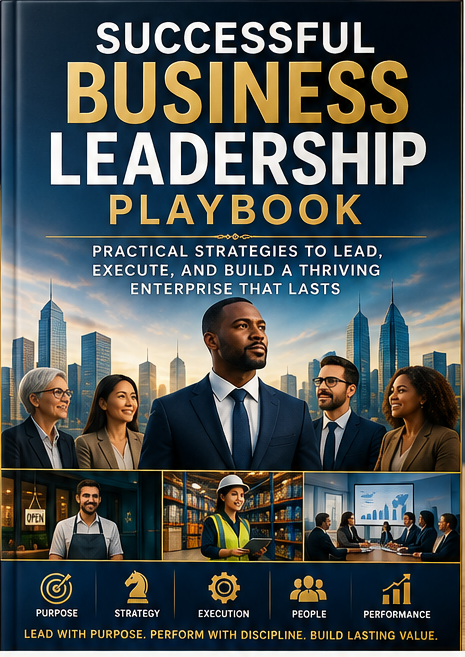
Successful Business Leadership Playbook
Leadership is the discipline that converts intention into enterprise value. A strategy can be intelligent and still fail when priorities are vague, accountability is diffuse, or decisions arrive too late. Effective leaders give people a clear purpose, define what matters now, and establish the conditions for sound execution. They use capital, talent, data, and time as resources entrusted to them rather than possessions to be consumed. The result is leadership understood not as status, but as stewardship.
A durable enterprise needs both direction and adaptability. Leaders must know what the organization is trying to become while remaining willing to change tactics when customers, technology, competition, financing conditions, or regulation shift. Stability without adaptation becomes rigidity, while adaptation without direction becomes drift. The stronger discipline is to preserve strategic intent while testing the assumptions beneath it. That balance allows a company to move without losing itself.
Execution improves when complexity is reduced. Duplicate work, unclear reporting lines, excessive layers, and unowned outcomes absorb energy that should create customer and economic value. Simpler structures make work visible, decisions faster, and accountability easier to enforce. They also expose where incentives conflict with priorities or where resources have migrated away from value creation. Clarity is therefore not cosmetic; it is an operating advantage.
Financial leadership separates impressive activity from healthy economics. Revenue can rise while margins deteriorate, cash becomes trapped, debt increases, or returns on capital weaken. Leaders must understand where the company actually earns money, what each growth initiative consumes, and how much strategic freedom remains on the balance sheet. Cash flow, unit economics, liquidity, and capital discipline deserve the same executive attention as sales. Growth becomes durable when the economics underneath it remain sound.
Technology creates value when it improves the quality and speed of action. A collection of disconnected tools can create more confusion, more dashboards, and more opportunities for conflicting data. Strong leaders standardize systems where standardization improves visibility, control, integration, and scale. They seek a dependable source of truth for financial, customer, workforce, and operational information. Technology should shorten the distance between evidence and action.
People remain central because strategy does not execute itself. Employees need priorities they can understand, authority appropriate to their responsibilities, honest feedback, and a credible connection between their work and the company’s future. Leaders who listen well learn what reports often miss: the operational friction, customer signals, and human constraints closest to the work. Candor and psychological safety can coexist with high standards. In fact, performance improves when people can surface problems early without escaping accountability for solving them.
Measurement matters, but more measurement is not automatically better management. Leaders need a small number of consistent indicators that reveal both results and the drivers behind them. Revenue and profit show what happened; conversion, retention, quality, productivity, fulfillment time, and cash collection help explain what may happen next. Metrics become useful only when someone owns them, and a decision follows from them. Otherwise reporting becomes theater.
Judgment becomes more important as uncertainty increases. Leaders must distinguish facts from stories, trends from isolated events, productive risk from avoidable exposure, and investment from vanity spending. Premortems, scenario planning, dissenting views, and deliberate time away from reactive noise improve decision quality. The goal is not to eliminate uncertainty, because business cannot offer that luxury. The goal is to make consequential decisions with clearer assumptions and better preparation.
Trust is an economic asset even when it does not appear on the balance sheet. Customers remember whether commitments were honored, employees remember whether difficult decisions were fair, investors remember whether management surfaced bad news early, and partners remember whether the company behaved reliably under pressure. Short-term gains achieved by damaging trust often create longer-term costs that are harder to measure and repair. Leadership protects credibility by making transparency and follow-through part of operating discipline.
This book turns these principles into a practical leadership system. Each chapter addresses one discipline that strengthens purpose, execution, financial quality, organizational capability, or resilience. The intention is not to create a rigid formula for every company, because industries and circumstances differ. It is to give leaders a set of questions, practices, and decision standards that can be applied repeatedly. Better leadership becomes visible when the business makes better decisions, acts faster on evidence, develops stronger people, and creates value that lasts.