






Liquidity Basics Explained — Measured (PDF Guide)
You have been told that stops pile up at round numbers, at obvious highs, at the levels everybody can see - and that this is why price goes there. Some of that is true and some of it is folklore, and nobody separates them because nobody has counted.
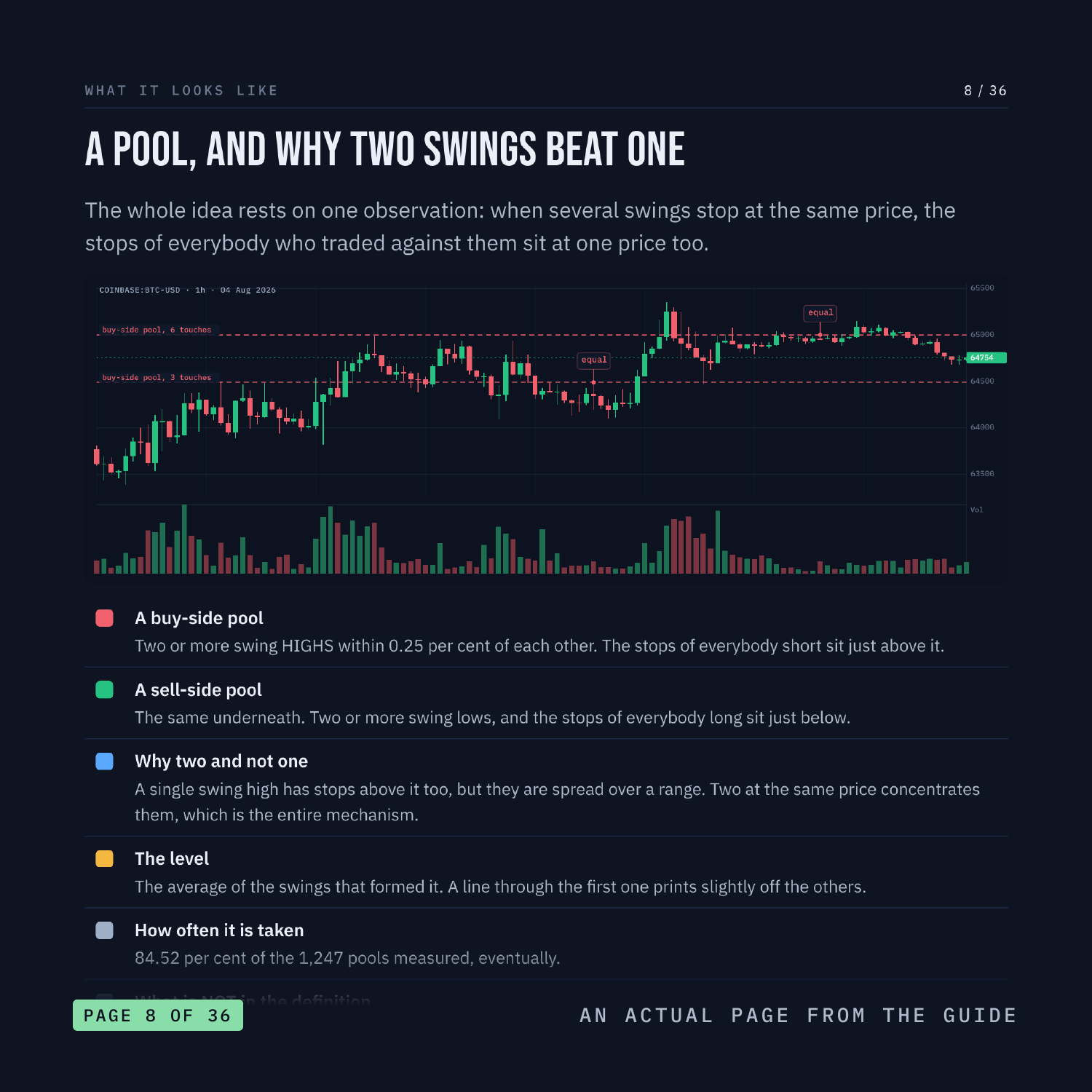
Counted. 1,247 equal-high and equal-low pools across 35,944 bars, tested for round-number clustering against a control of the swings that did not form a pool, and tracked forward to see how long each one sat before it was breached. One popular claim survives and one does not. This is a 36-page PDF that teaches Liquidity Basics from the first thing you see on the screen through to a written strategy with an entry, a stop and an explicit rule for when the trade is wrong.
Nothing is taught underneath a chart. Every label sits on the candle, the line or the level it is describing, on real BTC, ETH, SOL and LINK charts. There are three quizzes on real charts, each followed by the same chart re-shown annotated with the reasoning, plus faded practice pages where the first steps are filled in and you finish the rest.
WHAT'S INSIDE
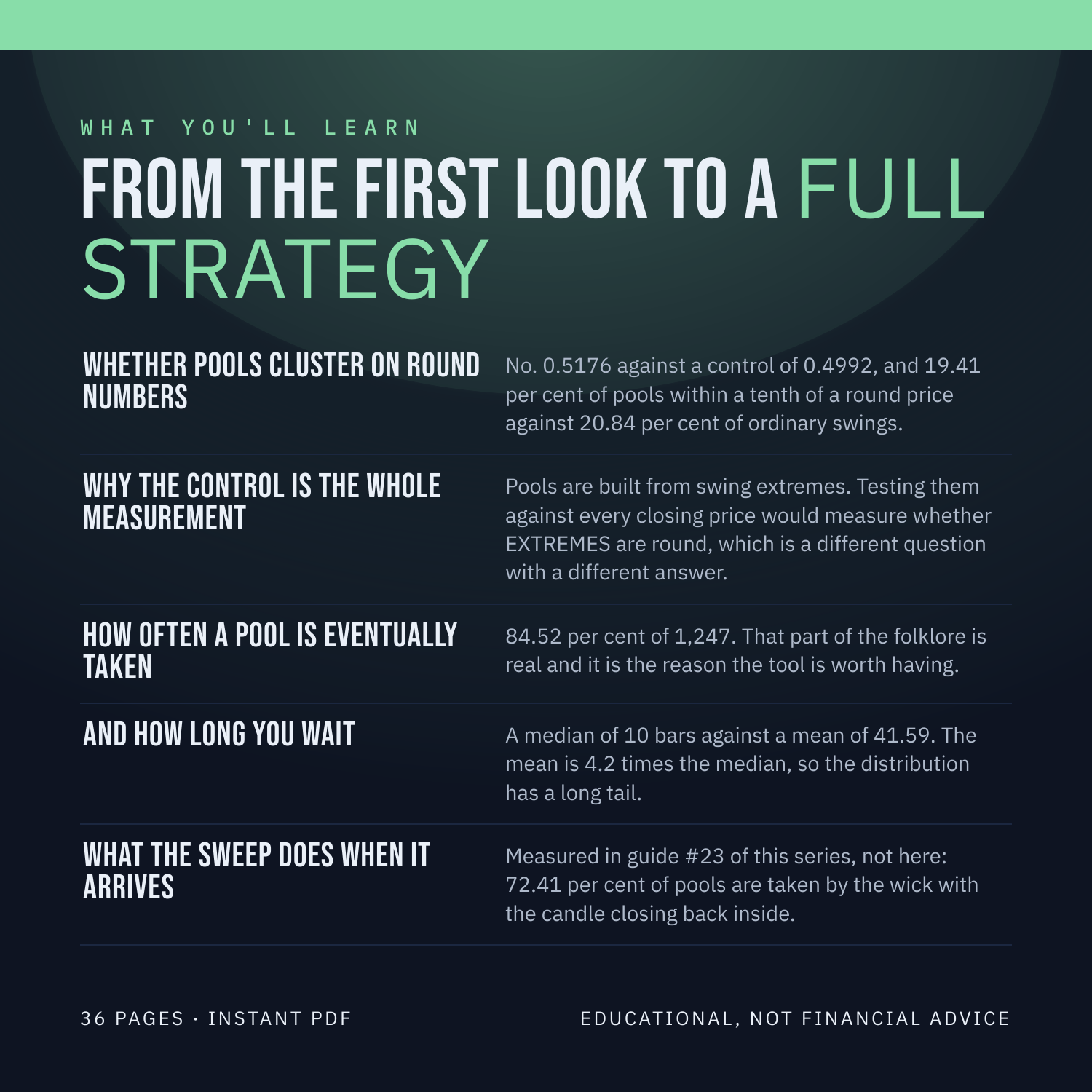
Whether pools cluster on round numbers - No. 0.5176 against a control of 0.4992, and 19.41 per cent of pools within a tenth of a round price against 20.84 per cent of ordinary swings.
Why the control is the whole measurement - Pools are built from swing extremes. Testing them against every closing price would measure whether EXTREMES are round, which is a different question with a different answer.
How often a pool is eventually taken - 84.52 per cent of 1,247. That part of the folklore is real and it is the reason the tool is worth having.
And how long you wait - A median of 10 bars against a mean of 41.59. The mean is 4.2 times the median, so the distribution has a long tail.
What the sweep does when it arrives - Measured in guide #23 of this series, not here: 72.41 per cent of pools are taken by the wick with the candle closing back inside.
WHAT YOU'LL BE ABLE TO DO
Mark an equal-high or equal-low pool by a written rule.
Say whether round numbers matter, with a number.
Choose a control that isolates the thing you are testing.
Read a median and a mean together and see the tail.
Separate the parts of liquidity folklore that survive from the parts that do not.
AN HONEST NOTE
A liquidity pool is a clue, not a crystal ball. It describes what price has already done. This guide contains no win-rates, no backtest results and no promises about what you will make, because nobody can verify those and you should not trust anyone who prints them. What it hands you instead is a set of rules you can test yourself on TradingView in an afternoon. Educational, not financial advice.
Instant download. 36 pages, PDF.