
Home Battery Rebate & Payback Calculator – Compare Quotes (Australia)
On Sale
A$14.00
A$14.00
Three battery quotes, three different "savings" claims. Which one's right for you?
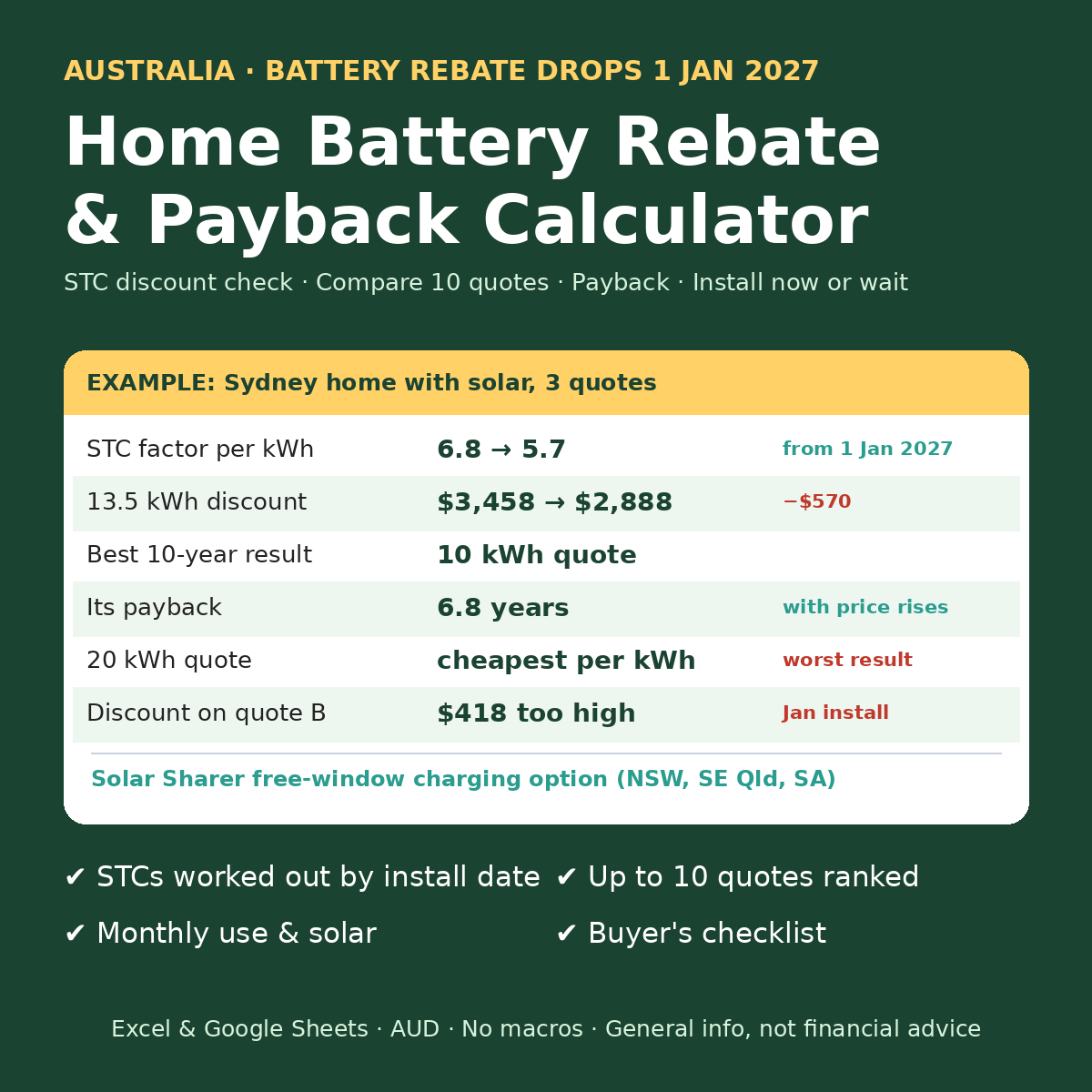
The federal Cheaper Home Batteries discount drops from 6.8 to 5.7 STCs per kWh for batteries installed from 1 January 2027, and again on 1 July 2027. Quotes are flying around with different sizes, discounts and install dates. This spreadsheet puts them all on the same footing: your usage, your solar, your rates.
Built for Australian households (and small businesses) with rooftop solar, or getting solar and a battery together.
What it does
- Checks each quote's discount: enter the usable size and planned install date and it works out the STCs and dollar discount the battery should get, with the size tiers (100% to 14 kWh, 60% to 28 kWh, 15% to 50 kWh) and rounding. If a January install is priced at the 2026 rate, or a discount looks short, it flags it so you can ask.
- Compares up to 10 quotes: net price after the federal discount and any state incentive, net price per usable kWh, energy supplied in year 1, yearly saving, payback (simple and with price rises and battery fade) and net benefit over the years you choose, ranked.
- Uses YOUR usage: 12 months of evening use and spare solar (rough is fine). It shows when a battery is bigger than your home can fill, which is often why the cheapest-per-kWh quote isn't the best buy.
- Grid charging options: Solar Sharer free window (NSW, SE Qld, SA) or an off-peak rate.
- Install now or wait? See the discount at every six-monthly step to 2030, plus the savings you'd miss while waiting, with an optional "prices might fall" assumption.
- Summary and checklist: today's STC factor, days left before the next step-down, your best quote, what a slip into January would cost, and a before-you-sign checklist from the government's guidance (approved battery, accredited installer, install date and slip terms in writing).
What you get
- 1 Excel workbook (.xlsx) that works in Excel, LibreOffice and Google Sheets
- Tabs: Instructions, Summary, Settings, Usage, Quotes, Timing, Rules, Checklist
- A worked EXAMPLE (a Sydney home with solar and three quotes) to clear when you're ready
- No macros, no add-ins, no subscription. AUD.
Good to know
- It's an estimate from monthly averages and your assumptions. It doesn't read smart-meter interval data or model demand tariffs, blackout backup or finance.
- It doesn't check whether a battery, inverter or installer is approved. Use the CEC and SAA lists (linked in the checklist).
- Rules and dates checked against dcceew.gov.au, cer.gov.au and legislation.gov.au on 22 November 2026. Update the STC price to the one your installer uses.
- General information only, not financial or electrical advice. Not affiliated with DCCEEW, the Clean Energy Regulator, the AER or any retailer or installer.