
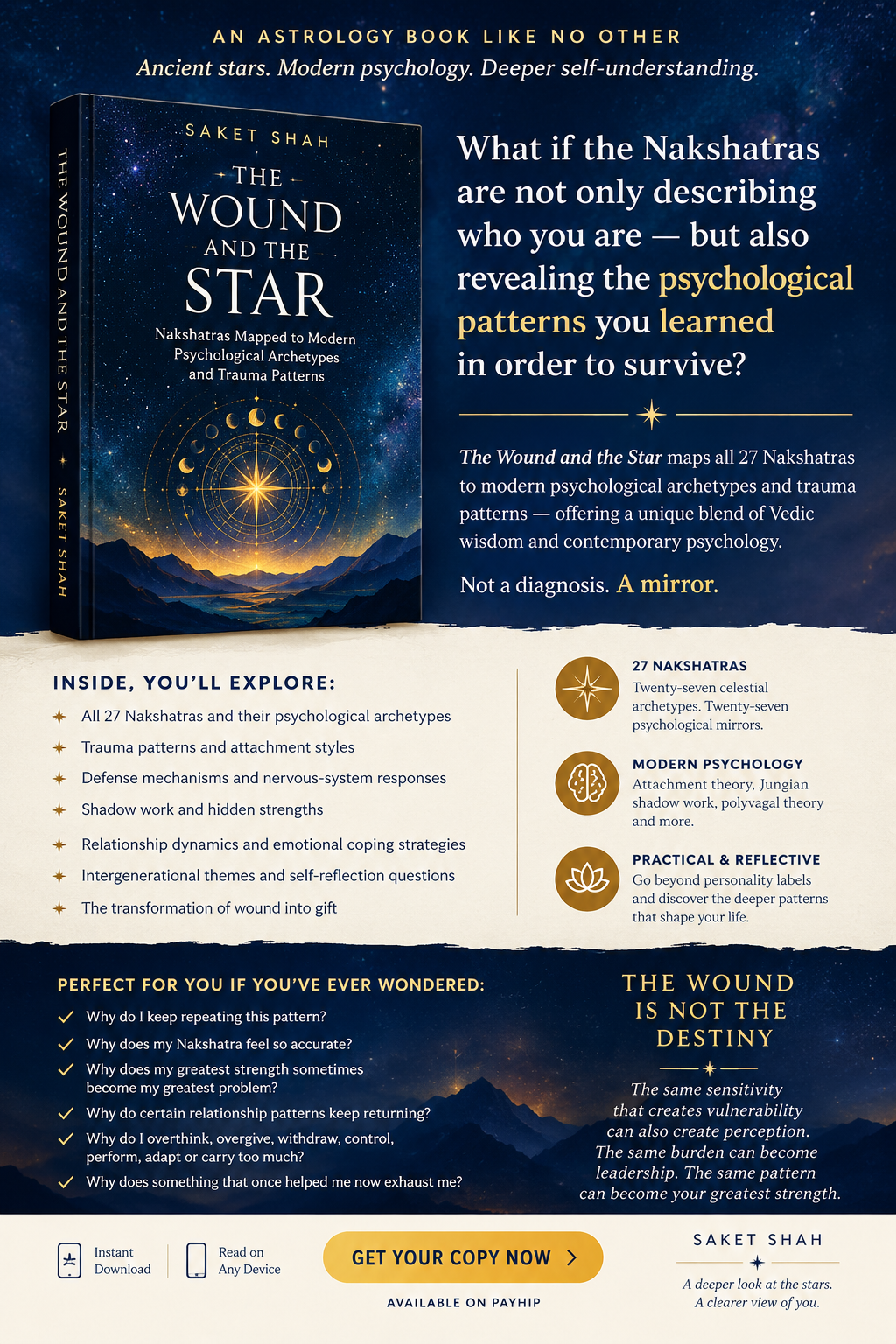
The Wound and the Star Nakshatras Mapped to Modern Psychological Archetypes and Trauma Patterns
THE WOUND AND THE STAR
Nakshatras Mapped to Modern Psychological Archetypes and Trauma Patterns
By SAKET SHAH
What if the Nakshatras are not only describing who you are — but also revealing the psychological patterns you learned in order to survive?
There are 27 Nakshatras.
Twenty-seven ancient celestial archetypes.
Twenty-seven symbolic ways of experiencing life.
But beneath the mythology, symbolism, temperament and personality descriptions lies another fascinating question:
What happens when the language of the Nakshatras is viewed through the lens of modern psychological patterns?
That is the question explored in The Wound and the Star.
This is not a conventional Nakshatra book.
It does not simply tell you that a particular Nakshatra is ambitious, emotional, independent, intelligent, spiritual or creative.
Instead, it asks a deeper question:
What wound can hide behind the gift?
And perhaps even more importantly:
What extraordinary gift can emerge when that wound is understood rather than unconsciously repeated?
A DIFFERENT WAY TO READ THE 27 NAKSHATRAS
Vedic astrology has traditionally used myth, deity, symbolism and planetary rulership to describe human nature.
Modern psychology uses another vocabulary:
- attachment patterns
- defense mechanisms
- nervous-system responses
- hypervigilance
- emotional suppression
- over-responsibility
- perfectionism
- scarcity patterns
- identity formation
- relational dynamics
- coping strategies
- intergenerational patterns
This book places these two languages side by side.
The result is an unusual psychological exploration of the 27 Nakshatras.
The book itself describes the approach as an archetypal mirror rather than a diagnosis or fixed label.
THE CENTRAL IDEA
A coping strategy may have once protected you.
But what protected you in one environment can later become the very thing that keeps you stuck.
Speed can become avoidance.
Responsibility can become over-functioning.
Discernment can become self-criticism.
Adaptability can become fear of standing firm.
Loyalty can become self-abandonment.
Strength can become emotional suppression.
Independence can become isolation.
And sensitivity can become hypervigilance.
The wound and the gift can be two sides of the same pattern.
That is the central psychological exploration of this book.
ALL 27 NAKSHATRAS — A PSYCHOLOGICAL MAP
1. ASHWINI — THE SPRINTER
Anxious-avoidant momentum and fear of stagnation
When movement becomes a safety strategy, stillness can feel dangerous.
Yet beneath the pattern lies extraordinary crisis competence and first-response courage.
2. BHARANI — THE OVERCARRIER
Fawn response and over-responsibility
The person who learned to carry everyone else's emotional weight may eventually forget where their own burden ends.
But the same capacity can become remarkable strength under pressure.
3. KRITTIKA — THE CRITIC'S BLADE
Perfectionism as armor
The inner critic may have developed as protection against external judgment.
But beneath the criticism is sharp discernment, editing ability and leadership potential.
4. ROHINI — THE FAVORITE'S BURDEN
Conditional worth and the need to be chosen
What happens when being loved becomes connected to being special?
The same sensitivity can become the rare ability to make another person feel genuinely seen.
5. MRIGASHIRA — THE VIGILANT SEEKER
Hypervigilance disguised as curiosity
Constant searching may sometimes be the nervous system scanning for danger.
Yet that same sensitivity can become extraordinary perceptiveness.
6. ARDRA — THE STORM CARRIER
Emotional flooding and nervous-system dysregulation
The storm is not merely destruction.
When emotional intensity becomes regulated, it can transform into empathy, creativity and emotional courage.
7. PUNARVASU — THE RETURNER
Repetition compulsion and hope that outlasts evidence
Why do some people keep returning to the same patterns?
And when does returning become genuine repair rather than repetition?
8. PUSHYA — THE DEPLETED CAREGIVER
Compassion fatigue and identity fused with usefulness
The person who nourishes everyone else may discover that they have quietly forgotten to nourish themselves.
The gift is extraordinary generosity.
9. ASHLESHA — THE STRATEGIST
Anxious attachment and control as safety
When closeness once felt unpredictable, managing relationships can become a form of protection.
Underneath lies powerful emotional intelligence.
10. MAGHA — THE LEGACY BEARER
Inherited and intergenerational patterns
Some fears may feel older than the individual carrying them.
Magha explores what happens when inherited patterns are finally recognized and consciously interrupted.
11. PURVA PHALGUNI — THE PLEASURE GUARDIAN
Pleasure-guilt and difficulty receiving
What if rest does not need to be earned?
The wound can hide a profound capacity for savoring beauty, comfort and connection.
12. UTTARA PHALGUNI — THE STEADY PROMISE-KEEPER
Over-functioning loyalty
Reliability can become a burden when every commitment begins to feel like an obligation that must never be renegotiated.
13. HASTA — THE SELF-MADE DISCIPLINE
Competence, control and fear of dependence
The ability to do everything yourself can be both strength and defense.
The deeper lesson is that accepting help can itself become a form of intimacy.
14. CHITRA — THE CURATED SELF
Identity performance and fear of being ordinary
The beautifully constructed exterior may hide a deeper question:
Who are you when nobody is watching?
15. SWATI — THE FLEXIBLE SURVIVOR
Adaptability, fawn-flight responses and fear of being controlled
Bending can keep you safe.
But not every relationship requires you to bend.
16. VISHAKHA — THE DIVIDED ACHIEVER
Ambivalent ambition and fear of choosing incorrectly
When every decision feels irreversible, analysis can become paralysis.
The hidden gift is extraordinary strategic range.
17. ANURADHA — THE DEVOTED FOLLOWER
Loyalty without reciprocity
Devotion can become identity.
The psychological question becomes:
Can loyalty include the expectation of being met halfway?
18. JYESHTHA — THE RELUCTANT AUTHORITY
Parentification and isolation through responsibility
Some people become adults too early.
Their reward is tested leadership—but their challenge is learning that leadership does not have to be lonely.
19. MULA — THE DEMOLISHER
Self-sabotage and fear of false foundations
Sometimes destruction is not caused by instability.
Sometimes stability itself feels suspicious.
Mula explores the difference between a truly rotten foundation and one that is merely unfamiliar.
20. PURVA ASHADHA — THE QUIET PURIFIER
Suppressed emotion and performed invulnerability
Strength can become a mask.
Real resilience may begin when emotion is allowed to move rather than continually pushed down.
21. UTTARA ASHADHA — THE UNACKNOWLEDGED FOUNDATION
Invisibility and worth tied to output
What happens when everyone depends on you but nobody notices what you contribute?
The hidden gift is extraordinary durability.
22. SHRAVANA — THE GRIEVING WITNESS
Absorbed grief and difficulty expressing personal needs
The person who has spent a lifetime listening to everyone else may eventually need to learn how to be heard.
23. DHANISHTA — THE GUARDED PROVIDER
Scarcity mindset and worth tied to material contribution
Even after circumstances improve, an old scarcity alarm may continue ringing.
The gift is powerful resourcefulness.
24. SHATABHISHA — THE GUARDED HEALER
Isolation and distrust of receiving help
The person who learned to heal themselves may become extraordinarily capable—but profoundly reluctant to depend on anyone.
25. PURVA BHADRAPADA — THE INTENSITY BEARER
Extremes as regulation
When chaos becomes familiar, calm can feel strangely uncomfortable.
The hidden gift is transformative courage.
26. UTTARA BHADRAPADA — THE CONTAINED DEPTH
Emotional suppression through over-restraint
Some people contain enormous emotional depth beneath an apparently calm surface.
The work is allowing the river to move.
27. REVATI — THE DISPLACED ADAPTER
Grief over lost timelines and resilience through reorientation
One of the most powerful psychological themes in the book:
grieving not only people who were lost, but the life that was supposed to happen.
Yet Revati also carries extraordinary adaptive resilience.
THIS BOOK IS FOR READERS WHO WANT MORE THAN PERSONALITY DESCRIPTIONS
If you have ever wondered:
Why do I keep repeating this pattern?
Why does my Nakshatra feel painfully accurate?
Why does my greatest strength sometimes become my greatest problem?
Why do certain relationship patterns keep returning?
Why do I overthink, overgive, withdraw, control, perform, adapt or carry too much?
Why does something that once helped me now exhaust me?
Then this book offers a completely different way to look at your Nakshatra.
THE WOUND IS NOT THE DESTINY
One of the most important ideas running through this work is that a psychological pattern should not become a permanent identity.
The book deliberately emphasizes that the Nakshatra is a mirror, not a verdict.
Every chapter therefore moves beyond the wound.
It searches for the gift hidden inside the wound.
Because the same sensitivity that creates vulnerability can create perception.
The same responsibility that creates exhaustion can create leadership.
The same intensity that creates overwhelm can create courage.
The same independence that creates isolation can create resilience.
The same loyalty that creates imbalance can create extraordinary devotion.
The same adaptability that creates instability can create survival intelligence.
A BOOK OF SELF-RECOGNITION
This is not a book asking you to label yourself.
It is a book asking you to recognize yourself.
Read Ashwini and ask:
Where am I always running?
Read Bharani and ask:
Whose emotional weight am I carrying?
Read Krittika and ask:
What does my inner critic believe it is protecting me from?
Read Rohini and ask:
Can I feel valuable without being the favorite?
Read Mrigashira and ask:
Am I curious—or am I scanning for danger?
Read Pushya and ask:
Can I receive without earning it first?
Read Magha and ask:
Which pattern may have begun before me?
Read Mula and ask:
Am I destroying something because it is broken—or because stability feels unfamiliar?
Read Revati and ask:
Have I actually grieved the life I expected?
These are not merely astrological questions.
They are human questions.
WHY THIS BOOK IS DIFFERENT
Ancient symbolism meets modern psychological language.
The book draws upon psychological concepts such as attachment theory, Jungian shadow work, polyvagal theory and trauma-informed approaches while keeping the Nakshatra archetypes at the center.
It does not attempt to turn astrology into clinical diagnosis.
Instead, it creates a vocabulary for recognizing recurring patterns.
27 Nakshatras.
27 psychological mirrors.
27 wounds.
27 gifts.
And one larger question:
What if the pattern that once protected you is also the doorway to your greatest strength?
WHAT YOU WILL EXPLORE
✓ All 27 Nakshatras
✓ Psychological archetypes
✓ Trauma-pattern interpretations
✓ Attachment patterns
✓ Defense mechanisms
✓ Nervous-system responses
✓ Shadow patterns
✓ Relationship dynamics
✓ Emotional coping strategies
✓ Intergenerational themes
✓ Hidden strengths
✓ Psychological reflection questions
✓ The transformation of wound into gift
IMPORTANT NOTE
This book is written for reflection and pattern recognition.
It is not a diagnostic manual and not a substitute for therapy or professional mental-health care. The source itself makes this distinction explicitly.
If a chapter brings up something painful, treat that experience as an invitation for reflection and, where appropriate, seek qualified professional support.
THE 27 NAKSHATRAS ARE MORE THAN STARS
They can be read as symbolic mirrors.
And sometimes the most powerful astrological insight is not:
“This is who you are.”
It is:
“This is the pattern you learned.
This is what it protected.
This is what it costs.
And this is the gift waiting underneath it.”
THE WOUND AND THE STAR
Nakshatras Mapped to Modern Psychological Archetypes and Trauma Patterns
By Saket Shah
A powerful psychological-archetypal exploration of the 27 Nakshatras for readers of Vedic astrology, symbolism, self-reflection and human behavior.
Read the stars differently.
Recognize the wound.
Find the gift.
SEO KEYWORDS
Vedic astrology, Nakshatra psychology, 27 Nakshatras, Nakshatra meanings, Nakshatra archetypes, psychological astrology, trauma patterns astrology, trauma informed astrology, Vedic astrology psychology, Nakshatra personality, Nakshatra shadow work, Jungian astrology, attachment theory astrology, emotional patterns astrology, nervous system astrology, psychological archetypes, astrology and trauma, astrology self discovery, Nakshatra healing, Nakshatra shadow, Ashwini psychology, Bharani psychology, Krittika psychology, Rohini psychology, Mrigashira psychology, Ardra psychology, Punarvasu psychology, Pushya psychology, Ashlesha psychology, Magha psychology, Purva Phalguni psychology, Uttara Phalguni psychology, Hasta psychology, Chitra psychology, Swati psychology, Vishakha psychology, Anuradha psychology, Jyeshtha psychology, Mula psychology, Purva Ashadha psychology, Uttara Ashadha psychology, Shravana psychology, Dhanishta psychology, Shatabhisha psychology, Purva Bhadrapada psychology, Uttara Bhadrapada psychology, Revati psychology, Saket Shah, Vedic astrology books, astrology ebook.