

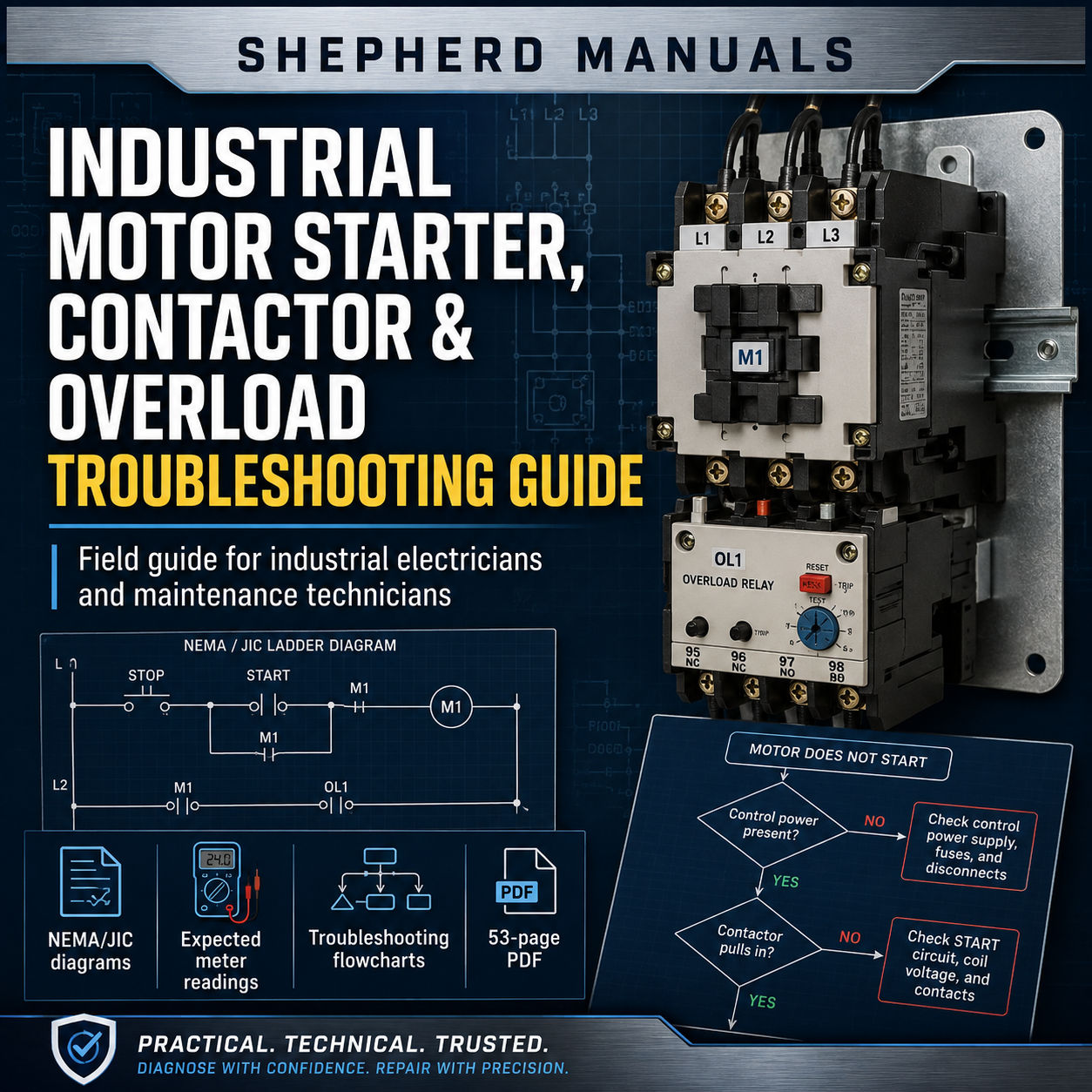
Industrial Starter, Contactor, and Overload Troubleshooting Guide
Industrial Motor Starter, Contactor & Overload Troubleshooting Guide
Troubleshooting a motor that will not start should not begin with replacing parts. It should begin with understanding the circuit, identifying what should be happening, taking the correct measurements, and locating exactly where the expected electrical condition is lost.
The Shepherd Manuals Industrial Motor Starter, Contactor & Overload Troubleshooting Guide is a practical 53-page field reference designed for industrial electricians, maintenance technicians, apprentices, and technical instructors.
This guide takes a systematic approach to diagnosing common motor-control problems involving contactors, overload relays, control circuits, three-phase power circuits, pushbuttons, auxiliary contacts, control transformers, PLC interfaces, reversing starters, and motor branch circuits.
Topics Include
- Motor starter and contactor fundamentals
- Power circuit versus control circuit troubleshooting
- Three-wire START/STOP control circuits
- NEMA/JIC-style ladder diagrams
- Contactor coil troubleshooting
- Main and auxiliary contact troubleshooting
- Overload relay operation and troubleshooting
- Motor will not start
- Contactor will not pull in
- Contactor pulls in but motor does not run
- Motor starts and immediately stops
- Contactor chattering and dropout
- Control fuse and circuit breaker problems
- Single-phasing
- Voltage imbalance
- Current imbalance
- Control transformer troubleshooting
- START and STOP pushbutton testing
- Holding/seal-in circuit problems
- Reversing starter troubleshooting
- 24 VDC control circuits
- PLC and interposing-relay interfaces
- Open circuits
- Short circuits
- Intermittent circuits
- Expected meter readings
- Full-page troubleshooting flowcharts
- Field measurement tables
- Real-world troubleshooting case studies
Built for Field Troubleshooting
The guide teaches technicians to work through a fault logically:
SYMPTOM → EXPECTED OPERATION → TEST POINT → EXPECTED READING → PROBABLE CAUSE → CORRECTIVE ACTION
Instead of guessing which component has failed, the technician learns how to determine whether the problem is in the:
- Control power supply
- Control circuit
- Contactor
- Overload circuit
- Three-phase power circuit
- Motor wiring
- Motor
- Mechanical load
Practical Electrical Testing
The guide explains how to interpret voltage measurements across open and closed devices and how to trace control voltage through switches, overload contacts, auxiliary contacts, relays, coils, and other control components.
It also includes practical procedures for comparing:
- L1-L2
- L2-L3
- L1-L3
- T1-T2
- T2-T3
- T1-T3
- Phase currents
- Control voltage
- Contactor coil voltage
- Motor nameplate current
- Overload settings
Who This Guide Is For
- Industrial electricians
- Electrical apprentices
- Maintenance technicians
- Mechatronics technicians
- Industrial maintenance departments
- Electrical instructors
- Apprenticeship programs
- Technical colleges
- Manufacturing facilities
Whether you are learning motor controls or troubleshooting equipment on the plant floor, this guide is designed to help you move from “the motor won't start” to a logical, measurable diagnosis.
Format: PDF Digital Download
Length: 53 pages
Publisher: Shepherd Manuals
Practical. Technical. Trusted.
Diagnose with confidence. Repair with precision.