
Built for the Messy Reality
This course isn’t another “here’s my template” product. It’s me taking you behind the curtain of Agile Periodization — not the spreadsheets, not the dashboards, but the thinking that decides what matters, how we plan, and why we change things when reality punches the plan in the mouth.
It’s philosophical on purpose. Because whether you admit it or not, you already coach with a philosophy — an implicit model of what exists, what matters, and what you should do next. The goal here is to make that layer explicit, so you can stress-test it, update it, and use it as a tool rather than an invisible ideology.
The backbone is built around two pillars: Complementarity (the world isn’t clean categories — it’s tensions and trade-offs) and Integrative/Pragmatic Pluralism (models are tools, not truths; each works in a domain, and fails outside it). From there, we work through the mental models that keep showing up in real coaching: map vs territory, place of things vs forum for action, top-down vs bottom-up, explore vs exploit, robust vs optimal, and Taleb’s “protect the downside, keep optionality for upside.”
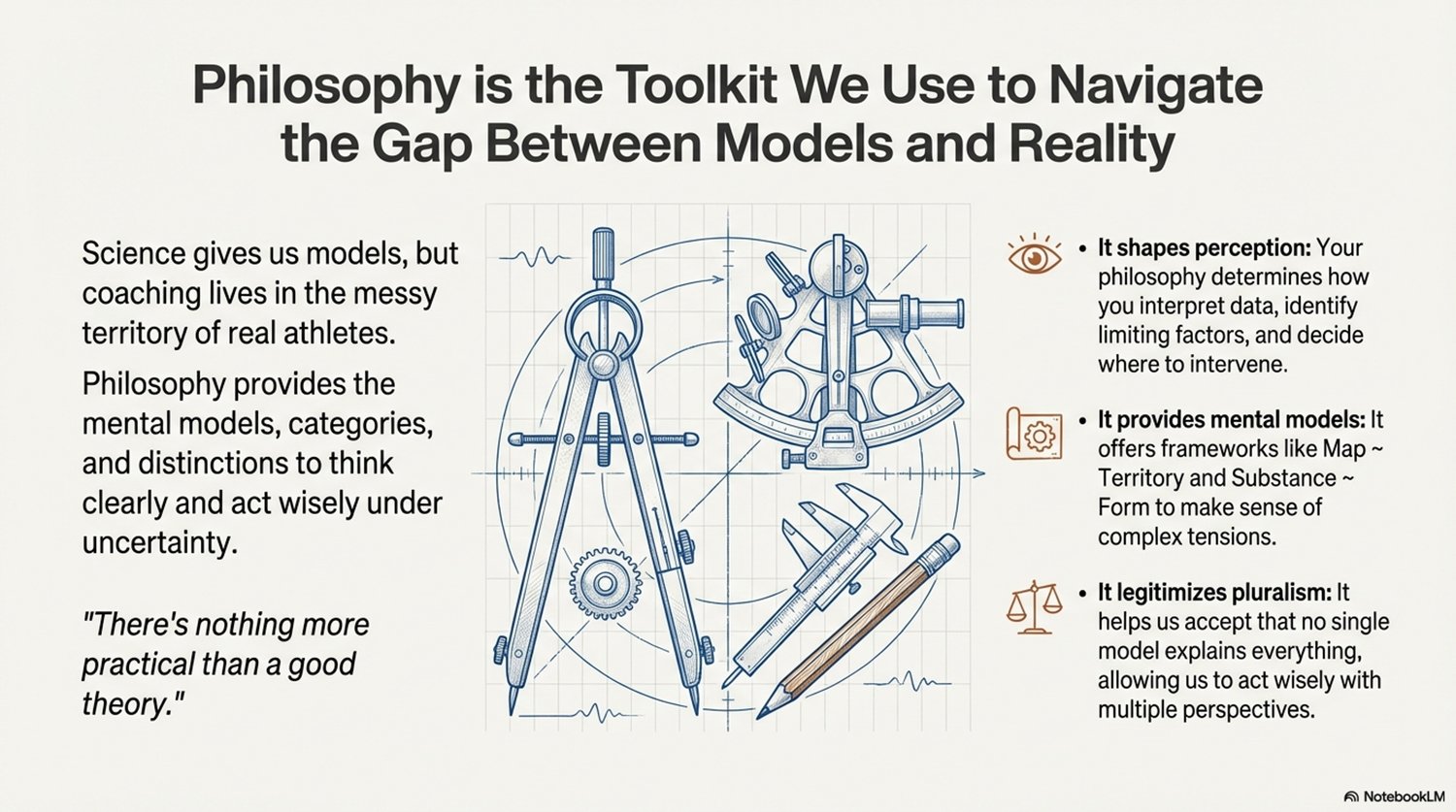
And yes — I’ll keep tying it back to practice. Because nothing is more practical than a good theory: theory shapes what you measure, what you ignore, where you intervene, and how you explain “what just happened” after a week goes sideways.
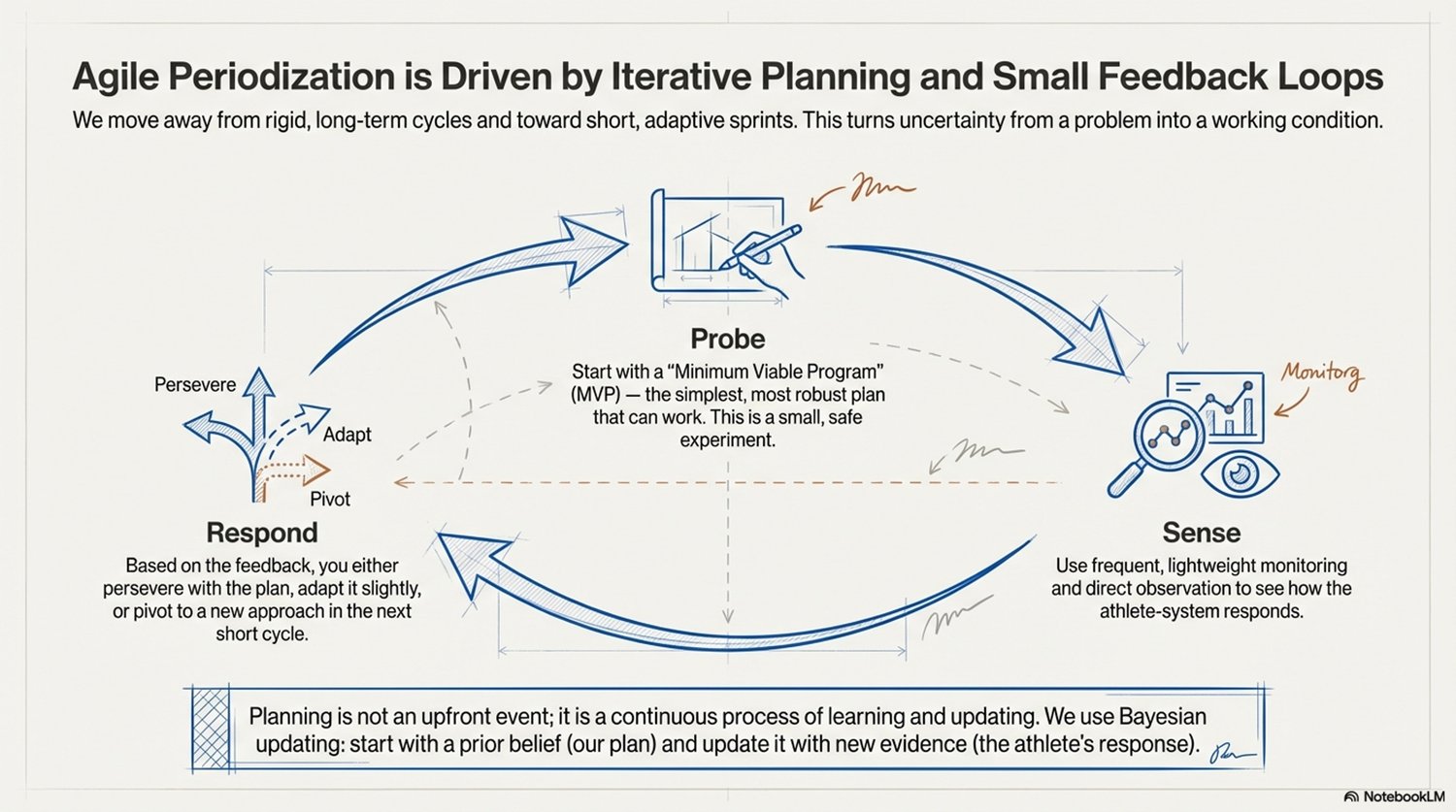
You’ll also see how this philosophy turns into actual Agile Periodization behavior: Minimum Viable Programs, small feedback loops, frequent testing/reviews, and iterative planning — not as a dogma, but as a way to operate under uncertainty without pretending the world is simpler than it is.
This is a living thing (work-in-progress). If you spot holes, contradictions, or better ways to operationalise these ideas in your sport: good. Send them. That feedback loop is the whole point.
Course Roadmap: The Agile Coaching Mindset (What We’ll Cover)
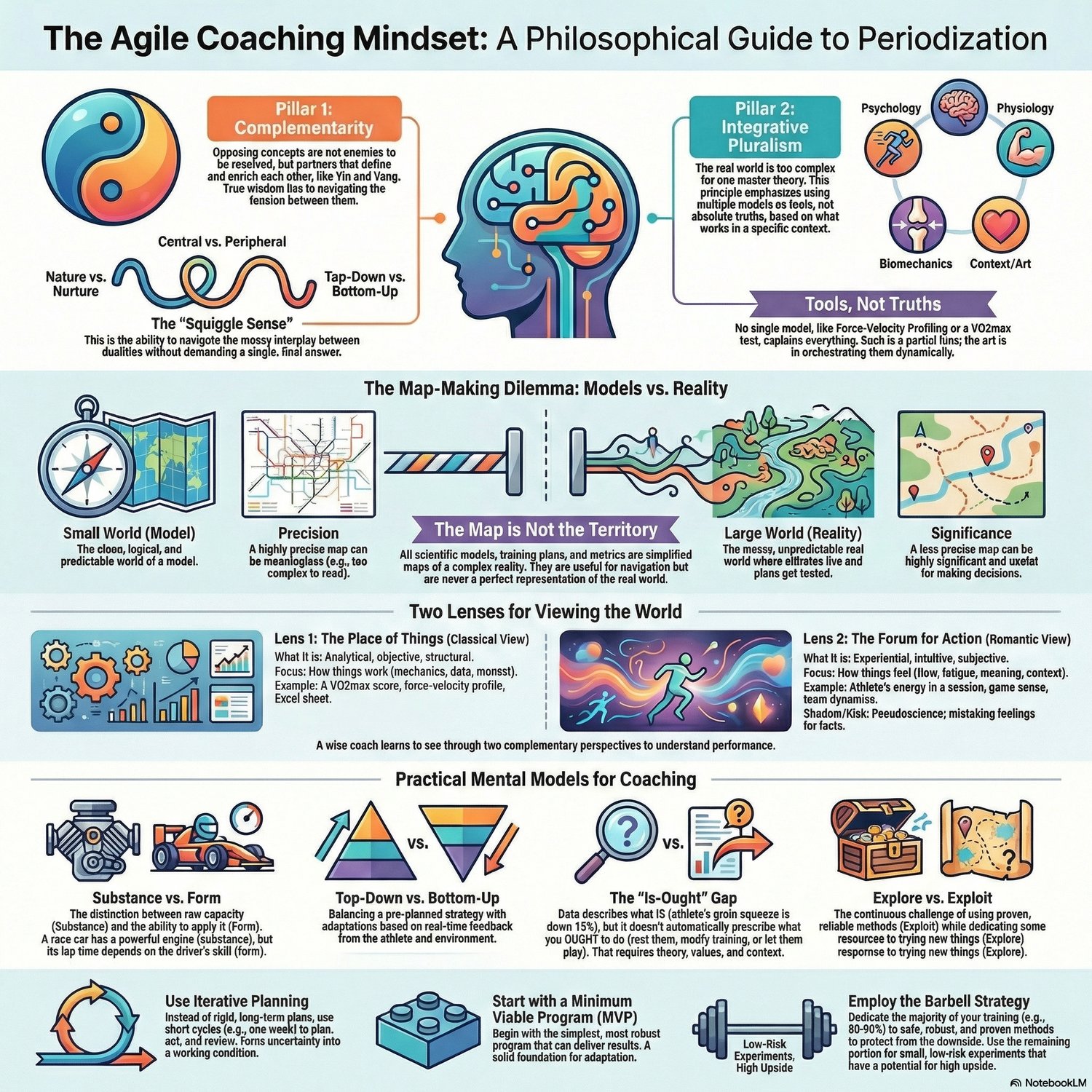
Use the infographic as a map. Not the territory — but a good-enough guide for where we’re going in this course.
Agile Periodization (at least the way I practice and teach it) starts one level deeper than sets, reps, and weekly templates. It starts with how you think about coaching in a messy world: uncertainty, trade-offs, incomplete information, and athletes who refuse to behave like textbook examples.
That’s why this course is mostly philosophical — and why it ends up being practical. Your programming choices (what you measure, what you ignore, when you push, when you pivot) are always downstream from your mental models, whether you’ve named them or not.
Here’s what we cover (more than 10h of video material):
1) Two core pillars
We start with Complementarity: opposing concepts aren’t enemies to “solve,” they’re partners you need to balance (top-down vs bottom-up, central vs peripheral, stability vs change). Then we build Integrative Pluralism: the real world is too complex for one master theory, so we use multiple models as tools — and learn when each one is useful (and when it becomes a liability).
2) Tools, not truths
We talk about the coaching trap of treating a metric or framework like a final answer. VO₂max, force–velocity profiling, readiness scores, training load, “best practice” periodization models… they can all help. None of them gets to drive the car alone. The skill is orchestration, not worship.
3) The map-making dilemma
You’ll learn to see the difference between Small World models (clean, logical, precise) and the Large World reality (messy, unpredictable, full of context). We unpack why “precision” can be a form of self-deception, and why significance (good enough to make decisions) often beats elegance.
4) Two lenses for viewing athletes
We use two complementary perspectives:
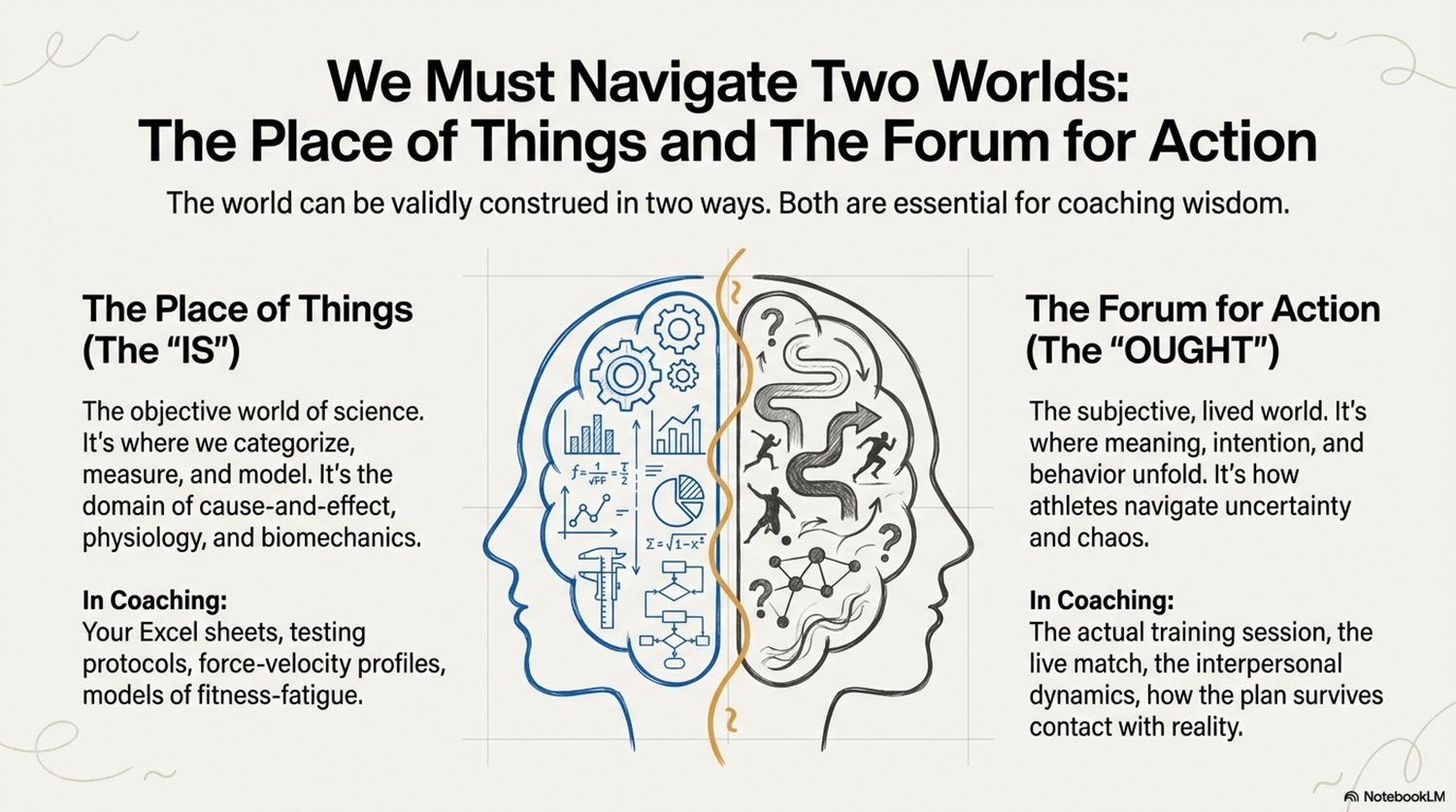
- Place of Things (classical view): structure, mechanics, monitoring, analysis.
- Forum for Action (romantic view): meaning, feel, motivation, context, decision-making under pressure.
You need both — and the ability to switch lenses without becoming dogmatic.
5) Practical mental models I actually use
We work through a small set of models that keep showing up in real coaching:
- Substance vs Form: capacity vs expression (engine vs driver).
- Top-down vs Bottom-up: planning vs adaptation.
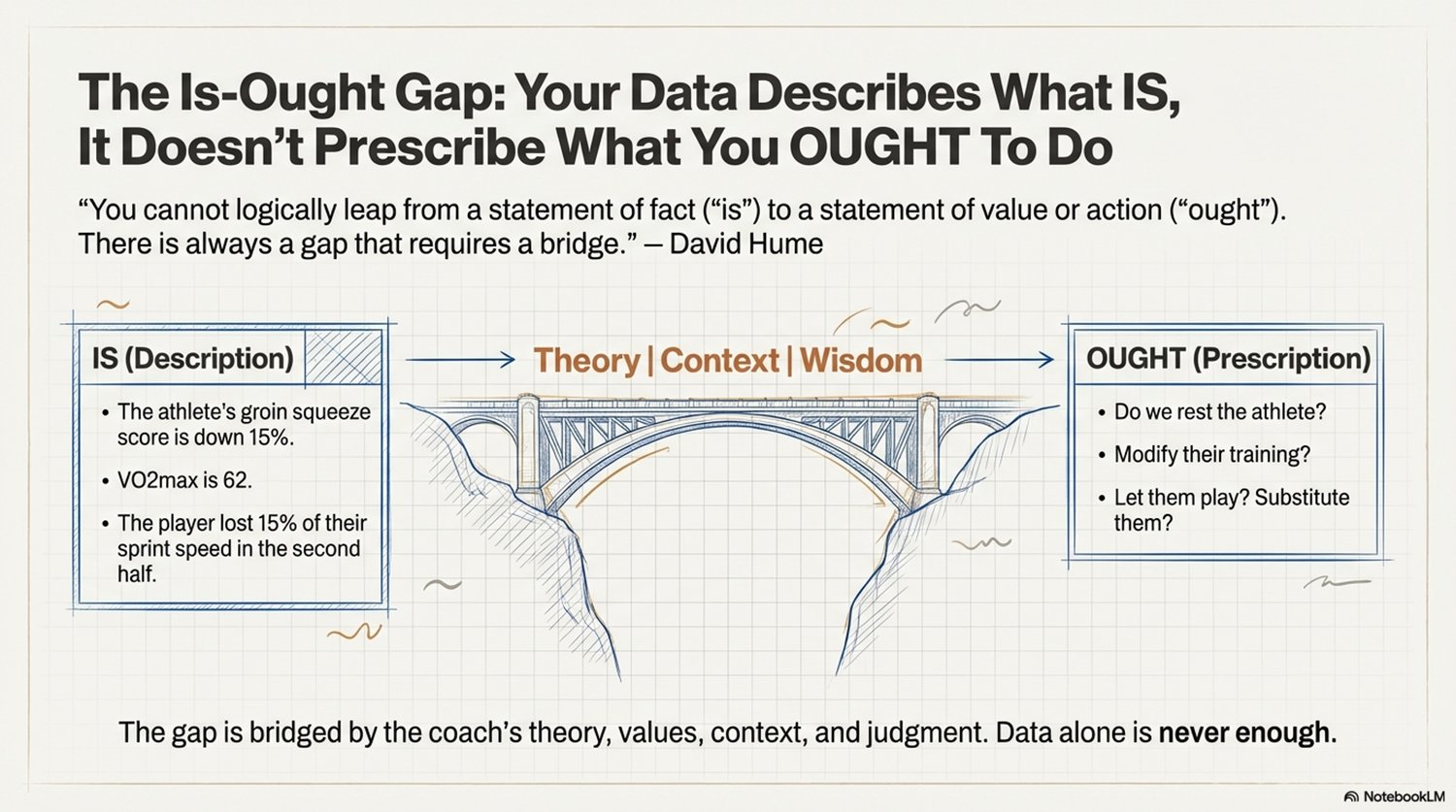
- The “Is–Ought” gap: data tells you what is; coaching decides what you do.
- Explore vs Exploit: experimentation vs reliable execution.
6) What this becomes in practice
Finally, we translate the mindset into operational behavior:
- Iterative planning (short cycles + frequent reviews)
- Minimum Viable Program (start robust, earn complexity)
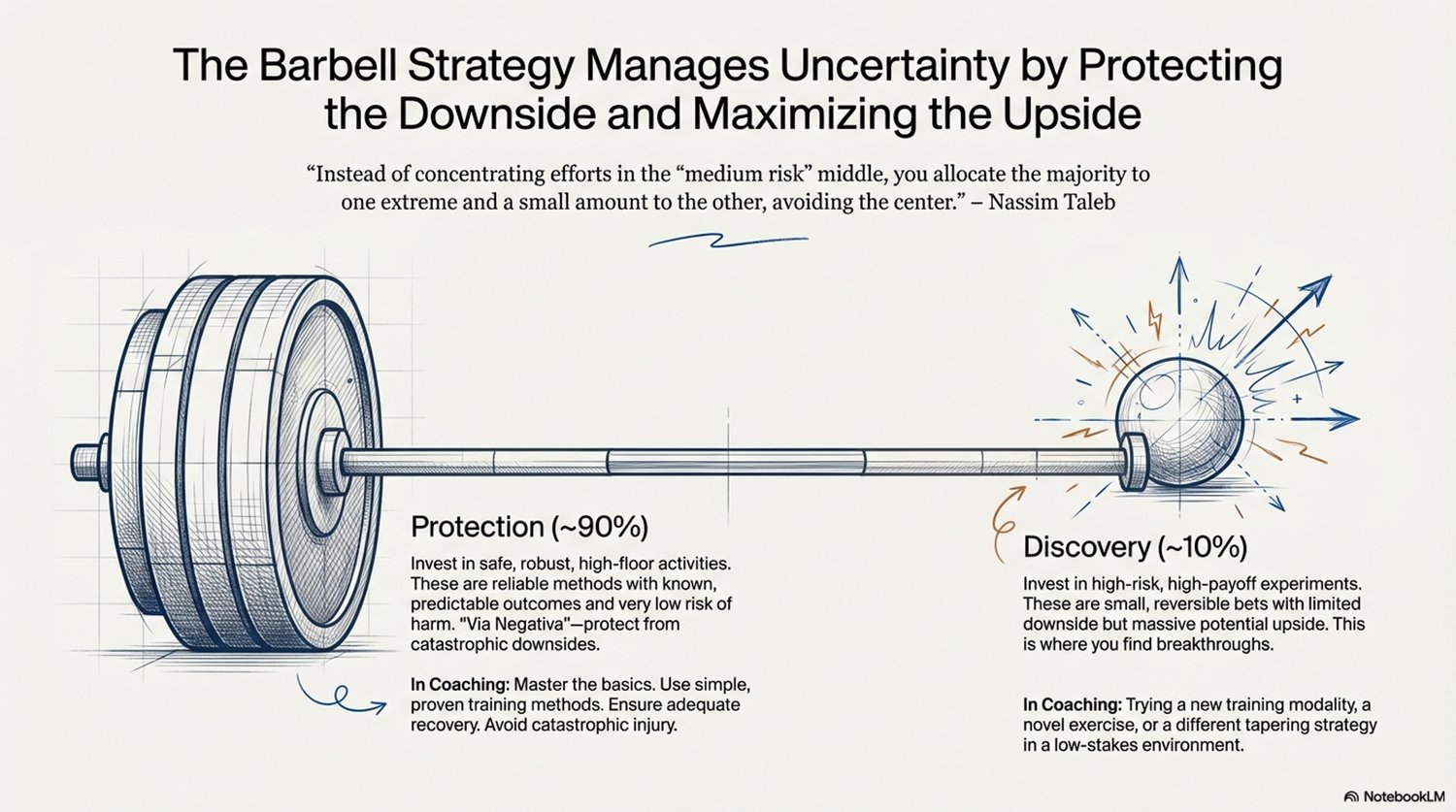
- Barbell strategy (protect the downside, keep optionality for upside)
If you’ve ever felt stuck between rigid planning and chaotic improvisation, this course gives you a third option: a way to coach with structure and adaptability — grounded in theory that respects reality.
What you’ll learn
By the end of this course, you’ll be able to:
- Explain why coaching is always philosophical (and why pretending it isn’t makes you more dogmatic, not more “evidence-based”)
- Use Complementarity to manage real trade-offs (structure vs flexibility, robustness vs performance, planning vs adaptation)
- Apply Integrative Pluralism: treat models as tools, not truths — and know when each tool becomes dangerous
- Spot the difference between Small World models and Large World reality (and stop confusing precision for usefulness)
- Work with the Map vs Territory problem without becoming cynical or naive
- Understand the Is–Ought gap: how data informs decisions, but never makes them for you
- Use Explore vs Exploit to decide when to experiment, when to standardize, and why “always varied” is just another religion
- Build decisions around Barbell strategy: protect the downside, keep optionality for upside
- Use Via Negativa to remove bottlenecks and fragilities before chasing fancy “performance hacks”
- Design a Minimum Viable Program (MVP) that survives reality — and earns complexity over time
- Translate philosophy into operations: iterative planning, short cycles, reviews/retrospectives, and better reasoning under uncertainty
Course curriculum
-
1Module 1: The Philosophical Bedrock
-
2Module 2: Maps, Models, and Reality
-
3Module 3: Core Lenses of Agile Periodization
-
4Module 4: Strategy Under Uncertainty
-
5Module 5: Operations and Iteration
-
6Module 6: Summary
-
7Module 7: Addendum