




Donchian Channels Explained — Real breakouts (PDF Guide)
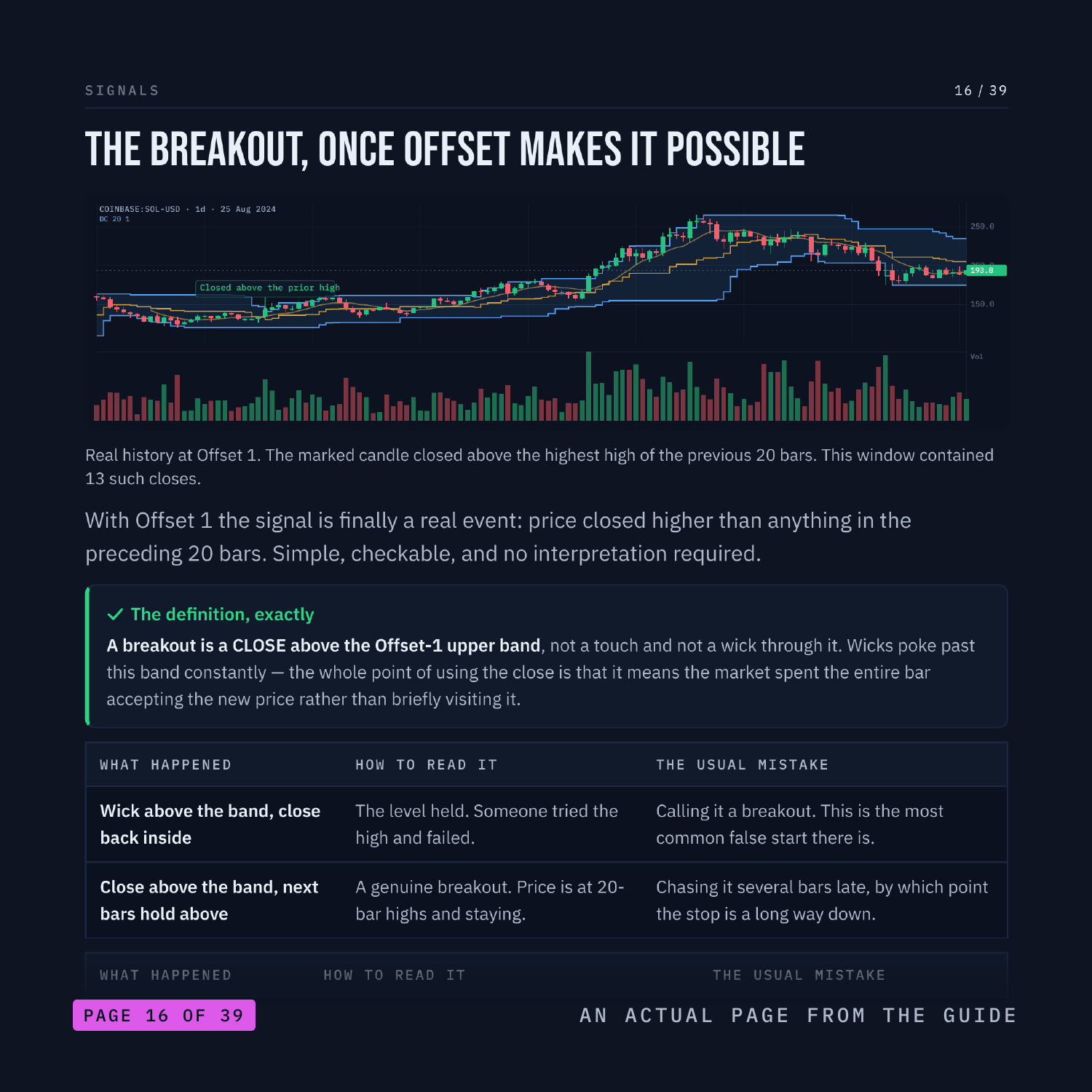
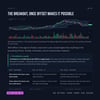
You put Donchian Channels on the chart, set an alert for a close above the upper band, and wait. It never fires. Price makes new high after new high and the alert stays silent, because on the default settings the band moves up to meet every one of them and the close you are waiting for is arithmetically impossible.
One input fixes it, and almost nobody changes it: Offset. This guide shows what the default is actually doing and why the fix is the way the original breakout rules were written. This is a 39-page PDF that teaches Donchian Channels from the first thing you see on the screen through to a written strategy with an entry, a stop and an explicit rule for when the trade is wrong.
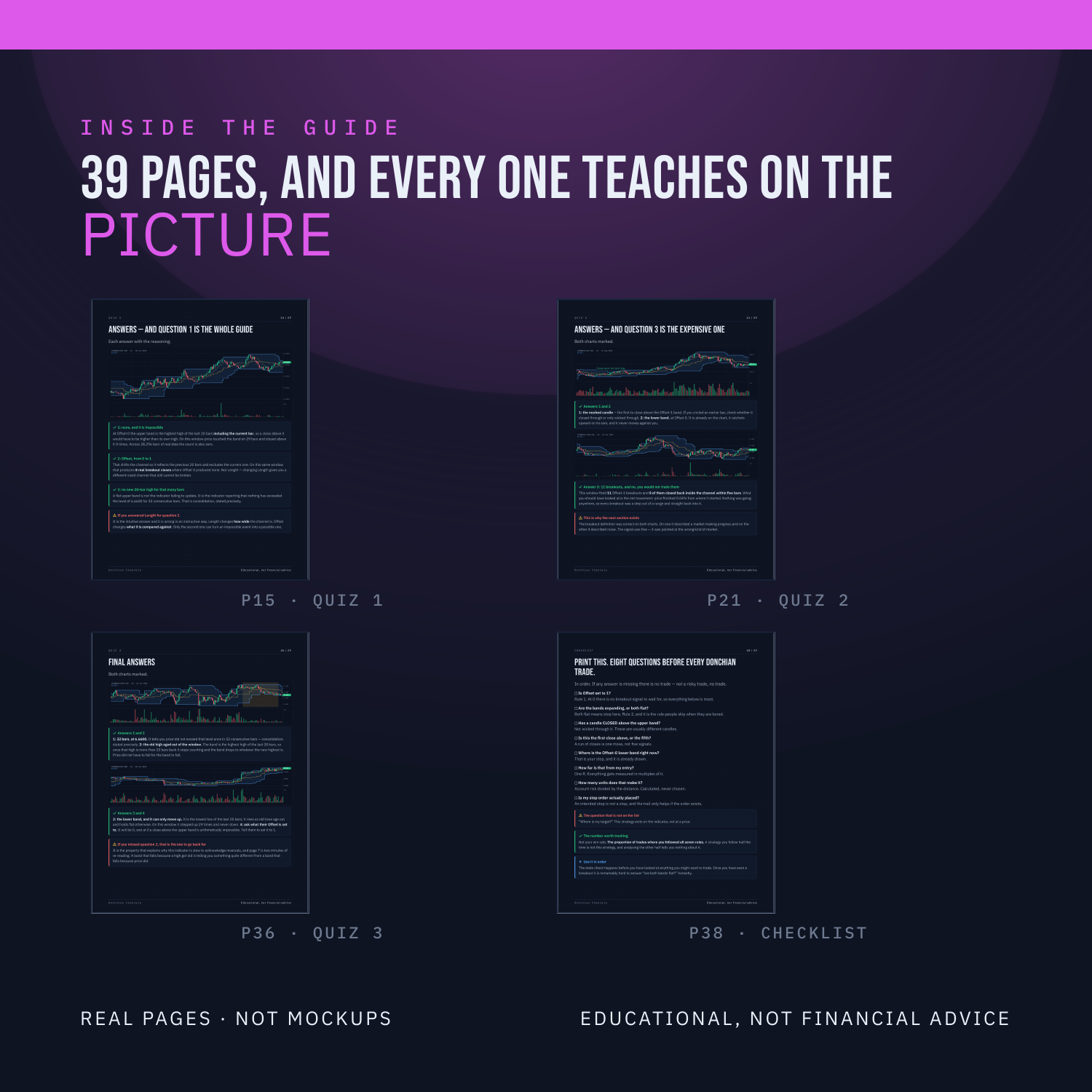
Nothing is taught underneath a chart. Every label sits on the candle, the line or the level it is describing, on real market data. There are three quizzes on real charts, each followed by the same chart re-shown annotated with the reasoning, plus faded practice pages where the first steps are filled in and you finish the rest.
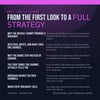
WHAT'S INSIDE
- Why the default cannot produce a breakout — Tested across 28,296 real bars: zero closes above the upper band at Offset 0, and 4.39% of bars at Offset 1.
- Both real inputs, and what each one changes — Length and Offset. Only two, so both are covered properly rather than padded out with settings that do not exist.
- Why the bands step instead of curving — The staircase is the signature, and the flat shelves are readable information in themselves.
- The four things the channel actually tells you — N-bar breakouts, flat shelves as consolidation, the basis as a mean reversion target, and the lower band as a trailing stop.
- Donchian against Keltner Channels — Two channel indicators that look alike and behave nothing alike, computed on one chart so the difference is visible.
- When every breakout fails — The range case, with the failures counted honestly rather than left out.
WHAT YOU'LL BE ABLE TO DO
- Explain why your breakout alert never fired.
- Set Offset deliberately, and say what it changed.
- Read a flat shelf as consolidation rather than as nothing happening.
- Use the lower band as a trailing stop that steps up on its own.
- Tell a breakout worth taking from one in a range.
- Choose between Donchian and Keltner for the chart in front of you.
AN HONEST NOTE
Donchian Channels is a clue, not a crystal ball. It describes what price has already done. This guide contains no win-rates, no backtest results and no promises about what you will make, because nobody can verify those and you should not trust anyone who prints them. What it hands you instead is a set of rules you can test yourself on TradingView in an afternoon. Educational, not financial advice.
Instant download. 39 pages, PDF.