
Concrete Defects - Half-Cell Corrosion Survey
Half-Cell Corrosion Survey Guide —
Map corrosion risk before the damage shows up at the surface.
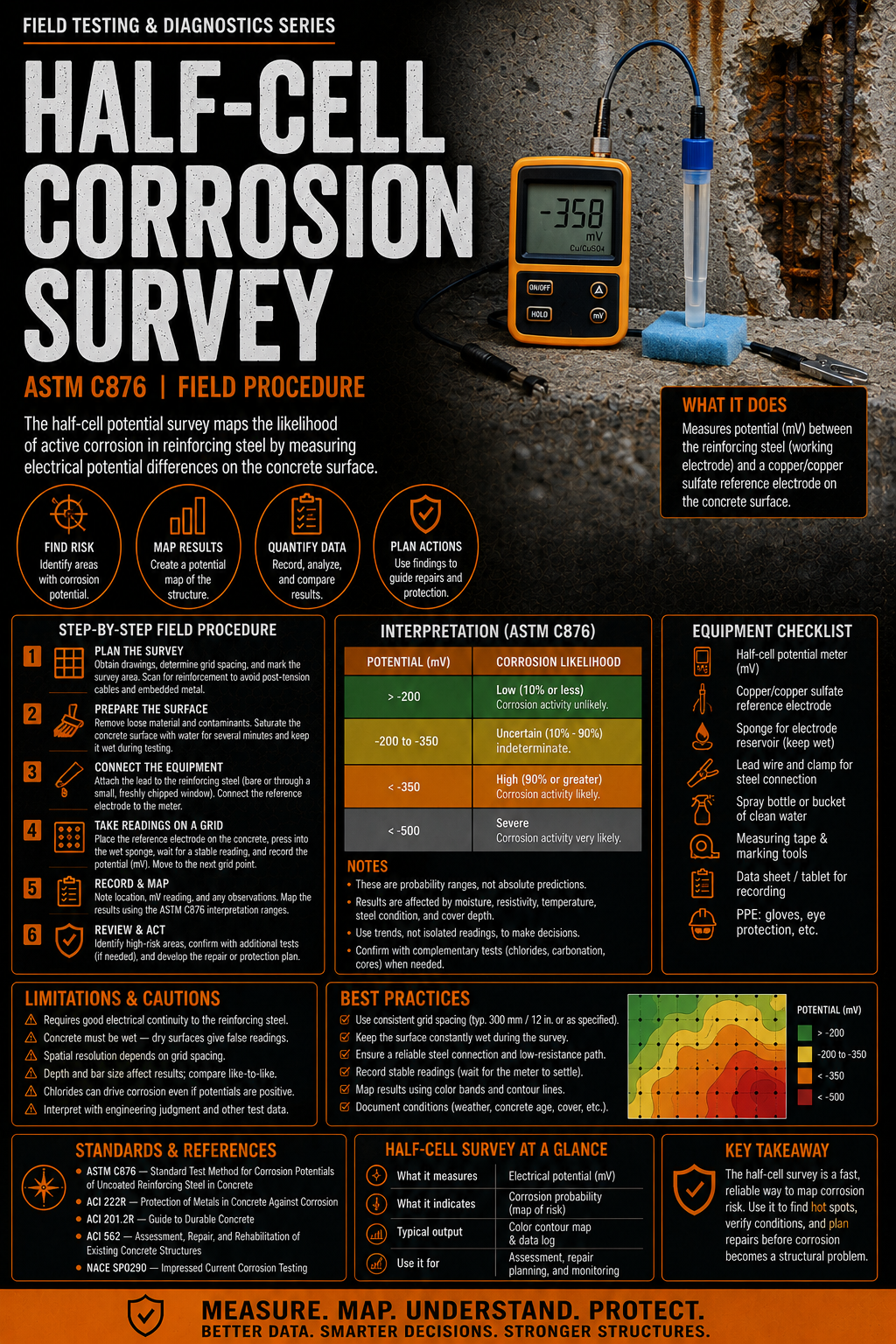
The Half-Cell Corrosion Survey Guide is a practical field testing reference for evaluating the probability of active reinforcement corrosion in concrete. Using the half-cell potential method, this guide helps concrete professionals understand how to set up a survey grid, connect to the reinforcing steel, take millivolt readings, map corrosion potential, and interpret the results using ASTM C876 guidance.
A half-cell survey does not measure corrosion rate or section loss. It measures the electrical potential of reinforcing steel against a reference electrode to help identify where active corrosion is most likely. That makes it a powerful tool for bridge decks, parking garages, balconies, marine structures, older reinforced concrete, and any structure where chloride or carbonation-induced corrosion is suspected.
This guide is built for inspectors, technicians, contractors, QC professionals, engineers, maintenance teams, and repair planners who need a clear, field-ready reference for corrosion potential testing.
What’s Included
- Clear explanation of what a half-cell survey is
- Field testing procedure based on corrosion potential testing
- ASTM C876-based interpretation guidance
- Equipment and setup checklist
- Survey grid layout guidance
- Reinforcement connection and continuity requirements
- Surface wetting and contact guidance
- Step-by-step testing procedure
- Potential mapping and contour interpretation
- Low / uncertain / high corrosion probability ranges
- Quick field decision path
- Limitations and cautions
- Best practices for consistent readings
- Standards and reference list
- Half-cell survey at-a-glance table
- Printable field checklist
Built for Real Field Testing
This guide helps answer the questions that matter during a corrosion investigation:
Where is corrosion most likely active?
Are the readings low, uncertain, or high probability?
Do the results support monitoring, further testing, corrosion assessment, or specialist review?
Are chloride content, cover depth, carbonation depth, and continuity being considered before repair decisions are made?
The guide walks through the full process: lay out a grid, expose and connect to the reinforcement, verify electrical continuity, pre-wet the surface, take readings at each grid point, record the values, map the results, and interpret the potentials using the proper ranges.
Interpretation Made Simple
The guide explains the commonly used copper/copper-sulfate electrode ranges:
- More positive than -200 mV: low probability of active corrosion
- -200 to -350 mV: uncertain corrosion activity; gather more data
- More negative than -350 mV: high probability of active corrosion
It also reminds users that half-cell readings indicate probability, not corrosion rate, and should be interpreted alongside chloride testing, concrete cover, carbonation data, surface condition, and engineering judgment.
Best For
- Concrete inspectors
- Bridge and parking garage inspectors
- Field technicians
- Repair contractors
- Engineers and engineering support staff
- Ready-mix and QC professionals
- Facility maintenance teams
- DOT and infrastructure inspection crews
- Anyone evaluating reinforcement corrosion risk
Why This Guide Matters
Corrosion can be active before major cracking, delamination, or spalling appears. A half-cell survey helps map areas of higher corrosion probability so repairs can be better targeted, budgets can be prioritized, and future deterioration can be monitored over time.
The Half-Cell Corrosion Survey Guide gives users a practical way to collect better field data, avoid relying on visual symptoms alone, and make smarter next-step decisions when corrosion is suspected.
Important Note
Half-cell testing is a field screening and mapping method. It should not be used alone to determine final repair scope. Readings can be affected by moisture, cover depth, oxygen, temperature, surface condition, reinforcement continuity, and concrete saturation. Critical findings should be confirmed with additional testing, specialist review, or engineering evaluation before repair decisions are made.
Measure the potential. Map the risk. Protect the structure.