

Multiregional Evolution Hypothesis
Product title Multiregional Evolution — The Theory That Lost to Out of Africa
The rival theory of human origins, its sources, its opponents, and the politics running underneath it. 17 pages, fully sourced.
Full description
For sixty years, two models fought over how modern humans came to populate the world. One of them lost. This guide is the history of the one that lost — and of what it turned out to be right about.
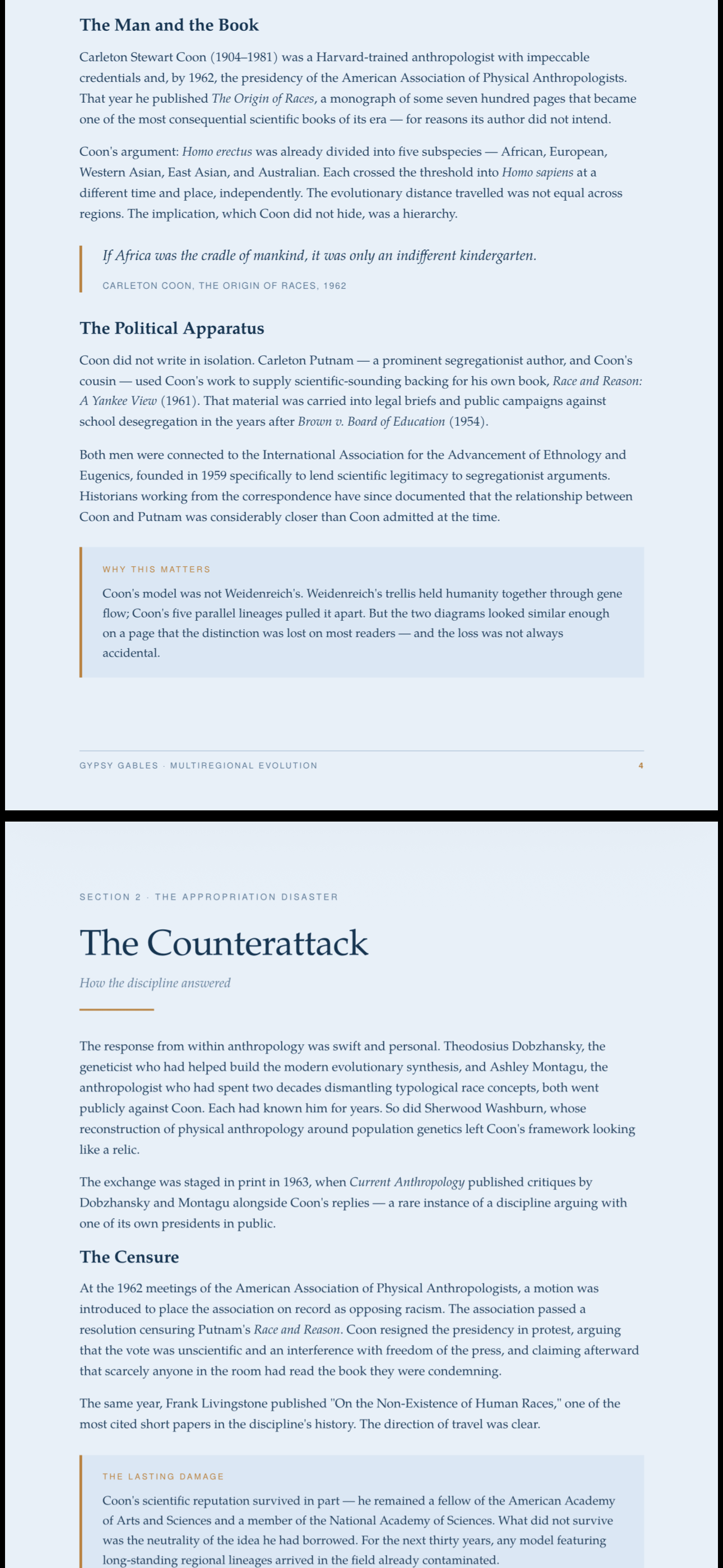
Multiregional evolution began with Franz Weidenreich, a Jewish anatomist driven out of Germany by the Nazi regime, who drew human ancestry as a lattice held together by constant gene flow. Two decades later Carleton Coon stripped out the connecting lines and handed the result to the segregationist campaign against school desegregation. The theory never recovered from the association, and the field spent thirty years flinching from anything that looked like it.
Then the molecular evidence arrived. Mitochondrial Eve in 1987 appeared to settle everything, until the 1992 rebuttals showed the African root was an artifact of the order data had been fed into a computer program. Better methods confirmed Africa anyway. And in 2010, the Neanderthal genome proved that archaic and modern humans had interbred after all — vindicating multiregionalism on a central point, fifteen years after it had been abandoned.
This guide traces the full arc, including the parts usually left out: how Chinese national identity, Australian Indigenous sovereignty, and a collapsed genome-sampling project shaped which evidence got gathered and how it was read. It closes with four persistent questions — why Africa is so internally diverse, what the fossil preservation gap hides, what ghost lineages are, and why dark skin is ancestral — and a full reading list of primary sources from Weidenreich in 1946 to Ragsdale in 2023.
Inside: 17 pages, eleven sections, every claim sourced.
Ancient wisdom at Gypsy Gables. Take heed, or don't. Either way, you are held.
@GypsyGables — Before the Bridge: The Old and Ancient Americas