
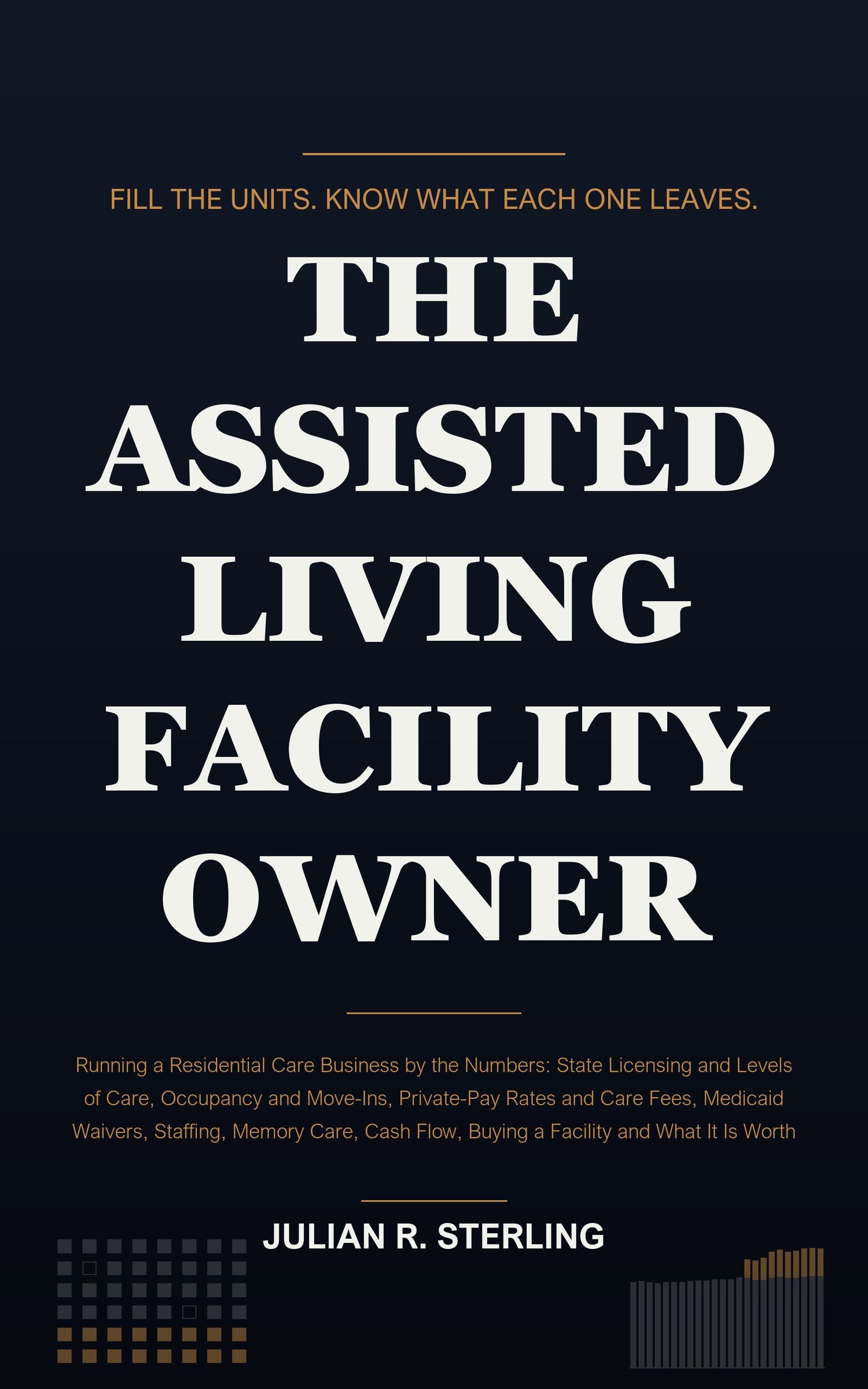
The Assisted Living Facility Owner (PDF edition)
November 2026. The registered nurse who founded an assisted living company reviews two fiscal years: a 48-unit residence at 94.8 percent occupancy, company revenue up from $3,131,721 to $4,077,439 with a second facility, EBITDA at 5.5 percent of revenue, a 14-bed residential care home bought with an SBA 7(a) loan that had not paid back by year end, Medicaid claims held for months after the change of ownership, and a letter of intent from a regional operator. The house manager asks whether an SBA 7(a) loan could finance buying the house alone.
The Assisted Living Facility Owner is a practitioner's guide to the economics of a licensed assisted living residence in the United States: state licensing and levels of care, occupancy and census, inquiries, tours and move-ins, base rents, care fees and community fees, Medicaid waivers and the settings rule, memory care, the staffing schedule, overtime and agency staff, the lease and rent coverage, the break-even, cash and prepaid charges, buying a second facility, and what the company is worth. One fictional company, every number from one model.
Some of what the arithmetic shows: why a Medicaid resident brings $2,691.96 a month less than a private one in the same unit; why the residence breaks even at 39.1 residents with its schedule held fixed but 35.6 when direct care is treated as variable; why one private resident more adds $5,737 a month; why the house needs about 21.8 more months to pay back; and why a buyer's price for the house covers an SBA loan's payments 1.29 times before anyone is paid to run it.
The model is not described, it is supplied. Seven companion workbooks hold revenue per occupied unit, the occupancy break-even, staffing hours and cost per resident-day, move-ins and length of stay, Medicaid and cash, the second facility, and the offer with rent coverage and the SBA loan, by live formula, each with a Checks tab, and the check-lists come as an editable document. The closing pages say where to find them.
What you will be able to do:
- Price a unit for a private resident and a Medicaid resident, level by level
- Measure occupancy, move-ins, length of stay and the cost of filling a unit
- Read the staffing schedule as steps and price its hours per resident-day
- Compute the break-even, the rent coverage and the cash a second facility will need
- Read a buyer's letter of intent and the lender's arithmetic before answering either
Sixteen chapters in four parts and four appendices: a guide to the workbooks with seven exercises, eight check-lists, sixty-nine questions for counsel and the state licensing agency, the state Medicaid agency, the landlord, a placement agency, the CPA, candidates, the lender, a seller and a buyer, and a glossary of fifty terms.
Written for owners and buyers of assisted living residences and residential care homes, the nurses and administrators who plan to open or buy one, and the lenders and advisers who read their numbers. The case, its company, residence, house, bank, landlord and buyer and their figures are fictional teaching assumptions, not market norms; federal rules are dated as of November 2026, and state rules differ. This book is for education only. It is not legal, tax, licensing, lending or accounting advice.
This edition: PDF, A5, 191 pages, DRM-free.