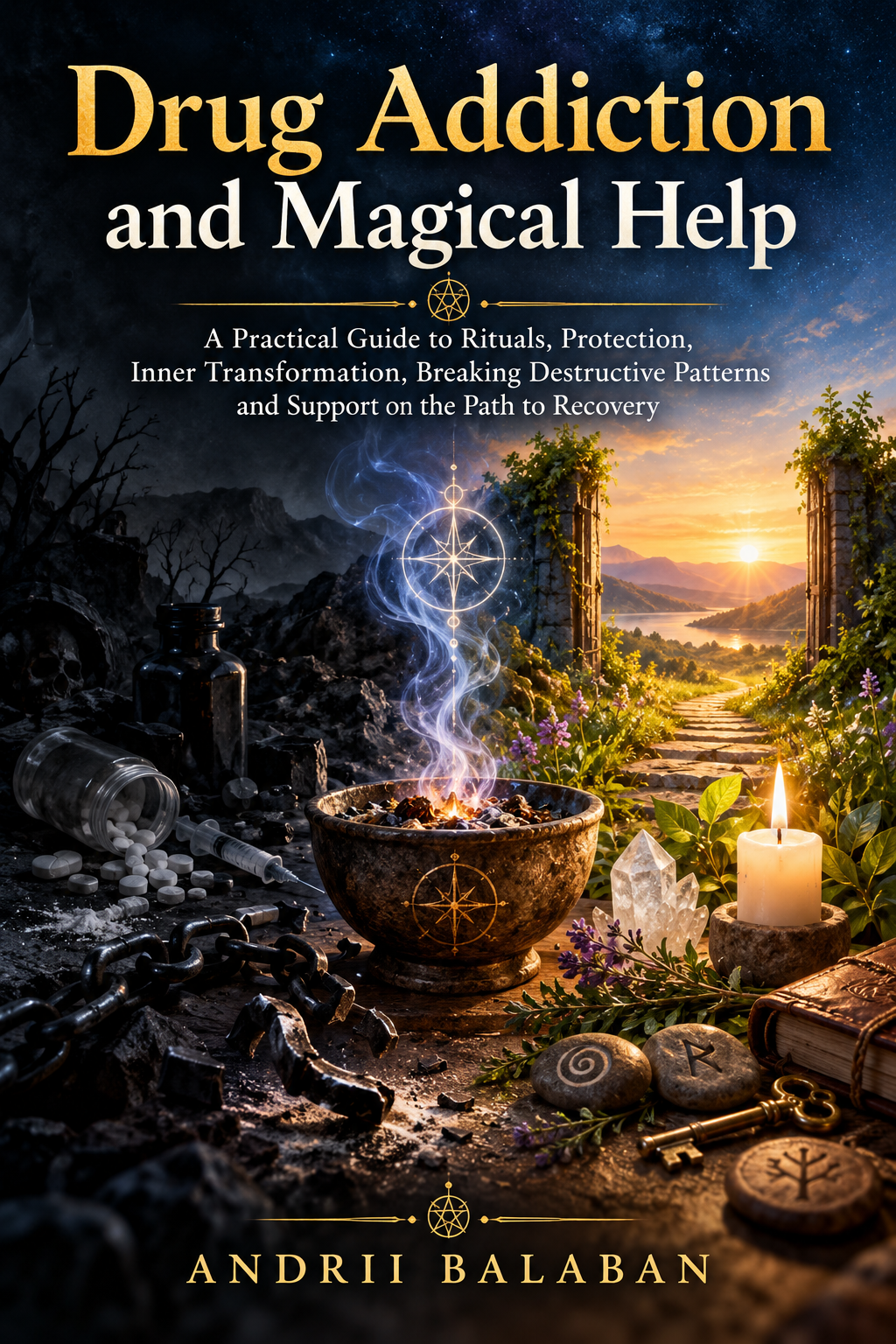
Drug addiction and magical help
Contents
Chapter 1. Drug dependence and the limits of magical help
The opening chapter establishes the foundation of the entire system by examining drug dependence as a complex condition involving biological, psychological, behavioral, interpersonal, and social processes rather than as evidence of weak character or spiritual corruption. It defines the appropriate place of magical practice within recovery and draws firm boundaries between ritual support and professional treatment. Particular attention is given to situations in which withdrawal, overdose, severe intoxication, psychiatric symptoms, or other acute problems require immediate medical intervention. The chapter introduces the central principle that will guide the entire book: magic may accompany recovery, strengthen meaning and intention, and support practical change, but it must never be used as a substitute for medicine, addiction treatment, psychiatry, psychotherapy, psychology, or rehabilitation.
Chapter 2. The magical anatomy of addiction: substance, desire, repetition, and bondage
This chapter develops a symbolic understanding of addiction through the images of the chain, circle, knot, gate, vessel, shadow, and path. Instead of treating addiction as a single force that can simply be “removed,” the reader learns to see the network that surrounds substance use: craving, relief, reward, fear, environment, relationships, secrecy, memories, rituals of obtaining and using drugs, and the identity that may gradually form around them. Magical symbolism is used to make these patterns visible and workable. The purpose is not to invent supernatural causes for addiction but to provide a ritual language through which the person can recognize where the bonds exist and where they can begin to be loosened.
Chapter 3. Diagnosis before ritual: understanding the person, the substance, and the pattern
Effective magical support must begin with reality rather than fantasy. This chapter presents a structured method for examining what substances are being used, how often, under what circumstances, what function they serve, what previous attempts at recovery have occurred, what triggers are present, what support exists, and what medical or psychiatric risks may require professional attention. Ritual assessment and divination may be used as reflective tools, but they are clearly separated from medical diagnosis. The chapter teaches the practitioner and the person seeking help to distinguish what is known from what is assumed, to identify the actual pattern of dependence, and to avoid dramatic interpretations such as curses, possession, or supernatural attack when ordinary clinical and psychological explanations are sufficient.
Chapter 4. The first threshold: rituals of decision, separation, and beginning
Recovery requires a point at which intention becomes action. This chapter develops rituals for marking that threshold through symbols such as a doorway, cord, stone, water, key, light, and written declaration. The purpose is not to make impossible promises about the future but to transform an abstract wish into a concrete beginning. Every ritual commitment is connected to a practical action: contacting a treatment provider, entering rehabilitation when appropriate, accepting medical evaluation, changing an unsafe environment, involving a trusted supporter, or removing access to situations associated with drug use. The central idea is that ritual marks the threshold, while real behavior carries the person across it.
Chapter 5. Purification and breaking the ritual cycle of drug use
Drug use often develops its own rituals: particular places, objects, people, routes, times of day, music, messages, money patterns, preparations, and sequences of behavior may become associated with obtaining and using a substance. This chapter approaches purification as the deliberate dismantling of that old ritual architecture. Safe practices involving water, salt, light, cleaning, symbolic disposal, rearrangement of space, and the retirement of objects associated with the former life are combined with practical environmental change. Purification is not presented as removing moral impurity from the person. Its purpose is to weaken associations and create a visible boundary between an old pattern and a new environment. Every removal is paired, where possible, with replacement so that emptiness does not simply invite the previous behavior to return.
Chapter 6. Craving, triggers, temptation, and magical protection
Craving can appear suddenly or grow gradually through stress, loneliness, conflict, excitement, boredom, memories, social contact, particular locations, or exposure to people connected with previous drug use. This chapter creates a practical system of magical protection for vulnerable moments using portable symbolic objects, brief rituals, protective circles, written formulas, stones, keys, light, water, and deliberate pauses. These practices are designed to support rather than replace established coping strategies and professional relapse-prevention work. Protection is understood not as the supernatural elimination of every craving but as the creation of a meaningful interval between impulse and action. Within that interval, the person can contact support, leave a dangerous environment, use a previously prepared plan, and make a different decision.
Chapter 7. Magic alongside medicine, psychiatry, psychotherapy, and rehabilitation
This chapter places magical practice directly beside the professional systems that may be necessary in recovery. It explores how ritual can support entering treatment, remaining engaged with rehabilitation, taking prescribed medication as directed, preparing emotionally for psychotherapy, tolerating difficult periods of change, and recognizing progress that may otherwise feel invisible. Medicine addresses medical needs; psychiatry addresses psychiatric conditions when present; psychotherapy and psychology work with emotions, cognition, behavior, trauma, relationships, and coping; rehabilitation can provide structure and intensive support; and ritual can contribute meaning, symbolism, identity, and personal commitment. The chapter rejects the false choice between spiritual and professional help and develops a model in which appropriate forms of support reinforce rather than sabotage one another.
Chapter 8. Family magic: protection, boundaries, and helping without control
Families affected by drug addiction often become trapped in cycles of rescue, surveillance, fear, anger, secrecy, financial loss, repeated promises, and disappointment. This chapter is devoted to magical practices for the family that focus on protection and clarity rather than coercive control. Rituals of boundaries, two circles, protected space, keys, doors, and separate lights help family members distinguish love from enabling and assistance from taking responsibility for another adult’s choices. Practical issues such as money, household safety, children, communication, and personal limits remain central. The chapter also recognizes that family members themselves may require psychological support and recovery after years of living around addiction.
Chapter 9. Relapse, overdose risk, shame, and the ritual of returning to the path
A relapse can be especially dangerous because tolerance and circumstances may have changed, increasing the risk of severe harm or overdose. This chapter therefore places immediate safety before symbolic interpretation. Once safety has been addressed, the relapse is examined as a sequence rather than a mysterious failure: what changed first, which supports disappeared, what thoughts returned, which relationships or environments became dangerous, and where intervention might have occurred earlier. A ritual of returning to the path is then used to acknowledge reality without turning it into permanent identity. The central formula of the chapter is that falling does not determine the next action. Recovery can resume, but the plan must learn from what happened.
Chapter 10. Reclaiming the self: body, identity, relationships, work, and meaning
Removing drugs from a person’s life creates a question that abstinence alone cannot answer: what will now occupy the space that addiction once controlled? This chapter moves the book from liberation toward construction. Magical practice is directed toward reclaiming time, caring for the body, rebuilding relationships, restoring financial order, returning to work or education, developing creativity, rediscovering pleasure, and forming a future identity that is not organized around drugs. Ritual objects gradually change from symbols of protection against addiction to symbols of what the person is building. The goal is not merely to become someone who does not use drugs, but to become a person whose life contains enough meaning, responsibility, connection, and possibility that recovery protects something genuinely valuable.
Chapter 11. Long-term protection and the magical maintenance of recovery
Long-term recovery requires neither permanent fear nor endless ritual intensity. This chapter develops daily, weekly, monthly, seasonal, and annual practices that can gradually become simpler as stability increases. The reader learns how to review stress, isolation, sleep, relationships, secrecy, old contacts, overconfidence, major transitions, and other changes without turning self-observation into obsession. Protective objects may eventually be retired, anniversaries can become occasions for gratitude and reassessment, and difficult seasons can be anticipated before they become crises. The ultimate shift is from protecting the person against drugs to protecting the life that has been created in their absence.
Chapter 12. The complete practice of magical support for recovery
The final chapter integrates the entire book into one coherent sequence: reality and safety assessment, decision, threshold, purification, protection, professional treatment, family boundaries, response to relapse, reconstruction of identity, and long-term maintenance. A complete concluding ritual brings together the principal symbols of the book — stone, water, light, thread, key, empty vessel, written record, and objects representing the life being built. The ritual does not promise supernatural immunity from addiction. Instead, it marks the transformation of recovery from a desperate struggle into an organized way of protecting life. Magic becomes progressively less about the substance and more about freedom, responsibility, relationships, creation, and the future. The book ends with a simple principle: the substance must become smaller in the story, while the person and the life that person is building become larger.