
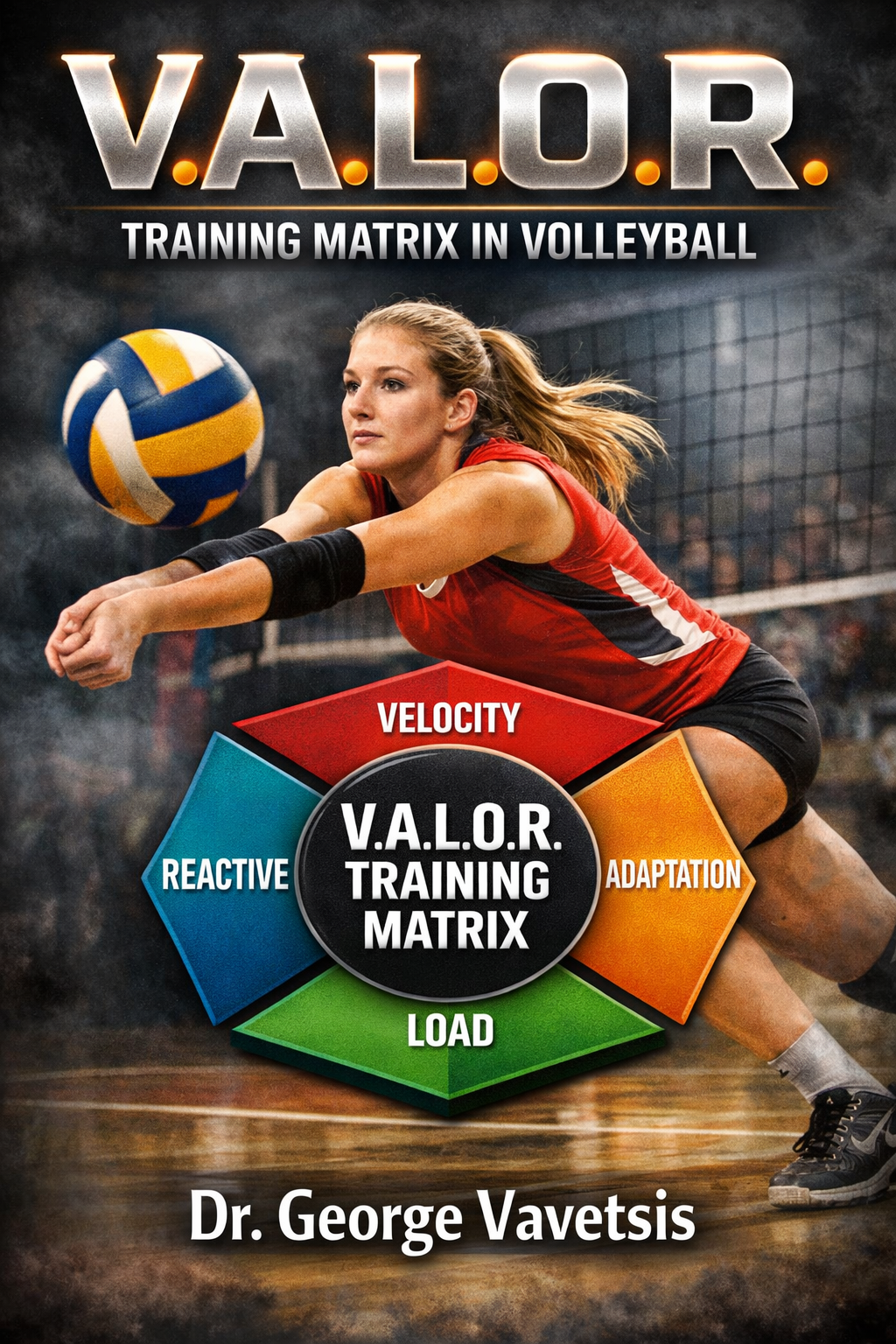
V.A.L.O.R. Training Matrix in Volleyball
Pages: 2985
High-performance sport is not built on isolated exercises, fragmented methodologies, or short-term physical gains. It is built on systems—integrated, dynamic, biological systems—where growth, load, neuromechanics, and adaptation interact continuously across time. Nowhere is this more evident than in volleyball, a sport defined by explosive jumping, rapid force transfer, reactive control, and repeated high-velocity motor actions. Within this complex environment, the challenge for coaches, sport scientists, and practitioners is not merely to train harder, but to train in harmony with the athlete’s biological evolution. This book emerges from that fundamental need.
The V.A.L.O.R. framework (Volleyball Athletic Long-term Organic Development) represents a systems-level approach to understanding how the developing athlete responds to training stimuli across maturation. It is not simply a training model; it is a biological-performance architecture. Growth velocity, neuromechanical stability, tissue tolerance, endocrine maturation, and load exposure are not independent variables—they are coupled signals within a living adaptive system. When these signals align, performance accelerates safely. When they desynchronize, instability, plateau, or injury emerges.
Traditional training paradigms often assume linear progressions: increase load, improve performance. Yet the developing athlete does not follow a linear path. Growth introduces instability. Limb length changes alter leverage and kinetic demands. Neural adaptation may accelerate while tendon adaptation lags. Hormonal activation enhances strength yet temporarily reduces tissue tolerance. These biological dissociations create windows of opportunity and windows of vulnerability. The purpose of this book is to map those windows with scientific precision and translate them into actionable training logic.
At the heart of this framework lies the concept of organismic maturation. Biological age—not chronological age—governs readiness, adaptation, and risk. Two athletes of the same calendar age may exist in entirely different biological states, with different capacities for load tolerance, neuromuscular control, and reactive performance. Training that ignores maturation risks forcing adaptation faster than tissue capacity allows. Training aligned with maturation harnesses the natural rhythms of growth, allowing performance to emerge organically rather than artificially.
Volleyball provides a unique lens through which to study these interactions. The sport demands repeated stretch-shortening cycle activity, rapid braking and re-acceleration, vertical impulse production, and precise coordination under fatigue. Growth modifies each of these requirements. As lever arms lengthen, force distribution changes. As body mass evolves, relative strength fluctuates. As neuromotor mapping recalibrates, coordination temporarily destabilizes. The athlete must relearn how to move within a changing body, and the coach must guide this process with biological intelligence.
The V.A.L.O.R. system therefore treats training as a feedback-controlled biological process rather than a fixed prescription. Inputs (growth, load, fatigue, environment) interact with constraints (tissue tolerance, neuromechanical stability, endocrine state) to produce outputs (performance, adaptation, injury risk). Continuous monitoring—of growth, readiness, neuromechanics, and load—closes the loop, allowing programming to adapt dynamically rather than reactively.
A central principle throughout this work is sequencing: teach – stabilize – load – express. Skill must precede intensity. Stability must precede reactive expression. Tissue tolerance must precede performance demand. When this sequence is respected, adaptation becomes cumulative and sustainable. When it is violated, progress becomes volatile and fragile. This sequencing is not philosophical—it is rooted in the differential timing of neural, structural, and endocrine adaptation.
Equally important is the concept of load ecology. Training load is not confined to the strength session or the volleyball court; it is the total mechanical exposure accumulated across practice, competition, and daily movement. Jump counts, landing intensity, braking quality, fatigue state, and recovery capacity all interact to determine the true mechanical dosage experienced by the athlete. Managing load therefore requires a systems view, integrating external exposure with internal readiness.
This book is written for practitioners who seek precision rather than approximation: strength and conditioning coaches, sport scientists, performance directors, medical professionals, and advanced coaches working within youth, developmental, and elite volleyball environments. Its purpose is not only to present theory, but to build a bridge between biological science and applied training design. Each concept is framed through the lens of performance, safety, and long-term athlete development.
The long-term vision of the V.A.L.O.R. framework extends beyond injury prevention or performance enhancement. It aims to create biologically intelligent athletes—athletes whose development follows the natural logic of growth, whose training respects the timing of adaptation, and whose performance emerges from systemic harmony rather than isolated capacity. Such athletes do not merely reach high performance; they sustain it.
In the chapters that follow, we will explore the clinical and biological architecture of maturation, the neuromechanical foundations of reactive performance, the endocrine influences on load tolerance, the mapping of adaptation windows, and the integration of monitoring into practical training systems. Together, these elements form a unified model of long-term athletic development grounded in science, guided by physiology, and refined through practice.
Performance is not a moment. It is a trajectory shaped by biology, time, and intelligent training. This book is an invitation to understand that trajectory—and to guide it with precision.