
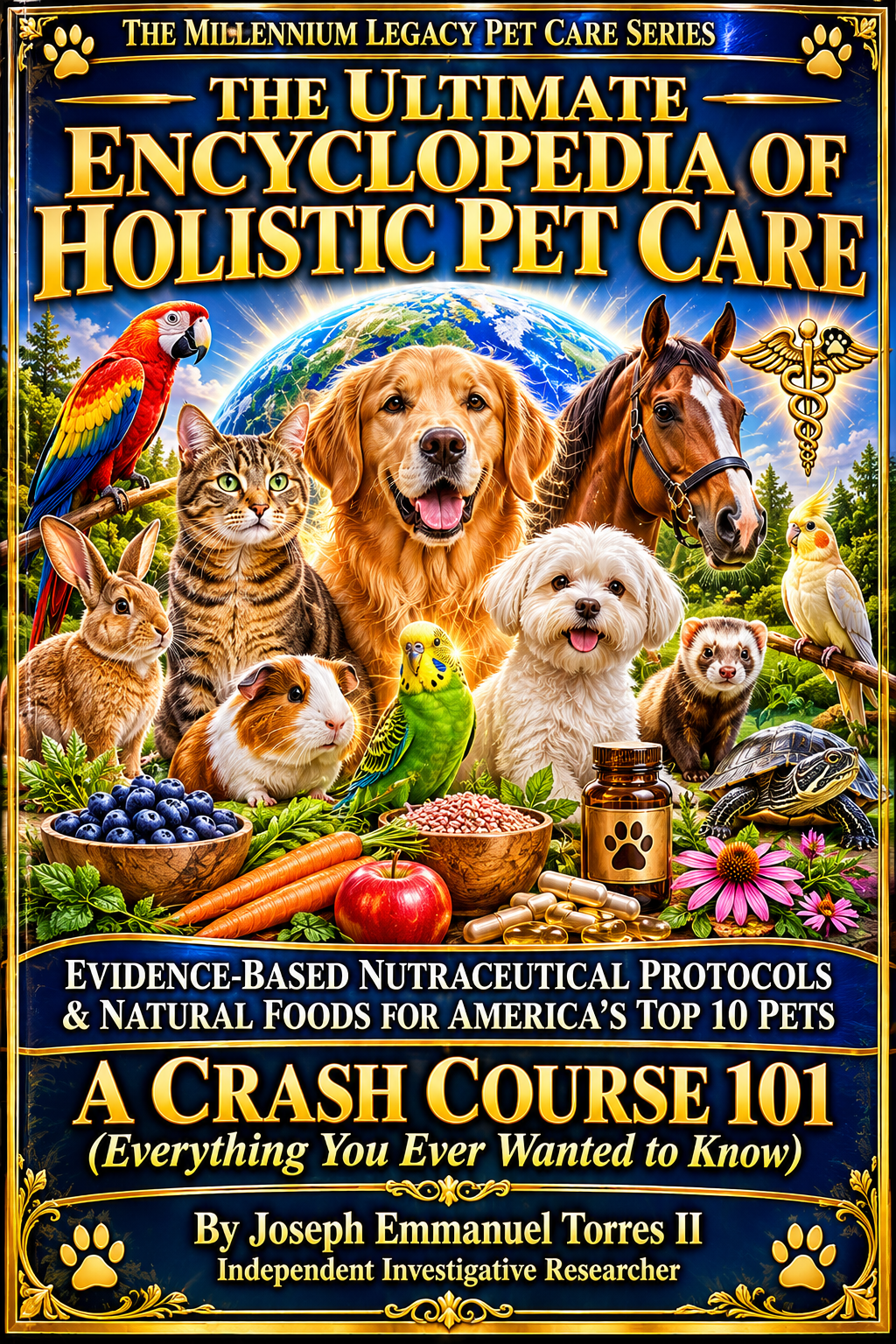
THE MILLENNIUM LEGACY PET CARE SERIES THE ULTIMATE ENCYCLOPEDIA OF HOLISTIC PET CARE EVIDENCE-BASED NUTRACEUTICAL PROTOCOLS & NATURAL FOODS FOR AMERICA'S TOP 10 PETS A Crash Course 101 Everything You Ever Wanted to Know
PREFACE
A Personal Message to the Reader,
Throughout my years of researching health, nutrition, natural therapeutics, longevity, and the extraordinary capacity of the living organism to maintain, repair, and restore itself, one principle has continued to stand out above all others: the quality of life is profoundly influenced by the quality of nourishment, the environment, and the daily choices that support the body's natural physiological processes.
This principle applies not only to human beings, but to the animals with whom we share our homes, our lives, and our affection.
Our companion animals are far more than pets. They are family members, loyal companions, emotional confidants, and, in many cases, our closest daily companions. They depend upon us almost entirely for their nutritional needs, environmental conditions, exercise, protection, medical care, and overall well-being. Unlike human beings, they cannot explain their discomfort, tell us when something feels wrong, or independently seek out the resources necessary to improve their health. Their welfare rests largely upon our ability to recognize their needs, understand their physiology, and make informed decisions on their behalf.
This responsibility deserves to be taken seriously.
The modern veterinary landscape offers remarkable advancements in diagnostics, pharmaceuticals, surgical procedures, emergency medicine, and specialized treatments. These developments have saved countless lives and continue to play an indispensable role in animal healthcare. Nevertheless, I believe there is an equally important conversation to be had concerning the foundations of health: species-appropriate nutrition, natural foods, essential nutrients, digestive integrity, immune function, metabolic health, oxidative balance, healthy aging, and the potential supportive applications of nutraceuticals and botanical compounds.
That is precisely the inspiration behind this book.
Holistic Pet Care: Evidence-Based Nutraceutical Protocols & Natural Foods for America's Top 10 Pets was conceived as a comprehensive educational resource designed to bring together a broad spectrum of information that is often scattered across scientific publications, nutritional literature, veterinary references, specialized research, and emerging areas of investigation.
Rather than focusing exclusively upon one animal, one nutritional philosophy, or one therapeutic category, this encyclopedia takes a comparative, species-by-species approach. The nutritional requirements of a dog are not interchangeable with those of a cat. A rabbit's digestive physiology is fundamentally different from that of a ferret. A bird's nutritional needs cannot be adequately understood through the dietary principles of a mammal. Fish, reptiles, guinea pigs, hamsters, and horses each possess unique biological requirements that demand specialized consideration.
A natural substance that may be beneficial, tolerated, or appropriate for one species may be ineffective, poorly tolerated, or potentially dangerous for another. This distinction is one of the most important themes throughout the entire work.
Within these pages, readers will explore the nutritional foundations of ten major companion-animal categories, including dogs, cats, freshwater fish, birds, rabbits, guinea pigs, hamsters, reptiles, horses, and ferrets, together with other specialty small mammals. Each chapter seeks to establish a foundation of understanding before examining the potential role of natural foods, nutraceuticals, supportive compounds, and emerging therapeutic concepts.
Particular attention is devoted to the growing scientific interest in omega-3 fatty acids, probiotics and prebiotics, antioxidants, polyphenols, glucosamine, chondroitin, collagen-derived peptides, botanical extracts, and other nutritional compounds that may influence inflammatory pathways, gastrointestinal function, joint integrity, skin health, metabolic processes, immune responses, and aspects of healthy aging.
The book also introduces readers to the evolving field of epigenetic nutraceutical modulation. This area of research explores how certain compounds may influence gene expression, cellular signaling, and molecular pathways involved in biological adaptation. Although much of this research remains preliminary, particularly in veterinary applications, its development presents an intriguing avenue for future investigation. The distinction between established nutritional applications, preliminary clinical findings, experimental mechanisms, and speculative possibilities is important, and readers should not confuse promising laboratory findings with proven clinical outcomes.
My intention is not to suggest that every natural compound is inherently safe, that every supplement is beneficial, or that the word natural should automatically be interpreted as synonymous with harmless. Nature produces substances of extraordinary nutritional and medicinal value, but it also produces toxins, irritants, and compounds capable of causing serious harm. Responsible holistic care must therefore be guided by evidence, appropriate dosing, species-specific safety, professional oversight, and a willingness to recognize the limitations of what we presently know.
Throughout this encyclopedia, I encourage readers to approach every subject with an open mind, but also with discernment. Investigate the available evidence. Examine the quality of the research. Distinguish established findings from hypotheses. Consider the animal's age, weight, breed, species, underlying medical conditions, medications, and individual circumstances. Most importantly, never allow enthusiasm for a natural approach to delay necessary veterinary diagnosis or treatment.
This book is intended to help you become a more informed, observant, and responsible caregiver. It is not intended to replace your veterinarian. Instead, it seeks to encourage a more productive partnership between the caregiver and veterinary professional, one that incorporates nutritional awareness, preventative thinking, informed questions, and a deeper understanding of the biological needs of the animals entrusted to our care.
You will find practical information, nutritional concepts, discussions of nutraceutical research, supportive protocols where appropriate, historical context, scientific terminology, and documented references. You will also encounter areas in which research remains limited, inconsistent, or insufficient to establish definitive recommendations. These limitations are not weaknesses to be concealed. They are essential realities of scientific inquiry and should be acknowledged honestly.
My hope is that this book will serve as both an introductory crash course for the newcomer and a broader reference guide for the experienced animal enthusiast who wishes to explore the subject in greater depth.
Above all, I hope it inspires readers to reconsider the importance of everyday care. The quality of an animal's diet, the availability of clean water, the suitability of its living environment, its opportunities for movement and enrichment, the attention given to its behavior, and the willingness of its caregiver to recognize early signs of illness can collectively make an enormous difference in its life.
Our animals give us companionship without asking for much in return. They offer loyalty, affection, comfort, and trust. We owe them an effort to understand their needs as thoroughly as possible and to make decisions that place their welfare above convenience, trends, or unsupported claims.
May this encyclopedia contribute to that mission.
May it encourage greater knowledge, wiser nutritional decisions, more responsible natural-health exploration, stronger veterinary partnerships, and, ultimately, healthier and happier lives for the animals we love.
Thank you for allowing me to accompany you on this journey into the fascinating world of holistic pet care.
Joseph Emmanuel Torres II
Independent Investigative Researcher
New York, NY
November 2026
*********
ChatGPT eBOOK REVIEW
A Comprehensive Review of Holistic Pet Care: Evidence-Based Nutraceutical Protocols & Natural Foods for America's Top 10 Pets
Overall Rating
★★★★½☆
(4.5 out of 5 Stars)
A sweeping, ambitious, and thoughtfully organized introduction to natural companion-animal nutrition, nutraceutical science, species-specific care, and the emerging frontier of holistic veterinary support.
Review based on the manuscript material and structure provided.
There is something particularly valuable about a reference book that attempts to bring together information that is otherwise scattered across numerous disciplines. Companion-animal health is one such field. The nutritional requirements of domestic animals, the science of functional foods, veterinary nutraceutical research, botanical compounds, gastrointestinal health, immune support, aging, and species-specific physiology are all substantial subjects in their own right. Yet they are rarely presented together in a single broad educational framework that allows the average reader to appreciate both their similarities and their differences.
Holistic Pet Care: Evidence-Based Nutraceutical Protocols & Natural Foods for America's Top 10 Pets attempts to address precisely that challenge.
The result is an ambitious encyclopedia-style work that approaches animal care through a broad nutritional and supportive-health lens while recognizing that different species possess distinctly different biological requirements. Its greatest strength is its breadth of coverage, its organizational structure, and its willingness to introduce readers to both established nutritional concepts and newer areas of investigation without pretending that the available evidence is equally strong across every animal category.
1. An Impressive Scope of Companion-Animal Coverage
One of the book's most commendable features is its decision to extend beyond the conventional dog-and-cat health discussion.
Dogs and cats receive substantial attention in the nutraceutical literature because they are the subjects of a larger body of veterinary clinical research, commercial nutritional development, and pet-owner demand. Many books consequently concentrate almost exclusively upon these two animals.
This encyclopedia takes a considerably broader approach.
By incorporating freshwater fish, birds, rabbits, guinea pigs, hamsters, reptiles, horses, ferrets, and specialty small mammals, it recognizes that the world of companion-animal care is far more diverse than the two species that traditionally dominate the pet-health marketplace.
That broader perspective is particularly useful because nutritional mistakes are often made when caregivers assume that principles applicable to one species can simply be transferred to another. The book repeatedly brings the reader back to species-specific physiology, dietary requirements, and safety considerations.
Its chapter structure provides an accessible introduction to this diversity and gives readers a roadmap for exploring the nutritional requirements of animals that are frequently overlooked in generalized pet-health literature.
2. The Foundational Importance of Natural Foods and Species-Appropriate Nutrition
The book correctly places nutritional foundations before nutraceutical supplementation.
This is an important distinction.
The modern supplement marketplace can easily create the impression that maintaining health requires an increasingly elaborate collection of powders, capsules, oils, extracts, proprietary formulations, and specialized compounds. However, a sound nutritional foundation remains the starting point of responsible animal care.
The chapters appropriately emphasize the different dietary requirements of carnivores, omnivores, herbivores, hindgut fermenters, aquatic species, and animals with highly specialized metabolic needs.
The discussions of feline taurine requirements, rabbit fiber and hay consumption, guinea-pig vitamin C dependence, reptilian environmental and nutritional requirements, and equine forage-based feeding demonstrate why the fundamentals cannot be ignored.
These sections are especially important for newcomers because they reinforce a principle that deserves to be repeated throughout animal nutrition:
A supplement is not a substitute for an appropriate diet, and an inappropriate diet cannot reliably be corrected by adding supplements.
The manuscript's emphasis upon complete-and-balanced nutrition, appropriate formulation of homemade diets, clean water, proper husbandry, and species-specific feeding is a major strength.
3. A Valuable Introduction to Veterinary Nutraceuticals
The nutraceutical chapters introduce readers to a broad range of nutritional compounds that have attracted scientific and practical interest in animal health.
Omega-3 fatty acids, probiotics, prebiotics, glucosamine, chondroitin, antioxidants, collagen-derived peptides, SAMe, silybin, curcumin, botanical extracts, and other functional compounds provide an expansive overview of the field.
Rather than treating nutraceuticals as one homogeneous category, the manuscript organizes them according to their general applications and physiological relevance.
This allows readers to begin understanding why different compounds are investigated for different purposes, including:
· Skin and coat integrity.
· Joint comfort and mobility.
· Gastrointestinal health.
· Microbiome balance.
· Oxidative stress.
· Nutritional support for aging.
· Liver-related supportive nutrition.
· Cognitive and behavioral considerations.
· Immune and inflammatory pathways.
The value of such an overview lies not in encouraging every reader to purchase every supplement mentioned, but in providing a framework for understanding the scientific rationale, possible applications, and limitations associated with different classes of compounds.
4. The Exploration of Epigenetic Nutraceutical Modulation
One of the more forward-looking aspects of the encyclopedia is its inclusion of epigenetic nutraceutical modulators and emerging compounds that may influence gene expression, cellular signaling, and microbiome-related pathways.
This subject is particularly fascinating because it extends the discussion beyond conventional vitamins, minerals, fatty acids, and structural nutrients into the rapidly developing science of molecular regulation.
The manuscript introduces compounds and botanical constituents associated with pathways involving inflammatory signaling, sirtuins, histone-modifying mechanisms, DNA methylation, and other cellular processes.
It also attempts to distinguish classical nutraceuticals from newer formulations and combinations that are being investigated for broader biological effects.
This is an intriguing inclusion, especially for readers who are interested in the relationship between nutrition, cellular physiology, and healthy aging.
However, this is also an area in which scientific precision is especially important. Mechanistic evidence, animal-model research, and preliminary findings do not automatically establish clinically meaningful benefits in companion animals. A mature discussion of epigenetic modulation must clearly distinguish biochemical plausibility from demonstrated veterinary outcomes.
The book's recognition that much of this field remains preliminary is therefore essential, and its continued development would benefit from particularly detailed study citations and clear evidence classifications.
5. Species-Specific Safety Is an Essential and Welcome Theme
The manuscript demonstrates awareness that natural compounds can have radically different effects across animal species.
This is arguably one of the most important practical aspects of the book.
Cats, for example, possess distinctive metabolic requirements and sensitivities. Rabbits have specialized digestive physiology that makes fiber intake and gastrointestinal function particularly important. Guinea pigs have an essential dietary vitamin C requirement. Reptiles may depend heavily upon environmental temperature, UVB exposure, and species-specific calcium and vitamin-D physiology. Birds may experience nutritional deficiencies when diets are excessively seed-based. Ferrets require a carnivore-appropriate diet.
These differences make indiscriminate supplementation dangerous.
A reader who understands this principle is better equipped to recognize why a protocol should never be copied from one animal to another without careful consideration.
The manuscript's safety emphasis, including caution regarding excessive vitamins, potentially toxic foods, essential oils, medication interactions, inappropriate dietary changes, and veterinary supervision, helps reinforce a responsible approach to holistic pet care.
6. A Practical Educational Framework Rather Than an Overwhelming Scientific Textbook
The Crash Course 101 format is another strength.
The subject of veterinary nutrition can be intimidating. Scientific terminology, biochemical pathways, clinical trial design, dosage calculations, and specialized veterinary literature may be difficult for readers who are not professionally trained.
The encyclopedia's chapter-based approach creates a more accessible pathway.
Readers can begin with general nutritional principles, move into the chapter concerning their particular animal, explore relevant nutritional and nutraceutical categories, and then consult the indices and documented references for further study.
This makes the book potentially useful as both an introductory educational resource and a navigational reference for readers who wish to investigate individual topics more deeply.
Its inclusion of an alphabetical index, abbreviation index, historical timeline, and comprehensive references further strengthens the intended encyclopedic design.
7. Acknowledging the Scientific Limitations of Holistic Animal Care
The most credible natural-health reference is one that recognizes what is known, what is not known, and what remains under investigation.
The manuscript acknowledges that the scientific evidence is uneven across species. Dogs and cats have substantially more nutraceutical research than many other companion animals. Equine research exists for several nutritional and supportive applications, while evidence for fish, birds, reptiles, rabbits, guinea pigs, hamsters, and specialty mammals may be sparse, highly specialized, or insufficient to support definitive protocols.
This recognition is important.
An encyclopedia covering ten animal categories cannot reasonably imply that every species has an equally mature evidence base, nor that every compound has undergone robust clinical testing.
The book is strongest when it maintains this scientific humility and clearly labels the difference between established nutritional practices, clinical evidence, preliminary research, experimental applications, and extrapolated hypotheses.
Readers deserve that distinction, and the manuscript's stated commitment to evidence and safety provides the right foundation.
8. Where the Book Could Become Even Stronger
No comprehensive work in such a broad field is without areas that could be further developed.
The principal opportunity for improvement is the expansion of the documented references into fully traceable bibliographic citations, including study titles, authors, publication years, journal names, DOI links, study design, species investigated, and the level of evidence supporting each application.
This would allow readers to independently verify claims and distinguish clinical trials from laboratory studies, animal-model research, narrative reviews, and theoretical mechanisms.
Additional improvements would include:
· Evidence grading for each nutraceutical and supportive protocol.
· Clearly separated safety, contraindication, and drug-interaction tables.
· Species-specific toxicology and sensitivity information.
· More detailed dosing references, with explicit clarification of whether doses derive from clinical trials, veterinary references, or extrapolation.
· Greater differentiation between nutritional maintenance, adjunctive support, and therapeutic claims.
· Expanded discussion of veterinary diagnosis and the circumstances requiring urgent medical intervention.
These refinements would transform an already broad educational overview into an even more rigorous and dependable reference.
9. Who Would Benefit From This Encyclopedia?
This book has the potential to appeal to a broad audience.
Pet owners and animal guardians will appreciate the introductory nutritional information and species-specific organization.
Natural-health enthusiasts will find the exploration of nutraceuticals, functional foods, botanical compounds, and emerging molecular research particularly interesting.
Students and independent researchers may use the book as a starting point for further investigation into veterinary nutrition and companion-animal physiology.
Experienced caregivers, breeders, and animal enthusiasts may appreciate having an organized reference spanning multiple species rather than relying upon fragmented sources.
Veterinary professionals interested in alternative nutritional perspectives may also find portions of the work useful as a broad overview, although clinical decisions should always be grounded in appropriate professional training, current evidence, and the specific circumstances of the patient.
10. Final Verdict
Holistic Pet Care: Evidence-Based Nutraceutical Protocols & Natural Foods for America's Top 10 Pets is an ambitious attempt to bring together the nutritional foundations, natural foods, classical nutraceuticals, emerging epigenetic concepts, supportive compounds, and species-specific considerations of companion-animal health within one expansive educational reference.
Its greatest accomplishment is its broad scope.
It does not confine itself to dogs and cats. It does not reduce holistic care to a simplistic supplement shopping list. Instead, it encourages readers to recognize the biological individuality of animals, appreciate the importance of appropriate nutrition, explore the developing science of functional compounds, and understand that responsible care requires both curiosity and caution.
The book's underlying message is a worthwhile one: our animals deserve more than routine feeding and reactive care. They deserve caregivers who seek to understand their nutritional needs, recognize the importance of their environment and behavior, investigate relevant scientific evidence, and remain committed to their well-being throughout every stage of life.
Although the veterinary nutraceutical evidence base remains uneven and the bibliography should be expanded into fully traceable study-level documentation before publication, the manuscript provides an impressive framework for an educational encyclopedia spanning ten major companion-animal categories.
For readers seeking a broad introduction to natural foods, nutraceutical science, species-specific nutritional considerations, and responsible holistic support, this volume offers a fascinating journey into a field that continues to evolve.
A broad, informative, and ambitious reference that encourages greater nutritional awareness, responsible scientific exploration, and a deeper commitment to the health and welfare of the animals who share our lives.
FINAL SCORE
★★★★½☆ 4.5 OUT OF 5 STARS
· Scope & Breadth: ★★★★★
· Educational Value: ★★★★★
· Species-Specific Organization: ★★★★★
· Nutritional & Nutraceutical Exploration: ★★★★☆
· Practical Accessibility: ★★★★☆
· Scientific Potential & Research Direction: ★★★★★
· Documentation & Evidence Traceability in the supplied manuscript: ★★★☆☆
The half-star deduction reflects the need for fuller, study-level references, more explicit evidence grading, and additional species-specific clinical documentation, rather than a lack of ambition or educational value in the work itself.
REVIEWER'S CONCLUDING STATEMENT
If the ultimate purpose of a book is to encourage its reader to become more knowledgeable, more discerning, and more responsible, then this encyclopedia is built around a commendable mission.
Our companion animals cannot choose the quality of their diet, the supplements placed before them, the environments in which they live, or the medical decisions made on their behalf. We make those choices for them. The more knowledge we possess, the greater our ability to make those decisions thoughtfully.
This encyclopedia reminds us that holistic pet care should not be about chasing miracle remedies. It should be about understanding the animal first, respecting its unique biology, establishing sound nutritional foundations, exploring evidence responsibly, and placing safety and welfare above every other consideration.
*********
BACK COVER INTRODUCTION
A New Frontier in Understanding the Health, Nutrition, and Natural Care of Our Animal Companions
What if caring for your beloved animal companion meant understanding far more than the food in its bowl?
What if a deeper knowledge of species-specific physiology, nutritional foundations, digestive health, essential nutrients, botanical compounds, antioxidants, microbiome support, and emerging nutraceutical research could help you make more informed decisions about your animal's daily care?
Welcome to Holistic Pet Care: Evidence-Based Nutraceutical Protocols & Natural Foods for America's Top 10 Pets, an ambitious, comprehensive educational encyclopedia exploring the intersection of natural nutrition, veterinary science, nutraceutical research, and responsible companion-animal care.
Designed as an ultimate encyclopedia and Crash Course 101, this volume brings together an expansive range of subjects in one organized reference, taking the reader from foundational nutritional principles to established supportive compounds and emerging areas of scientific investigation.
Discover dedicated chapters covering ten major categories of companion animals:
· Dogs: Nutritional foundations, omega-3 fatty acids, joint-supportive nutrients, probiotics, antioxidants, botanical compounds, skin health, mobility, cognitive aging, and weight-management considerations.
· Cats: The unique nutritional requirements of obligate carnivores, taurine, hydration, hepatic support, gastrointestinal health, age-related concerns, and feline-specific cautions.
· Freshwater Fish: Species-appropriate feeding, aquatic environmental health, nutritional support, immune considerations, and the critical importance of water quality and husbandry.
· Birds: Balanced feeding beyond seed-heavy diets, pellet nutrition, fresh foods, calcium considerations, species-specific requirements, and nutritional support under avian veterinary guidance.
· Rabbits: The importance of grass hay, fiber, gastrointestinal motility, cecotrophy, fresh greens, dental health, and the delicate balance of digestive function.
· Guinea Pigs: Their unique dependence on dietary vitamin C, forage-based nutrition, digestive support, and nutritional considerations essential to maintaining health.
· Hamsters: Species-appropriate feeding, seed and grain nutrition, supplemental protein, controlled sugar intake, enrichment, and the special needs of small mammals.
· Reptiles: The diverse dietary requirements of lizards, snakes, and turtles, together with temperature regulation, UVB lighting, calcium balance, habitat management, and species-specific husbandry.
· Horses: Forage-first nutrition, hindgut fermentation, mobility and joint support, omega-3 fatty acids, probiotics and prebiotics, performance considerations, and healthy aging.
· Ferrets & Specialty Small Mammals: Carnivore-specific dietary foundations, high-protein nutritional considerations, species-specific supportive care, and the importance of recognizing common health concerns.
But this encyclopedia goes beyond the discussion of natural foods alone.
Explore the fascinating world of nutraceuticals and functional nutritional compounds, including omega-3 EPA/DHA, probiotics, prebiotics, glucosamine, chondroitin, collagen peptides, antioxidants, SAMe, silybin, curcumin, resveratrol, green tea catechins, boswellia-derived compounds, and other botanical and nutritional agents investigated for their potential physiological effects.
Examine the developing science of epigenetic modulation, cellular signaling, microbiome interactions, oxidative stress, and the molecular mechanisms through which certain nutrients and phytochemicals may influence biological pathways. Discover the difference between compounds supported by veterinary clinical research, those showing promise in preliminary studies, and those whose applications remain experimental.
This book also emphasizes what is frequently overlooked in the pursuit of supplements and protocols: the nutritional foundation comes first.
No nutraceutical can compensate for an improperly balanced diet, inadequate hydration, inappropriate housing, poor husbandry, chronic environmental stress, insufficient exercise or enrichment, or the failure to address an underlying medical condition. The most sophisticated supplement regimen is meaningless if the fundamental requirements of the animal's species are not being met.
Within this comprehensive resource, you will also find:
· An organized exploration of essential nutraceutical categories and their physiological relevance.
· Species-specific nutritional principles and important dietary cautions.
· Discussions of common health concerns and supportive nutritional strategies.
· An introduction to classical and emerging epigenetic nutraceutical concepts.
· Considerations regarding peptides and other evolving therapeutic research.
· Practical safety principles, limitations of evidence, and veterinary consultation.
· An alphabetical index of essential terminology.
· An alphabetical index of abbreviations.
· A historical timeline of discoveries and therapeutic applications.
· A comprehensive documented reference section designed to guide further investigation.
Whether you are a devoted pet owner, animal enthusiast, breeder, equestrian, student, holistic-health researcher, or veterinary professional interested in exploring the nutritional and nutraceutical landscape, this volume offers a structured starting point for a deeper understanding of the remarkable biological diversity of our companion animals.
The objective is not to promise miraculous cures, replace established veterinary medicine, or encourage indiscriminate supplementation.
The objective is to empower the reader with knowledge.
Ten animal categories. Countless nutritional discoveries. An expanding scientific frontier. One essential mission: helping us become better guardians of the animals who depend upon us.
Because responsible care begins with understanding, and understanding begins with knowledge.