
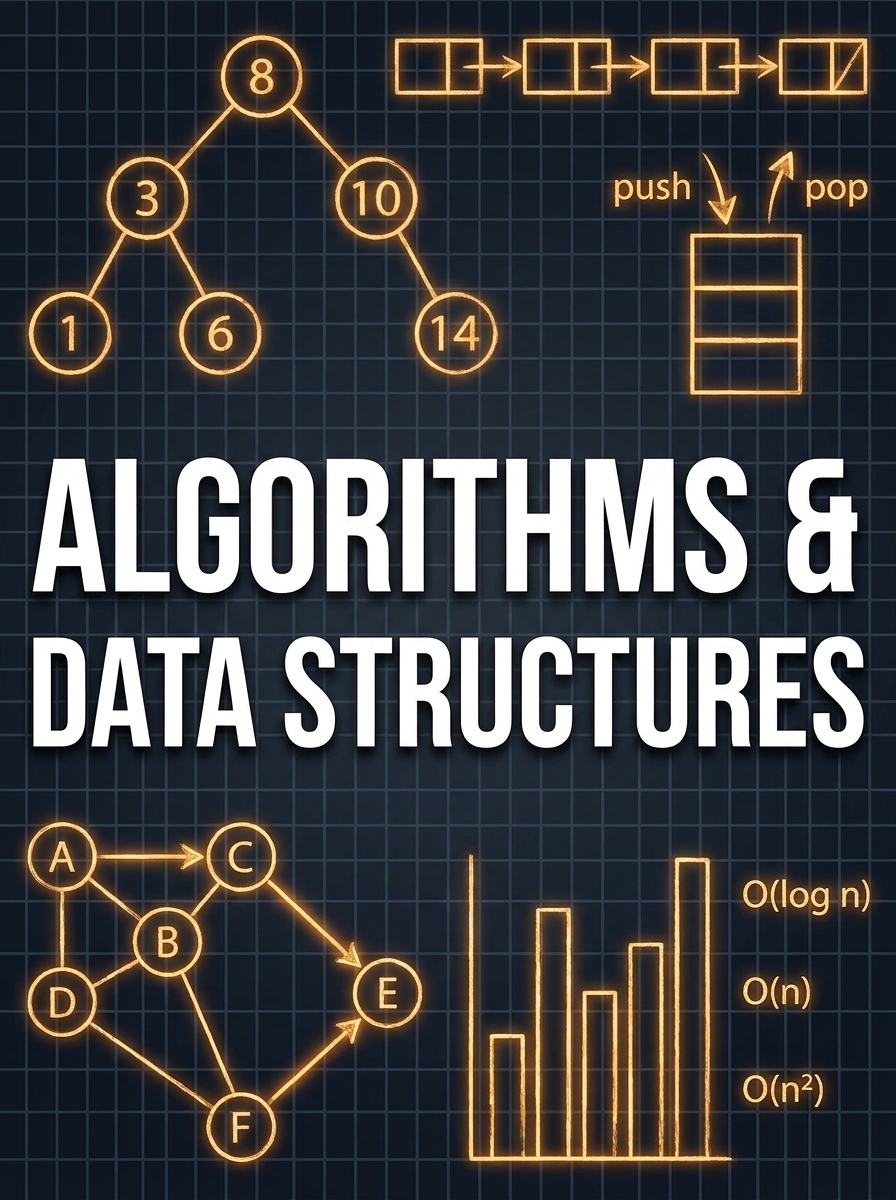
🧩 Algorithms & Data Structures Without the Misery
🧩 Algorithms & Data Structures Without the Misery
Your phone finds one contact among thousands before you lift your thumb. A maps app finds your best route without trying every road. The same computer can answer in a blink or take all week, depending only on how the data is arranged. This book explains the handful of ideas behind that, without the scary maths.
WHAT'S INSIDE:
📈 Big-O — counting steps, not seconds, and why a faster computer can't rescue a slow method
🔗 Arrays vs. linked lists — two ways to store a row of things, and when each one wins
🥞 Stacks and queues — who goes next, from your browser's back button to a print queue
#️⃣ Hash tables — why looking something up can be near-instant, even among millions
🔍 Searching — why 20 guesses are enough to find one item in a sorted list of a million
📊 Sorting — why merge sort beats bubble sort, and by how much
🌳 Trees — how a binary search tree keeps everything findable
🗺️ Graphs — how maps apps find the shortest route
⚠️ A "5 Common Mistakes" chapter — including why a faster computer won't fix a slow algorithm
🧮 A Big-O Cheat Sheet & Quick Reference appendix, with a worked example
✏️ 10 fully worked examples with every step shown
✅ 11 practice problems with complete answers at the back
WHO THIS IS FOR:
Anyone who has heard "algorithms" and "Big-O" and quietly nodded along. Anyone learning to code who wants to understand why some programs are fast and others crawl.
No prior knowledge of computer science required. 20 pages.