
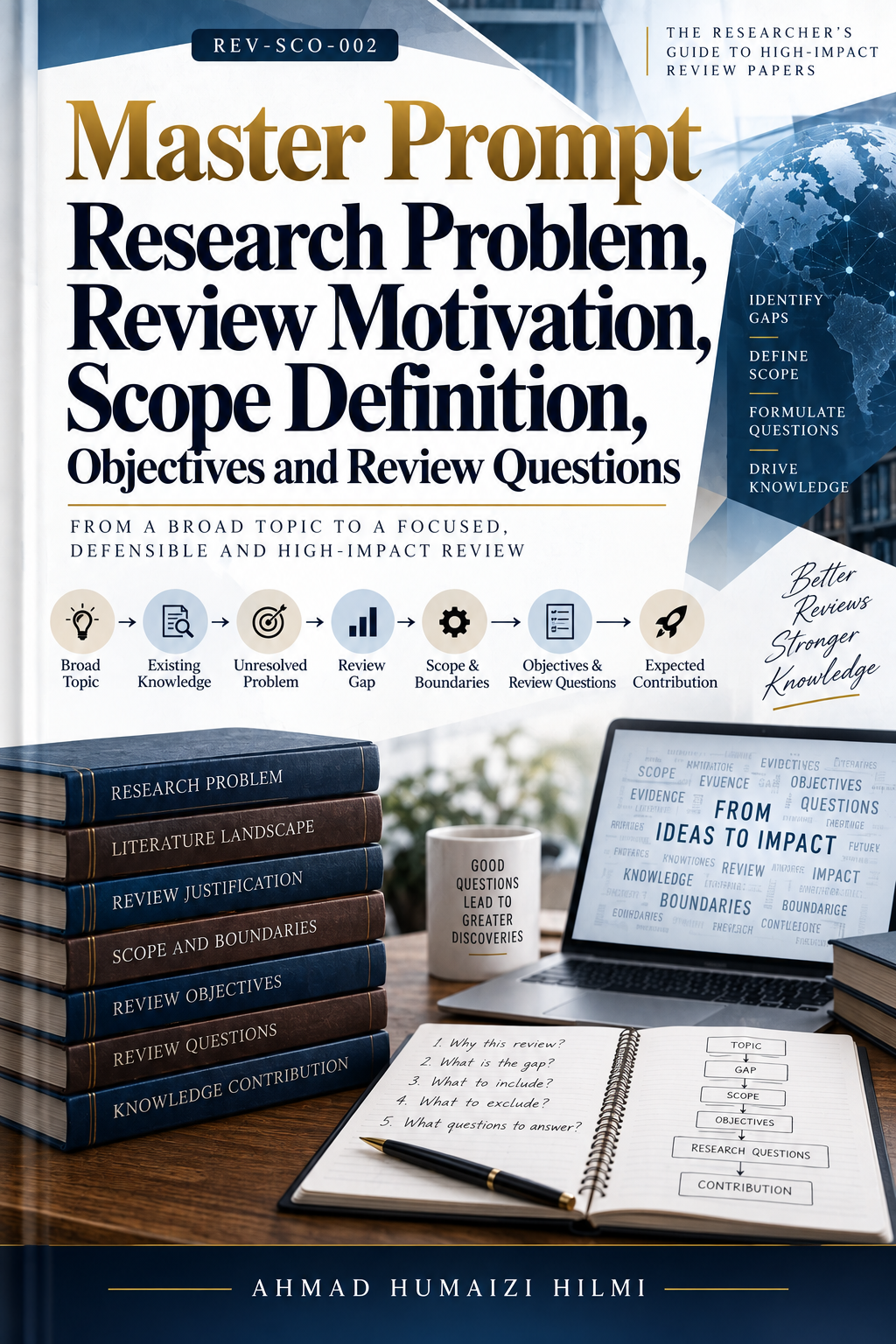
REV-SCO-002 — Research Problem, Review Motivation, Scope Definition, Objectives and Review Questions
Description
This Master Prompt focuses on converting a broad research topic into a clearly bounded, intellectually compelling, methodologically reviewable and evidence-responsive research problem. It guides researchers in establishing the background and current state of the field; defining the central concepts, phenomena and units of analysis; determining what is already known; identifying unresolved problems, inconsistencies, contradictions and limitations; distinguishing a genuine review gap from a topic that is merely underexplored; and translating the resulting problem into an explicit review scope, purpose, objectives and answerable review questions. The selected literature demonstrates several legitimate forms of review motivation: inconsistent primary findings may require systematic synthesis, as illustrated by the ebook-versus-paper engagement review; an important body of research may not yet have been synthesized, as in the deepfake-detection review; or an emerging concept may have so little empirical evidence that mapping the absence itself becomes informative.
A major emphasis is placed on demonstrating why another review is necessary before conducting it. Researchers should examine previous reviews and adjacent syntheses to determine whether they are outdated, methodologically limited, conceptually inconsistent, excessively broad or narrow, fragmented across disciplines, focused on different outcomes, unable to accommodate an emerging technology, lacking important populations or geographical contexts, or unable to resolve a newly significant theoretical or practical problem. The uploaded literature provides strong examples: the electrohydrodynamics review explicitly examines earlier reviews before delimiting its computational focus, while the Knowledge Graph review identifies the predominance of inter-paper approaches and the comparatively neglected internal semantic structure of individual papers as the conceptual gap motivating a new distinction between breadth-oriented and depth-oriented approaches.