
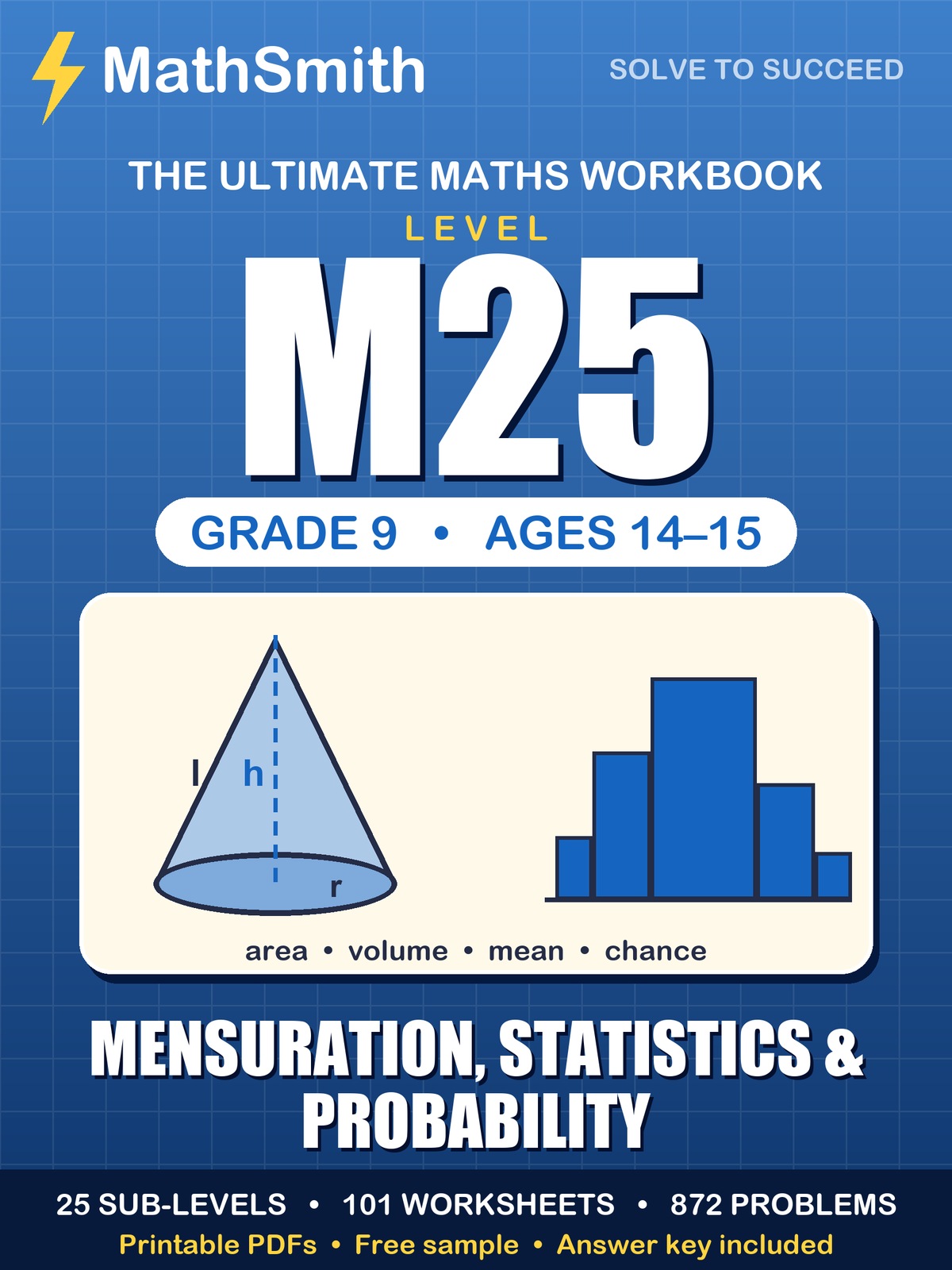
Gr 9 Maths Worksheets (Ages 14-15) | Level M25: Mensuration, Statistics & Probability
🎓 Launch offer: 80% OFF every MathSmith workbook with code LAUNCH80 (first 1000 orders). Click Add to Cart, then enter LAUNCH80 in the discount box before you pay.
Not sure which level your child needs? Take the free 40-question placement test: https://ebooks.thecodecrafters.net/placement
See free sample pages first: https://ebooks.thecodecrafters.net/
Help your child build absolute confidence and mastery in mathematics. This comprehensive workbook from MathSmith takes a highly structured, "one-rung-at-a-time" approach to Mensuration, Statistics and Probability, ensuring students fully understand concepts before moving forward.
Instead of overwhelming learners with random equations, this workbook uses a carefully scaffolded, predictable learning ladder. It is perfect for homework, structured independent study, or mastery practice.
📊 What Is Included?
1 Complete Level (Level M25)
25 Structured Sub-levels for gradual progression
101 Printable Worksheets
872 Total Problems for thorough practice
Full Answer Key online, unlocked by the order ID on your Payhip receipt, for quick, stress-free marking
🗺️ Curriculum Breakdown
This collection focuses deeply on mastering Mensuration, Statistics and Probability through a carefully curated system:
An area with no height in it (3 Sub-levels): Three rungs, and the first of them is the only area rule in the book that asks for no perpendicular at all. Every rule before it wants a height - M9's rectangle, M12's triangle, M21's trapezium - and a scalene triangle drawn on paper has none marked on it and no obvious way to find one, which is exactly the case a tape measure meets in a field. Heron's formula reaches the area from the three sides, so the figure carries three lengths and no dashed line: a height drawn on it would be offering a route the formula does not take. The strand closes on a quadrilateral, cut on its diagonal into two triangles the formula does separately - which is the level's own argument showing itself for the first time.
The surface, cut open and laid flat (6 Sub-levels): Six rungs, and every wrong answer in them is the right rule applied to the wrong faces or to the wrong length. Which faces first: a pipe has no ends, a bucket has one, a closed tin has two, and a room's lateral surface is four of its six. Then the cone, which is where the level's notation arrives. A cone carries three lengths and only two of them may be drawn the same way - the slant height is an edge of the surface and the vertical height runs up the inside, so one is solid and the other is dashed with a square at its foot. That square puts the right triangle on the page, which is why l squared equals r squared plus h squared needs no figure of its own. The strand ends on the hemisphere, whose two answers differ by the flat face that a ball does not have.
How much fits inside (6 Sub-levels): Six rungs. The volume of a cuboid runs BACKWARDS - two edges and the volume give the third - and the point of asking it is that a surface area will not run backwards like that at all. A cylinder is a circle lifted, exactly as a cuboid is a rectangle lifted, and nothing about the base being round changes the argument. The cone is a third of its cylinder, stated as what it is: taken on trust here and proved at M35, because M24 spent a level on the difference between measuring a thing and showing it must be so. And the strand closes on the one idea in it that is not a formula - melt a solid down and its surface area changes while its volume does not, so counting how many small things came out of one big one is a division of volumes and the shapes at the two ends may be anything at all.
Readings cut into classes, and what that costs (6 Sub-levels): Six rungs. Grouping is the only cut on the level that LOSES something: a quadrilateral split on a diagonal is the same quadrilateral and a cone rolled flat is the same paper, but once thirty readings have become five counts the readings cannot be got back. What the classes buy is a picture, and the picture has a property nobody mentions while every class is the same width - a bar means its AREA, not its height. Widen one class and the two part company, and the page then says that class is far the commonest when it need not be, with every number on it still the number that was counted. The strand closes on the frequency polygon, whose two closing points look like decoration and are what make the area under the line the area of the bars.
One number standing for the whole set (2 Sub-levels): Two rungs. Mean, median and mode are three different answers to a question that does not say which it wants, so every ask names one - and the step that gets skipped is putting the list in order before the middle of it is read off. Then the mean of a grouped table, where the readings themselves are gone and every one of them is replaced by its class mark. That answer is an ESTIMATE and the level says so: the readings are spread across their classes rather than sitting at the middles of them, and the number would come out a little different if the original list still existed. It is the price of grouping, paid in the open.
Probability, which here is counting what happened (2 Sub-levels): Two rungs, and the word is empirical. Nothing in them is worked out from what a coin OUGHT to do: somebody tossed it a hundred times and counted, and the answer is the count over the number of tosses. It is the only probability a child can check, and it is what makes the theoretical kind a claim about the world rather than a definition. The second rung takes one off a table of counts, where the number that goes under the bar is the total of the whole table and not of the row the question is about - which is the one mistake that rung exists for.
🎯 Who Is This For?
Parents looking to provide structured math support at home.
Homeschoolers searching for a sequential curriculum to guarantee zero gaps in math skills.
Teachers & Tutors looking for bite-sized, scaffolded printables for classroom morning work or targeted intervention.
📖 How To Use This Workbook
Print the workbook, read each rung's method page, and let your child work inside the printed frame. Then check the answers your way: in the printable answer-key PDF included in this download, or online, one page at a time, with the order ID on your Payhip receipt (valid for six months). Please keep the answer key for the adult marking the work and do not share it with your child: the workbook only works if they have worked each answer out for themselves.
Step-by-step manual and video guide: https://ebooks.thecodecrafters.net/manual/
Check the answers: https://ebooks.thecodecrafters.net/answers
⚙️ Digital Delivery Details
Format: four instant-download PDFs (free sample, sample answers, workbook, full answer key). The answer key is also available online.
Print Ready: Easily printable on home or school printers.
Usage: Licensed for individual family or single-classroom use.