
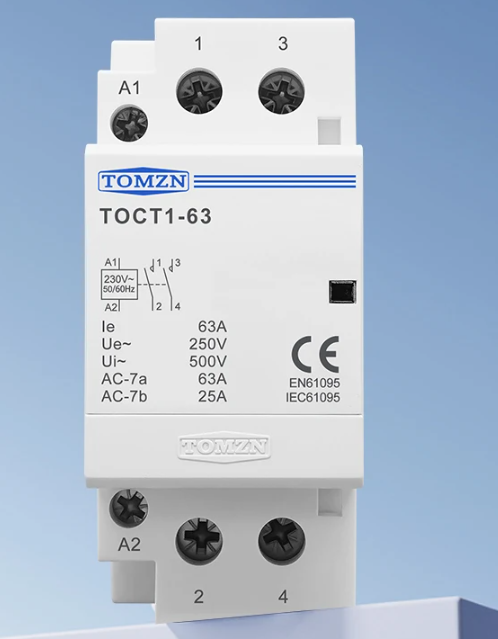
Understanding Contactors: Essential Components for Reliable Electrical Control
In the world of electrical engineering, contactors play a pivotal role in managing power distribution and automation. Whether you're a homeowner looking to upgrade your electrical setup or an electrician seeking durable solutions, understanding contactors is key to ensuring safety, efficiency, and longevity in your systems. This guide dives into the fundamentals of contactors, their applications, and why TOMZN's modular contactors stand out as a top choice for household AC needs. Explore reliable Din Rail contactors and household AC modular contactors designed for seamless integration.
What is a Contactor?
A contactor is an electrically controlled switch used for switching an electrical power circuit on or off. Unlike a simple relay, which handles lower power loads, a contactor is built to manage high-current applications, making it indispensable in both residential and industrial settings. Think of it as the "muscle" behind your appliances—safely connecting and disconnecting high-voltage loads like motors, heaters, or lighting systems.
Contactors consist of three main parts:
- Contacts: The switching elements that carry the load current.
- Electromagnetic Coil: Energizes to create a magnetic field, pulling the contacts together.
- Arc Extinguisher: Suppresses electrical arcs during switching to prevent damage.
By using modular contactors, you gain flexibility in design, allowing easy installation on standard Din Rail mounts for organized panel setups.
How Do Contactors Work?
The operation of a contactor is straightforward yet ingenious. When a low-voltage signal energizes the coil, it generates a magnetic field that attracts an armature, closing the main contacts and completing the circuit. De-energizing the coil releases the armature, opening the contacts and interrupting the flow.
This process ensures remote control of heavy loads without manual intervention, reducing wear and enhancing safety. For AC contactors, the design accounts for alternating current's sinusoidal waveform, while DC contactors handle steady direct current for specialized applications like battery systems.
Key to their reliability is the ability to handle frequent switching—up to millions of cycles—without degradation, making them ideal for automated environments.
Types of Contactors: Finding the Right Fit
Contactors come in various types to suit diverse needs:
- Definite Purpose Contactors: Tailored for specific loads like HVAC or refrigeration.
- General Purpose Contactors: Versatile for broad applications, such as TOMZN's TOCT1 series.
- Reversing Contactors: Used in motor control for forward/reverse operations.
- Modular Contactors: Compact, rail-mountable designs perfect for space-constrained panels.
TOMZN specializes in 2-pole modular contactors (2P), offering configurations like 2NO (two normally open), 1NO 1NC (one normally open, one normally closed), or 2NC. Current ratings span from 16A to 100A, with coil voltages including AC/DC 24V, 110V, and 220V/230V at 50/60Hz. These household AC contactors are engineered for single-phase use, ensuring compact yet powerful performance.
Applications of Contactors in Household and Industrial Settings
Contactors are ubiquitous where reliable power switching is required:
- Home Automation: Controlling air conditioners, water heaters, and pool pumps.
- HVAC Systems: Managing compressors and fans for efficient climate control.
- Lighting and Appliances: Automating high-power fixtures in smart homes.
- Industrial Machinery: Though TOMZN focuses on household, their robust designs scale to light commercial uses like workshops or small offices.
In residential setups, a Din Rail household AC modular contactor like the TOCT1 simplifies wiring and maintenance, preventing overloads and extending equipment life. For instance, a 63A model can safely handle demanding loads while fitting neatly into distribution boards.
Why Choose TOMZN Contactors? Reliability Meets Innovation
When selecting a contactor supplier, TOMZN delivers value through quality engineering and affordability. Their TOCT1 series excels in:
- Versatile Configurations: Options for manual control switches, auxiliary contacts (e.g., O+F Auxiliary for added functionality), and DC coils (12V or 24V) for modern smart systems.
- High Current Capacity: From 16A for light duties to 100A for heavy appliances, all in a small footprint.
- Easy Installation: Din Rail compatibility speeds up setup, ideal for DIY or professional installs.
- Broad Voltage Support: AC/DC coils ensure compatibility with global standards.
TOMZN contactors prioritize safety with arc-resistant designs and durable materials, minimizing downtime and risks. Unlike generic options, these electrical contactors offer precise control for energy-efficient homes, helping reduce utility bills through optimized switching.
Key Features of the TOMZN TOCT1 Series
Discover the standout specs that make TOCT1 a go-to for modular contactor enthusiasts:
- Current Ratings: 16A, 20A, 25A, 63A, 100A.
- Pole Configuration: 2P with 2NO, 1NO 1NC, 2NC, or custom combos like 2NO 2NC.
- Coil Options: 220V/230V AC (50/60Hz), 110V, 24V AC/DC, 12V DC.
- Special Variants: Models with manual switches for on-site testing or emergency overrides.
- Compact Design: Single-phase focus for streamlined household panels.
Whether you're upgrading a 25A AC modular contactor for kitchen appliances or a 100A unit for whole-home systems, TOMZN ensures seamless performance.
Elevate Your Electrical Setup with TOMZN Contactors Today
Contactors aren't just switches—they're the foundation of safe, efficient power management. By choosing TOMZN's innovative Din Rail contactors, you invest in reliability that powers your life without interruption. Ready to explore? Visit our contactor product category to browse the full TOCT1 lineup and find the perfect match for your needs. For expert advice, contact our team and power up with confidence!