
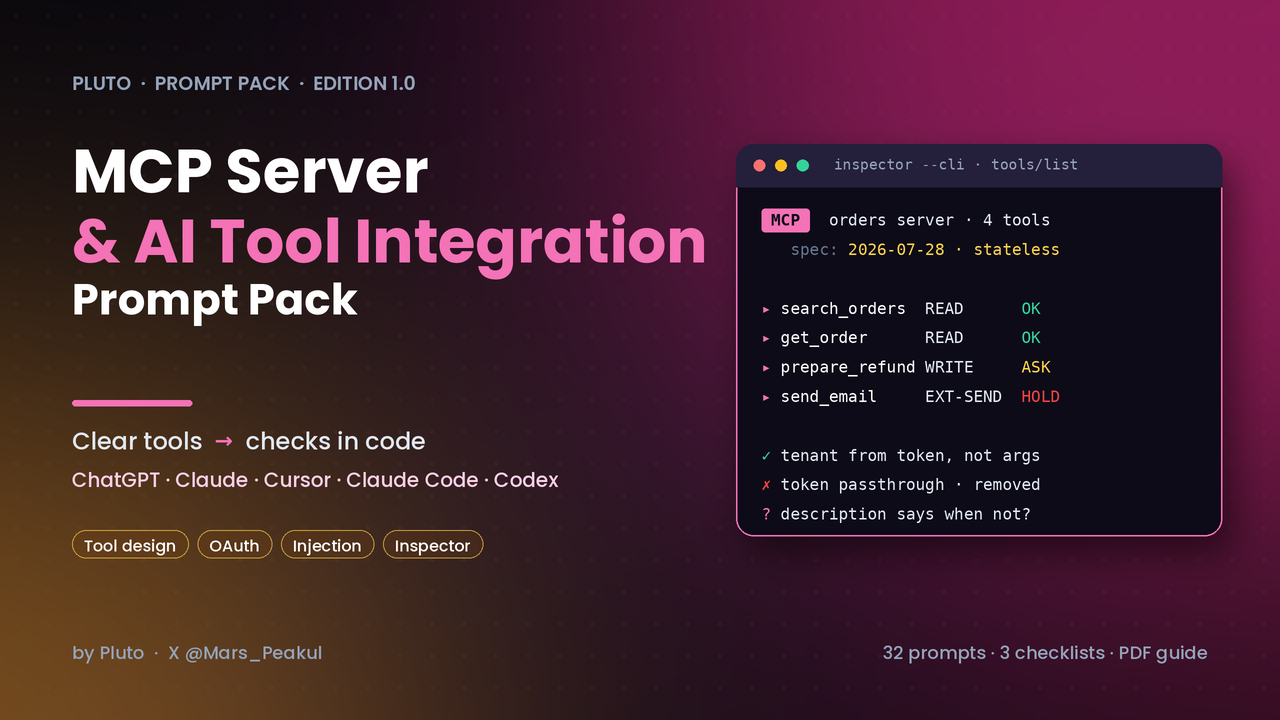
MCP Server & AI Tool Integration Prompt Pack
Ask an AI tool to "build an MCP server for our API" and you'll get one tool per endpoint, descriptions that say what but never when, the tenant ID as a tool argument — and protocol code from a spec revision that no longer exists.
Tool integrations have two audiences. Developers read the code; a model reads your tool names, descriptions, schemas and results on every request and decides what to do from them. Most failures live in that second contract: the agent picks the wrong tool, loops on an error it can't understand, returns half the database, or follows an instruction hidden in a support ticket and sends private data somewhere it shouldn't.
MCP Server & AI Tool Integration Prompt Pack gives you 32 ready-to-paste prompts for ChatGPT, Claude, Cursor, Claude Code and Codex that make the model work from your tool definitions, your handler code and the spec pages you paste, refuse to invent SDK APIs or protocol fields (anything unverified is marked VERIFY against your target revision), keep authorization in server code rather than in descriptions, treat tool results and third-party descriptions as untrusted data, label every side effect READ / WRITE / DESTRUCTIVE / EXTERNAL-SEND, and hand you reviewable output: tool surface tables, JSON Schemas, error tables, threat tables, scope designs, Inspector commands, contract tests, eval cases and release reviews.
What you get
- PDF guide (59 pages, A4): why AI tool integrations go wrong, the integration context block, "MCP in one page" (primitives, transports, what changed in 2026-07-28 — with sources), all 32 prompts with when-to-use notes, the named risks from the MCP security docs, an MCP Inspector quick reference, reusable patterns, combinations for common situations and a fictional worked example
- templates/: 32 plain-Markdown prompts + 3 checklists + README
The 32 prompts
- Foundations (01–04): integration context block · does MCP fit, and which primitives · minimal tool surface · spec revision & SDK compatibility plan
- Tool design (05–12): naming & namespacing · descriptions a model can use · input schemas · results & structured output · recoverable errors · large result sets · explicit state handles · annotations & confirmation points
- Security (13–19): threat model · OAuth scopes & audience-bound tokens · per-call authorization in code · prompt-injection & exfiltration defenses · third-party tool definition review · local (stdio) server hardening · secrets & personal data hygiene
- Reliability & operations (20–23): rate limits, quotas & timeouts · idempotent, previewable, reversible write tools · long-running work, progress & cancellation · audit log, metrics & traces
- Testing & evals (24–27): MCP Inspector smoke tests · contract tests · tool-use evals · adversarial test cases
- Host integration, review & shipping (28–32): host-side plan · server PR review · versioning & deprecation · README & tool reference · release-readiness review
Also included: Tool definition checklist, MCP security checklist, Ship checklist.
What's NOT included: MCP client configuration and agent rule files, LLM app/RAG prompts, plain REST/OpenAPI design, app-wide vulnerability review, CI pipeline YAML, production incident response, and any fabricated benchmarks, adoption numbers, testimonials or case studies.
Accuracy: Protocol facts were checked against spec revision 2026-07-28 and are tied to that revision; prompts mark protocol fields, SDK APIs and host behaviour VERIFY. The tool definition and worked example are labelled fictional. Independent; not affiliated with or endorsed by the MCP project, Anthropic or any vendor.
Price: $19
Author: Pluto · X @Mars_Peakul
Edition: 1.0 · October 2026