

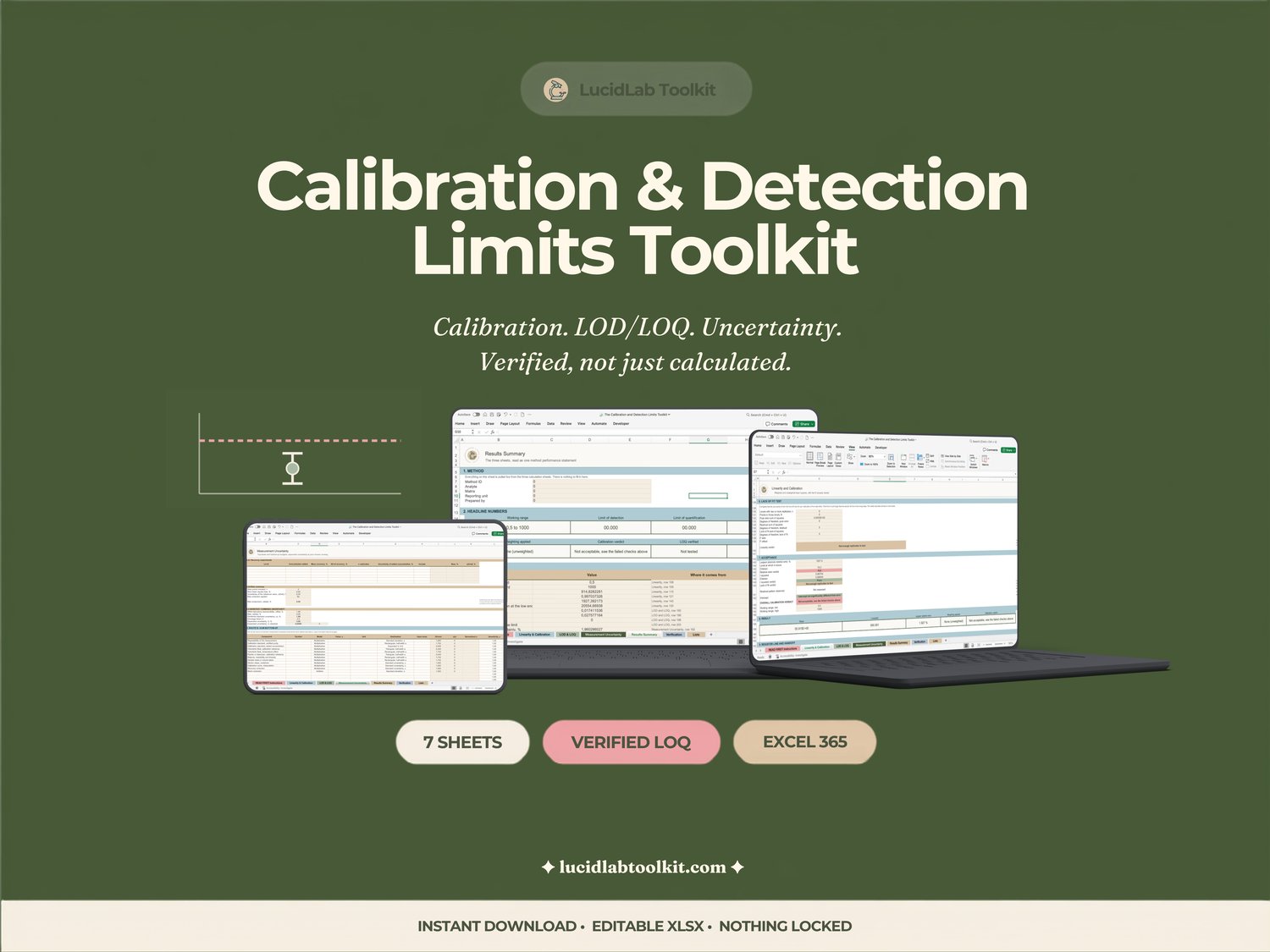
The Calibration & Detection Limits Toolkit
The Calibration & Detection Limits Toolkit | Excel & Google Sheets
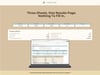
Three connected calculation engines for method validation, built to be verified, not just trusted.
You have rebuilt the same uncertainty budget from scratch for the fourth method this quarter, and somewhere around the third one, you stopped fully trusting the number you handed to the assessor.
I built this workbook so I would stop doing that.
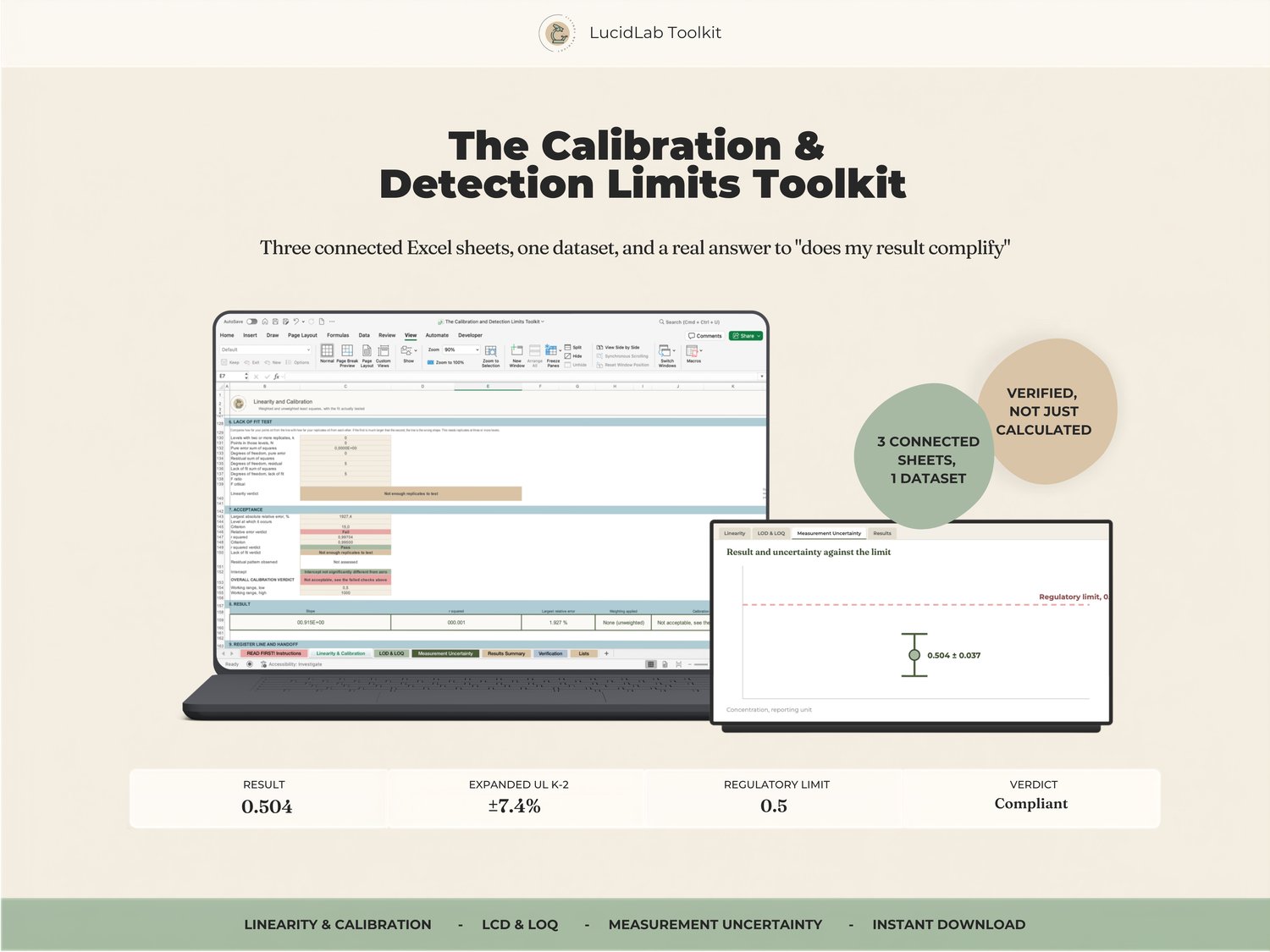
This is not a single formula pasted into a blank sheet. It is three connected calculation sheets, reading from one dataset instead of three, covering the actual arc of a validation: is the calibration good, what can the method actually detect and quantify, and how much uncertainty sits around the result. Every free calculator online gives you one number and no way to check it. This one is built around checking it.
⚗️ THE ONE THING THAT MAKES THIS DIFFERENT
Most templates stop at the formula. LOQ = 10 s / b, a number appears, and that's the product.
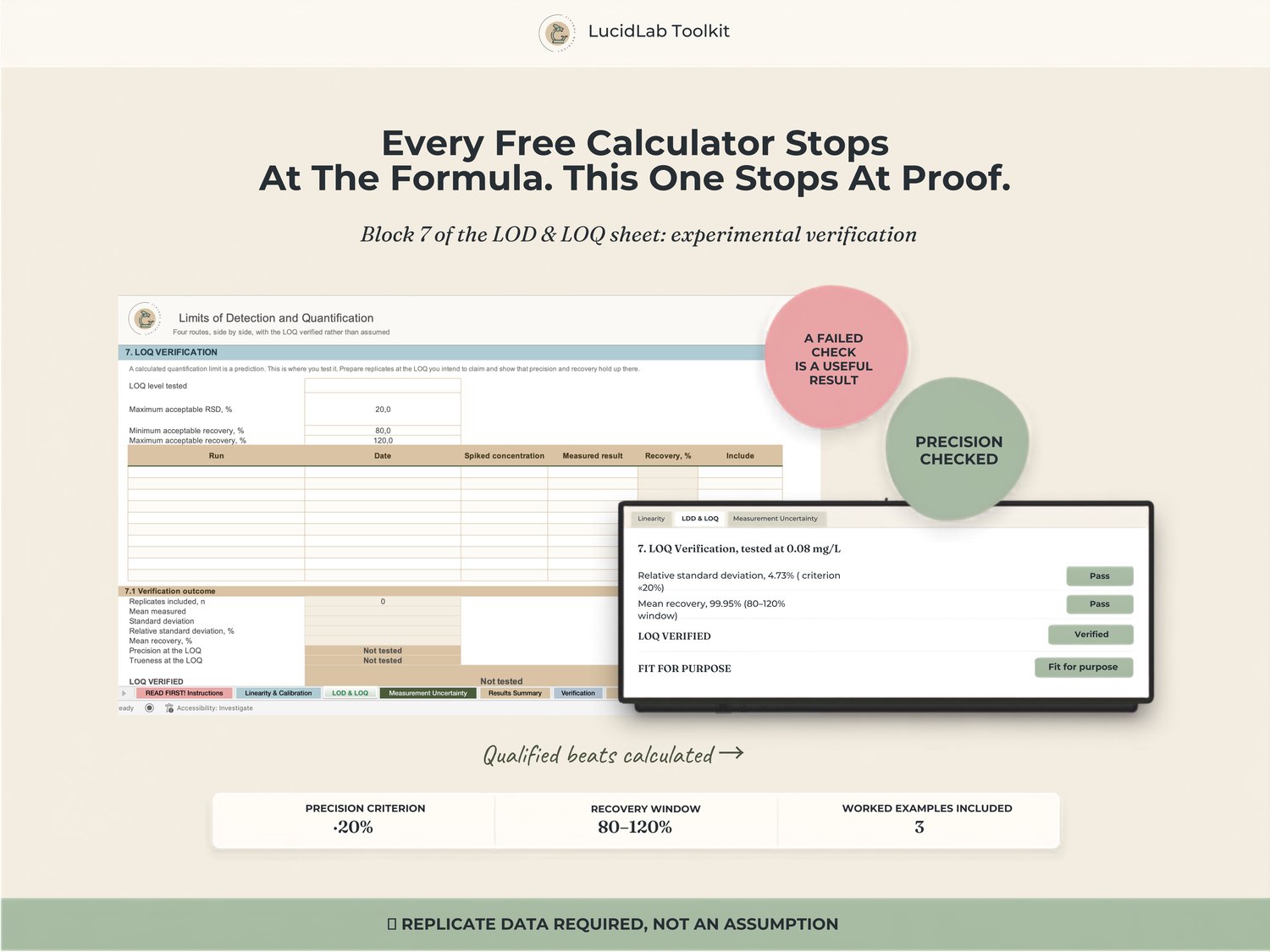
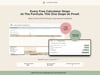
This workbook does not let you stop there. Once your limit of quantification is calculated, a dedicated verification step asks you to confirm it against real replicate data, precision and trueness, at the level you are claiming it. A calculated LOQ is a hypothesis. A verified one is something you can defend to an assessor.
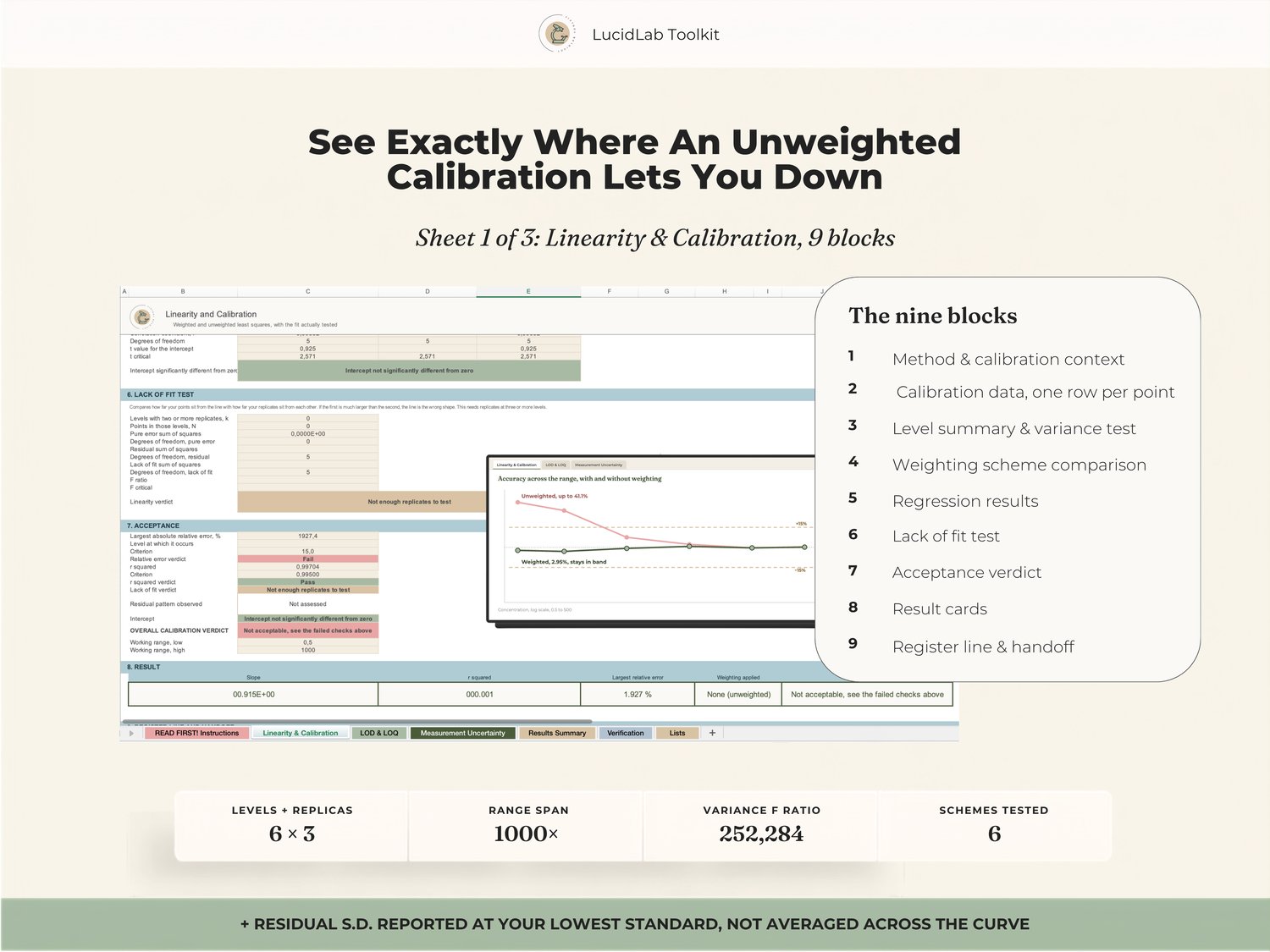
The same logic runs through the calibration sheet. If your calibration spans a wide concentration range, an unweighted fit quietly inflates your detection limit at the low end, because the top standard drags the whole line. This workbook tests whether your data actually needs weighting, compares multiple weighting schemes against your own numbers, and shows you the difference side by side, instead of assuming an answer.
📊 WHAT'S INSIDE, SHEET BY SHEET
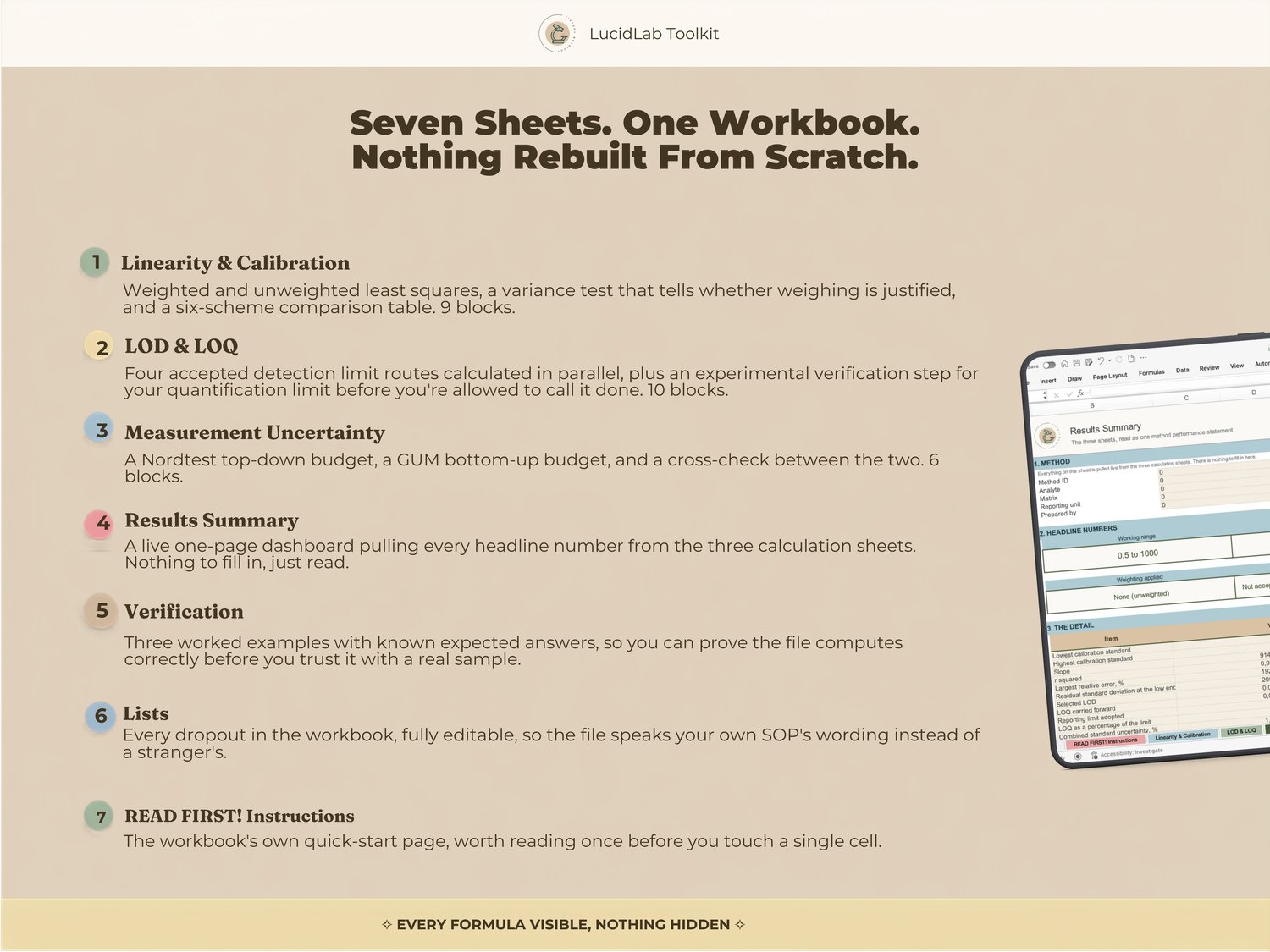
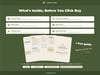
1. Linearity & Calibration Fits your calibration curve, weighted or unweighted, and tells you honestly whether the fit holds. Tests whether your data needs weighting rather than assuming it, compares weighting schemes on your own numbers, and reports the residual standard deviation at the low end of your range, which is the figure your detection limit actually depends on.
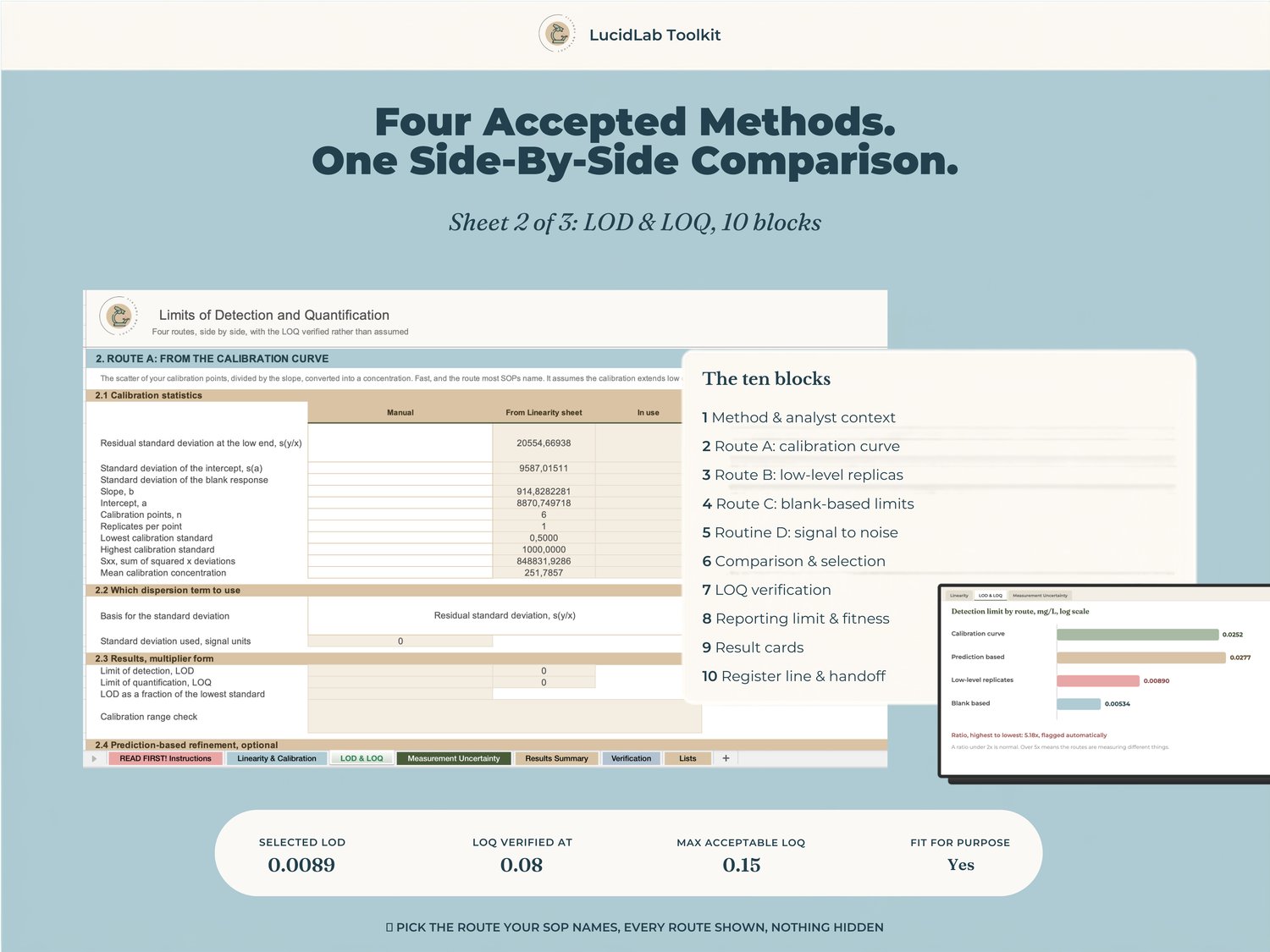
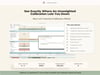
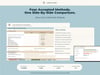
2. LOD & LOQ Calculates your limit of detection and limit of quantification by up to four accepted routes side by side, on a log scale so you can see where they disagree. Flags it plainly if your detection limit falls below the lowest standard you actually measured, the most common quiet flaw in a calibration-derived limit. Then verifies your chosen LOQ against real replicate data before it lets you call it done.
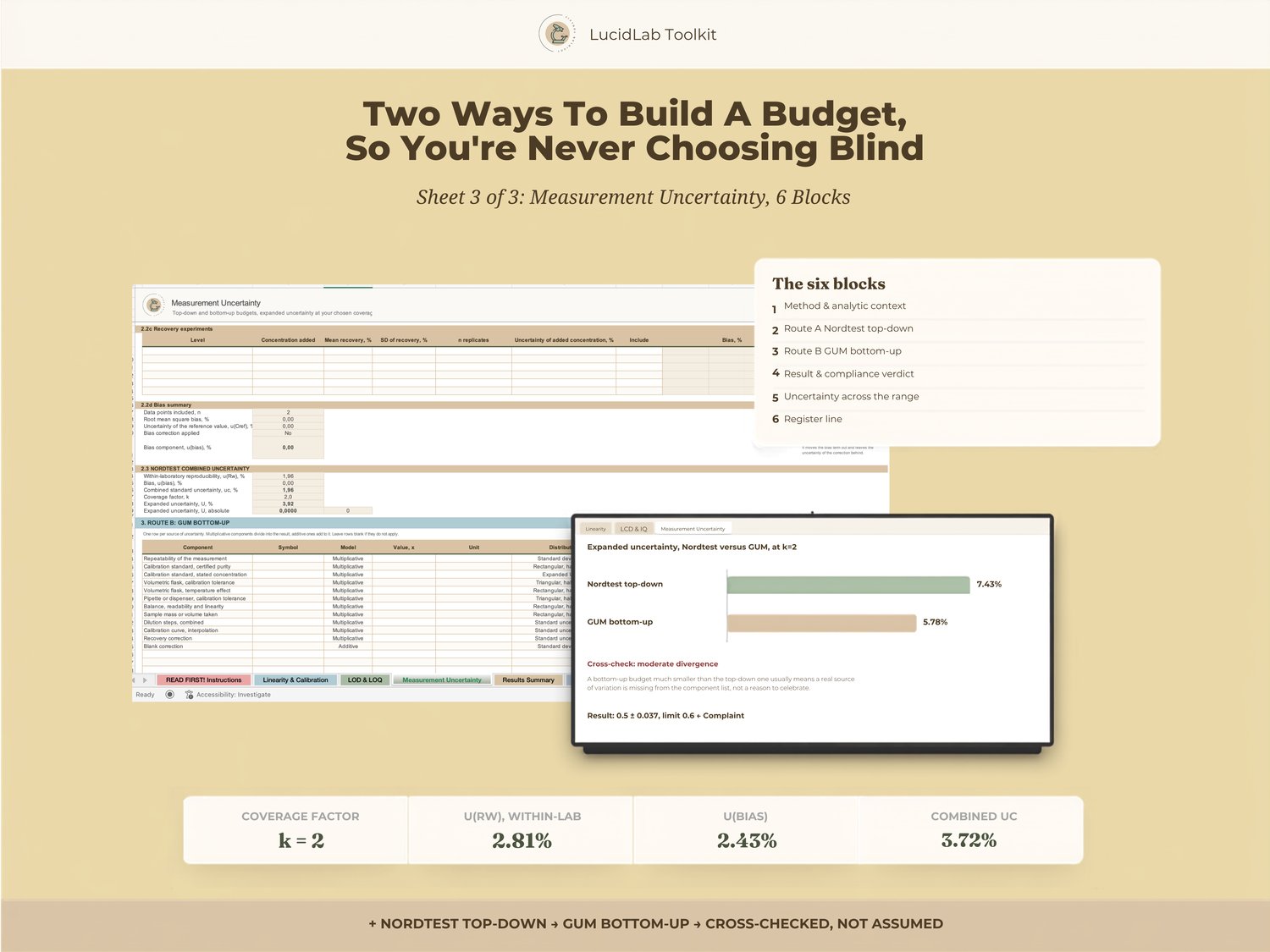
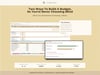
3. Measurement Uncertainty Two internationally accepted routes to an uncertainty budget: Nordtest top-down, built from your existing control chart and proficiency testing data, and GUM bottom-up, component by component. Run either, or both compared against each other. Reports combined and expanded uncertainty, a compliance call against your regulatory limit, and how uncertainty behaves across your working range rather than as one flat percentage.
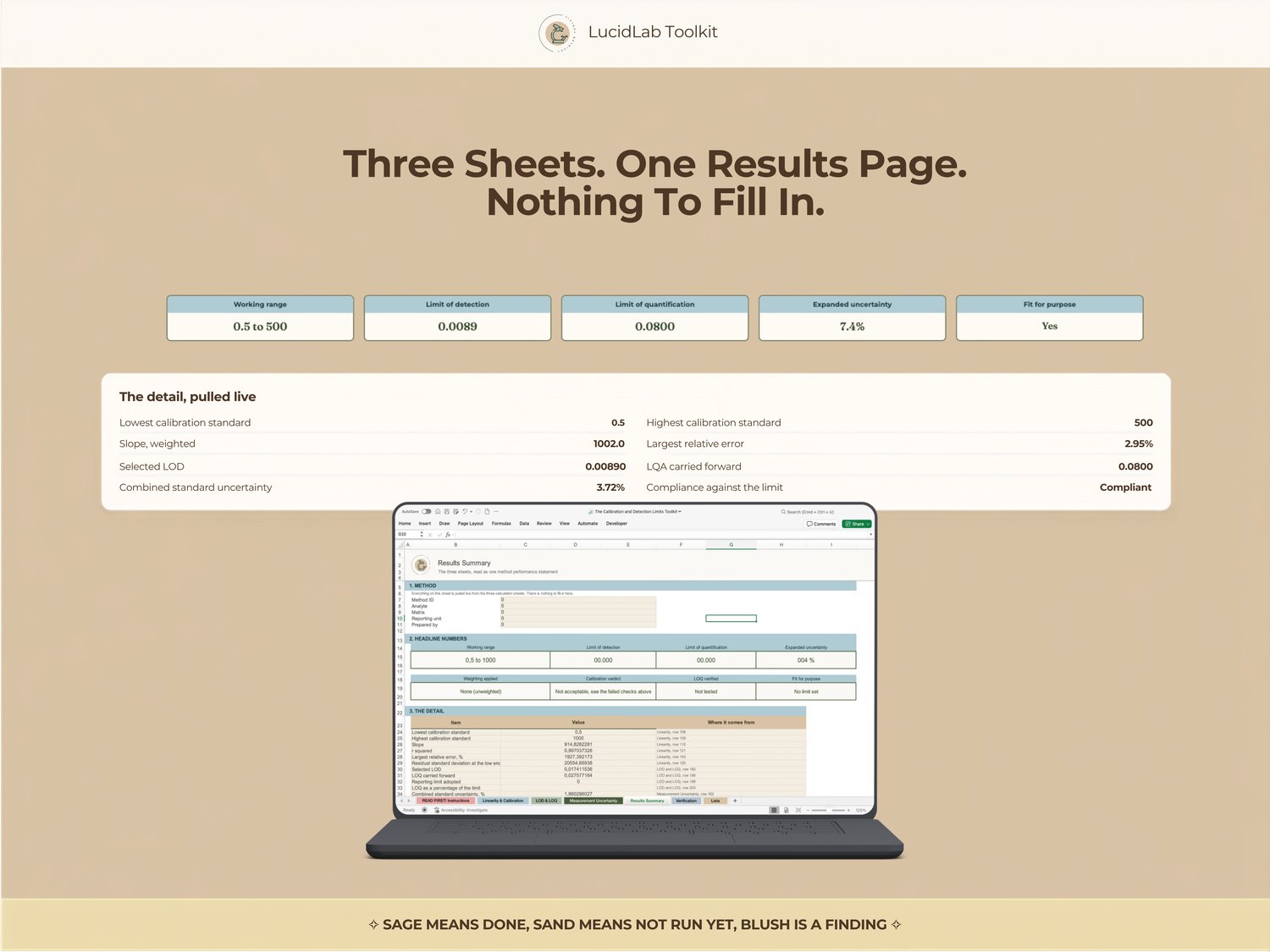
4. Results Summary A one-page dashboard pulling the headline numbers from all three calculation sheets. Nothing to fill in, just read.
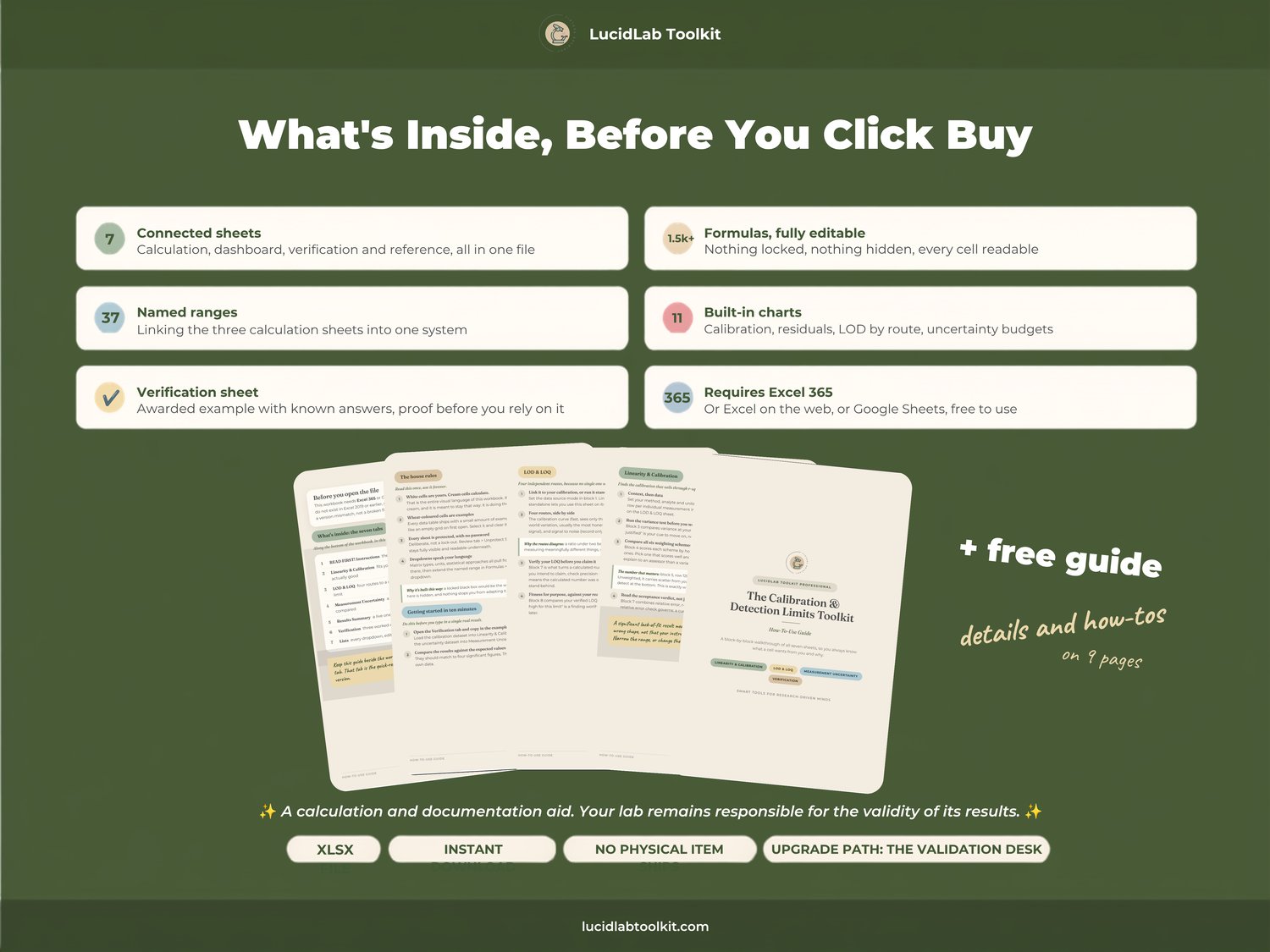
5. Verification sheet with worked example A synthetic dataset with known expected outputs, so you can confirm the workbook calculates correctly before you trust it with real data. Copy it in, check the numbers match, clear it, start your own validation.
6. Reference lists Every dropdown in the workbook, editable, in one place.
✅ FORMAT & REQUIREMENTS
Works in Excel 365 (desktop or web) and in Google Sheets. It uses newer functions your validation deserves and older Excel versions don't have, so Excel 2019 and earlier will show errors. If you're not sure which you have, Google Sheets opens it correctly with no changes needed.
- 7 connected sheets, one dataset feeding all three calculations
- Instant download, yours to keep
- Free updates, forever
🔬 WHO THIS IS FOR
Laboratory analysts and QA staff validating methods under ISO/IEC 17025 · Water, food, feed and environmental testing labs · Anyone who has to defend a detection limit or an uncertainty figure to an assessor · Labs currently rebuilding these calculations from scratch for every new method
📋 SCOPE, STATED PLAINLY
This is a calculation and documentation aid. It computes correctly and forces you to verify rather than skip that step. It does not confer or guarantee ISO/IEC 17025 compliance or accreditation, and your laboratory remains responsible for confirming that the approaches used match your own documented procedures and for the validity of your results. Anyone who has actually validated a method knows nobody can promise otherwise, and I'd rather say so plainly than oversell it.
↗️ IF YOU NEED MORE
This toolkit is the entry point to the full Validation Desk system, which adds precision and trueness tracking, control charts, and a cross-method validation register. Message me if you want to know more.
⚡ INSTANT DOWNLOAD
Files available the moment payment clears. For personal and organisational use within your laboratory; no resale or redistribution.
Questions before or after you buy? Message me, I answer every one.
Built by a researcher, for researchers.