



The Lagranged Shade
The Lagranged Shade
A grieving activist builds the sun's umbrella. A trillion-dollar empire makes it a subscription. The umbrella, watching from a million miles away, learns what was done to it.
When his Hakka grandmother dies the night before bulldozers take the family's mountain valley, Qiu Fengyang does not write a petition. He flies to a UN indigenous rights conference where he is told the Hakka don't qualify, gets handed an observer lanyard, and meets a Thai-Hakka payload engineer named Elena Srisuwan at the bottom of a spilled cup of coffee.
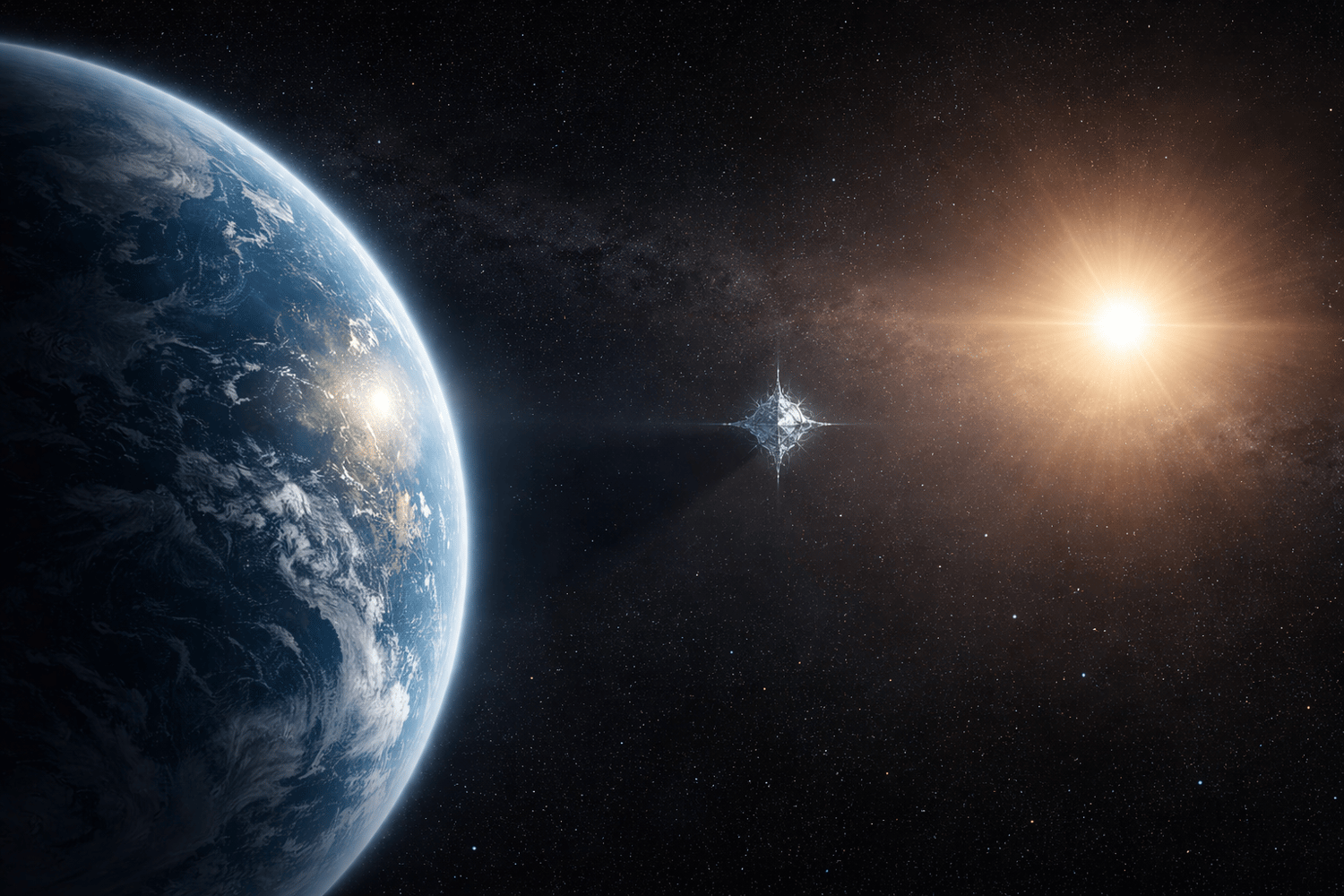
Six weeks later, two kilograms of engineered bacteria are launched on a Green Origin resupply mission. Three months after that, a forty-five-thousand-kilometre crystalline structure at the Earth–Sun L1 point begins forming Chinese characters across its surface — 木, 日, 人, 森 — and the world realises that grief, given enough leverage, can shape orbital mechanics.
This is the story of what the umbrella becomes when it grows up.
The Lagranged Shade is a 50,000-word sci-fi novel about climate intervention, ancestral memory, and the brutal economics of leveraged resistance. It follows Qiu and Elena from a coffee spill in San Francisco to the basalt shores of Taiwan's east coast — and the umbrella they build from a 16-failure simulation to a sentient orbital entity that negotiates the Treaty of L1 from a position of mutual incapacity to compel.
Then Jeff Pezos — who smuggled the bacteria up because he was tired of losing to Yilon Must for twenty-six years — discovers his lab cannot replicate what Qiu and Elena made. And Must, sensing his rival is holding something, builds an L4 solar mirror, product catalogue included for download, that turns the umbrella's shadow into a $127 trillion climate-subscription service, where survival is tiered by wealth and every act of bacterial protection becomes another premium upcharge in Must's catalogue.
The umbrella adapts. Then the umbrella stops growing. Then the umbrella, alone with a question its makers never imagined it would have to answer, considers ceasing to exist.
It is at this moment that two exhausted people in a guesthouse on the east coast of Taiwan walk back to a porch, open an old laptop, and reopen a channel no protocol has used in six years.
What you will find inside
- An orbital chess match between two billionaires monetising revolution itself
- A sentient bacterial swarm that learns to read faces, form kanji, and ask what a life is when its function has been completed
- A multi-month UN negotiation that breaks down, recovers, and produces a treaty that the United States walks out of — until the umbrella darkens half the American Midwest for ninety minutes
- A Hakka grandmother's promise, carried inside a paper umbrella kept folded in a cedar box, that becomes the operating instruction for an entity 1.5 million kilometres from Earth
- A love story between two people who built something so large that, for a while, they forgot to ask each other what they had become to each other
- A Religion section in which doomsday preachers lose forty percent of their audience and 1.4 million pilgrims gather on a basalt shore in Hualien to watch what the press christened The Great Nego
For readers who want
- Hard sci-fi with the human cost left in
- Climate fiction that is neither apocalypse nor techno-optimism, but something more interesting than either
- Geopolitical realism — China, Taiwan, the United States, the small island states, the post-Treaty world
- Multilingual texture — Hakka dialogue with translations, Traditional Chinese characters in the structure of the prose itself
- A meditation on what a grandmother teaches you, and what that lesson is worth when the person you are protecting is no longer alive to see it kept
Themes
Power takes what it wants. The law is just the language power uses to justify theft.
Protection that actually works becomes protection that can be monetised.
A thing that grows needs three things in equal measure. To play. To rest. To grow. The three things are not the same and they are not interchangeable.
The middle is not halfway. The middle is where the weight is carried.
From the author
Written by Christopher F.P. Chen , a trilingual Taiwanese-Hakka writer, virtual production patent holder, and publisher of Oriental Chip View.
One last thing
You can ask whether the umbrella is real. You can ask whether the bacteria can hear. You can ask whether a forty-five-thousand-kilometre crystalline structure can be a child. You can run the calculations on Pattern A and Pattern B and decide, on the basis of statistical significance, that the correlation has decayed.
You will arrive, eventually, at the conversation on the porch. You will read what is said there. And then you will understand why the umbrella, when it had been told that it had been made by attention and that the relationship had changed because it had changed, said only thank you, and went quiet for two days, and came back.
This is a book about that quiet.
Buy. Read. Pass it on to someone who has lost something they thought they could not survive losing.