
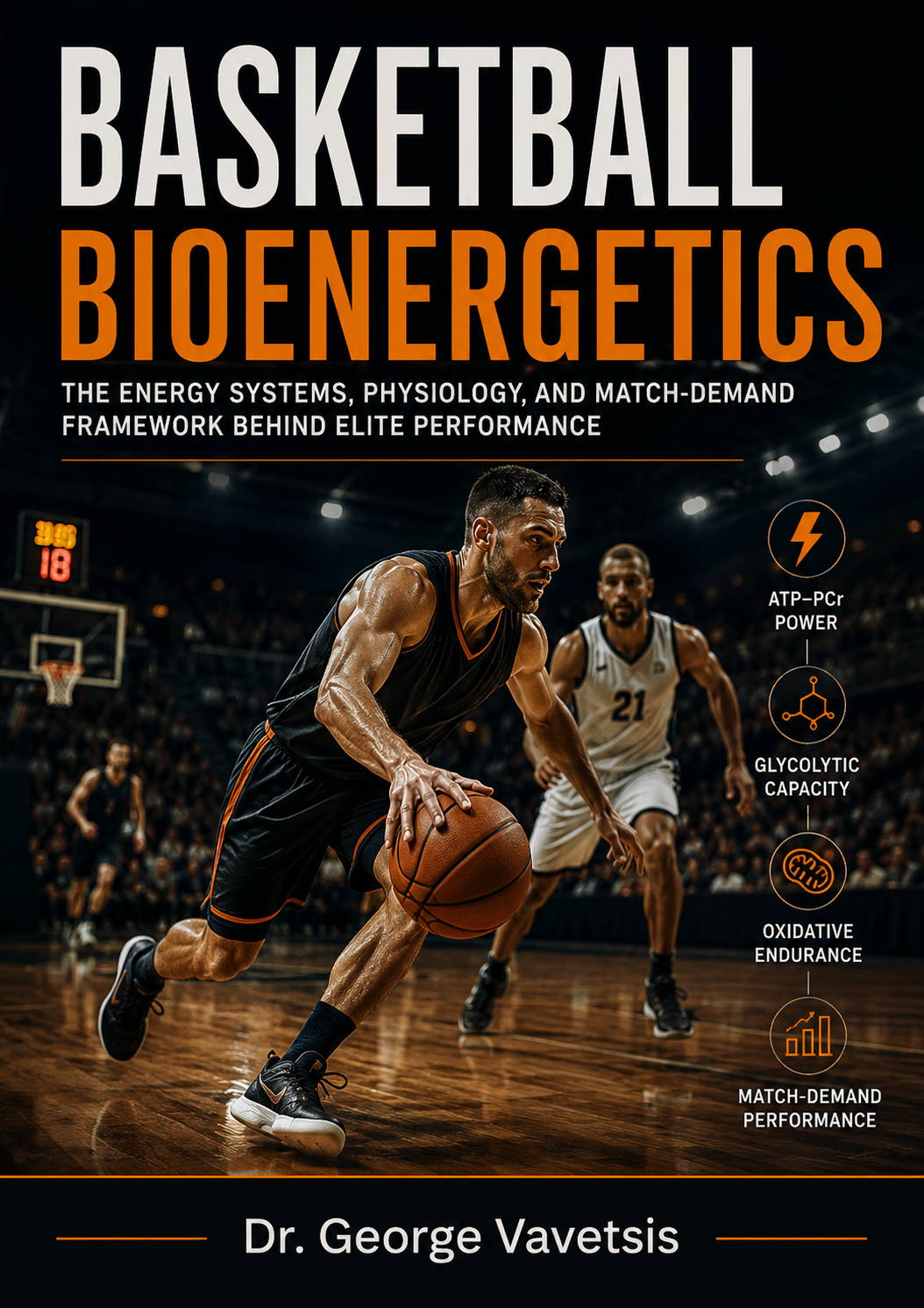
Basketball Bioenergetics
Pages: 462
Basketball is no longer governed exclusively by tactical intelligence, technical execution, or anthropometric superiority. Modern elite basketball has evolved into a bioenergetic contest in which the capacity to repeatedly produce, recover, and sustain high-intensity mechanical outputs determines competitive success. The contemporary game is increasingly defined by acceleration density, neuromuscular repeatability, metabolic resilience, and recovery efficiency under conditions of escalating tactical pace. Consequently, understanding basketball through the lens of bioenergetics is no longer optional for coaches, sports scientists, performance specialists, or practitioners operating at the professional level—it is foundational.
This book was developed to bridge the gap between classical exercise physiology and the unique metabolic architecture of elite basketball competition. Traditional physiological models frequently classify basketball as an intermittent sport requiring contributions from all three energy systems. While technically accurate, such generalized descriptions fail to capture the extraordinarily complex interplay between ATP–PCr turnover, glycolytic overload, oxidative restoration, acceleration–deceleration energetics, neuromuscular fatigue kinetics, and tactical tempo architecture that characterizes elite-level basketball. The sport possesses a distinct metabolic fingerprint, and this text aims to define it with scientific precision.
Basketball competition is physiologically chaotic. Every possession creates fluctuating energetic demands involving explosive first-step separation mechanics, repeated braking and re-acceleration sequences, multidirectional sprint clusters, reactive jumping density, collision-based eccentric loading, and brief recovery windows that challenge metabolic restoration capacity. These actions occur not in isolation but within constantly shifting tactical ecosystems influenced by game pace, positional role, transition frequency, spacing dynamics, and coaching philosophy. As a result, basketball bioenergetics must be understood as an integrated systems model rather than as isolated energy pathways operating independently.
The ATP–PCr system forms the neurological and mechanical foundation of basketball explosiveness. Fast-break acceleration, penetration separation, closeout reactions, rebound elevation, and rapid transition responses all rely heavily upon phosphocreatine hydrolysis and rapid ATP turnover. However, the true determinant of elite performance is not merely maximal power production—it is the ability to reproduce explosive outputs repeatedly under incomplete recovery conditions. This distinction transforms basketball from a purely alactic sport into a metabolically hybrid environment requiring highly advanced energetic management.
As transition density increases, glycolytic contribution becomes progressively more dominant. High-tempo basketball systems characterized by continuous pressing, repeated penetration sequences, aggressive defensive rotations, and sustained transition play generate substantial anaerobic glycolytic stress. Elevated lactate accumulation, hydrogen ion buffering requirements, and metabolic acidosis become defining constraints to technical efficiency and tactical decision-making. In these conditions, physiological fatigue is no longer simply a peripheral muscular phenomenon; it becomes a tactical variable capable of altering spacing integrity, reaction speed, shot selection, defensive timing, and cognitive processing.
Yet basketball performance cannot be understood solely through fatigue production. Equally important is the physiology of recovery. The oxidative system plays a critical role in ATP restoration between possessions, parasympathetic reactivation during tactical pauses, and recovery between explosive sequences. Elite players are not merely those who can produce force—they are those who can restore force-production capacity rapidly enough to sustain tactical efficiency across the entire competitive exposure. Recovery physiology therefore becomes inseparable from performance physiology.
This book also explores one of the most overlooked dimensions of basketball science: the energetic cost of acceleration–deceleration mechanics. Modern basketball contains an enormous density of braking actions, eccentric loading exposures, directional changes, and reactive re-accelerations. These sequences create substantial metabolic and neuromuscular stress that is often underestimated when evaluating external load alone. The biochemical and mechanical consequences of repeated deceleration density profoundly influence fatigue accumulation, tissue stress, reactive strength integrity, and movement efficiency. Understanding these processes is essential for designing scientifically sound conditioning systems and managing athlete readiness throughout congested competition schedules.
Additionally, the text emphasizes positional bioenergetics. Guards, wings, hybrid forwards, and interior players each possess unique energetic signatures based on their tactical responsibilities. Penetration-oriented guards demonstrate heavy glycolytic reliance due to repeated accelerative attacks and braking actions. Wings experience significant mixed-system demands due to transition locomotion and repeated jump exposures. Hybrid forwards require metabolic versatility capable of supporting both perimeter and interior responsibilities, while centers incur substantial ATP expenditure through rebounding density, positional collisions, and repeated vertical efforts. Effective conditioning therefore cannot rely upon generalized team models; it must reflect position-specific metabolic architecture.
Another major purpose of this book is to connect physiology directly to practical conditioning design. Too often, energy-system discussions remain theoretical and disconnected from the realities of basketball training environments. This text instead integrates physiological principles with applied conditioning strategies, including sprint-cluster programming, alactic work-to-rest prescription, glycolytic overload systems, oxidative recovery training, jump-density management, acceleration–deceleration conditioning, and tactical-tempo periodization. The objective is not merely to explain basketball bioenergetics, but to operationalize it.
Importantly, the future of basketball conditioning lies in integration rather than separation. The distinction between tactical coaching and physiological preparation is rapidly disappearing. Tactical tempo dictates metabolic demand. Spacing architecture influences acceleration frequency. Defensive systems alter glycolytic density. Bench rotations modify oxidative recovery opportunity. Consequently, conditioning must evolve beyond generic running protocols toward basketball-specific metabolic engineering that reflects the exact physiological realities of competition.
The scientific evolution of basketball demands a new language of performance preparation—one rooted in energetics, neurophysiology, biomechanics, and tactical physiology. This book attempts to contribute to that evolution. It is intended for strength and conditioning coaches, sports scientists, physiologists, performance analysts, rehabilitation specialists, basketball coaches, and advanced practitioners seeking a deeper understanding of the metabolic mechanisms underpinning elite basketball performance.
Ultimately, basketball is a sport of energy transformation. Every explosive movement, every recovery interval, every tactical transition, and every neuromuscular response is governed by bioenergetic processes operating beneath the visible surface of the game. To understand these mechanisms is to understand the true physiological engine of basketball itself.