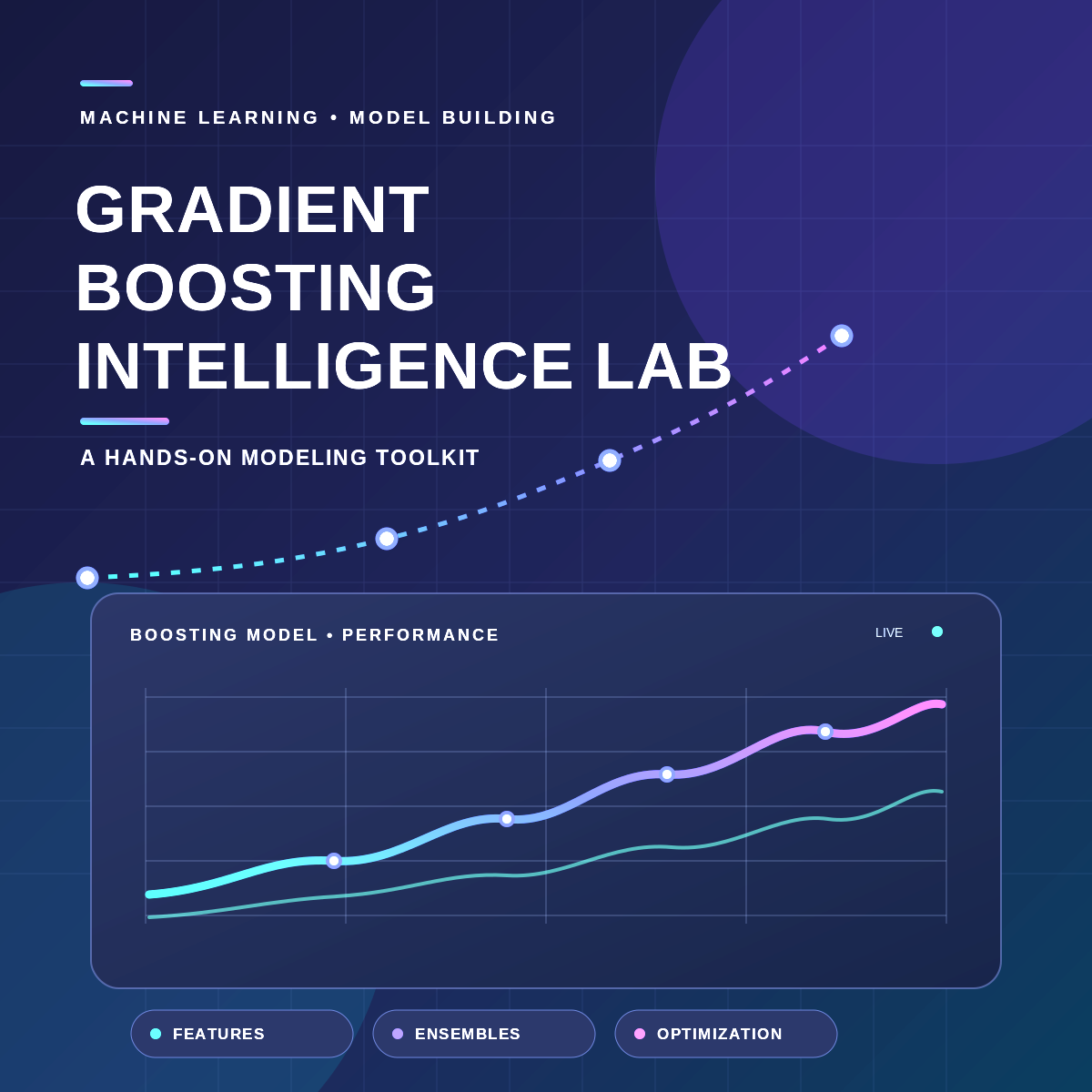
GRADIENT BOOSTING INTELLIGENCE LAB
GRADIENT BOOSTING INTELLIGENCE LAB
Master Hotel Demand Forecasting with Gradient Boosting
Understand the Algorithm. Test the Forecast. Communicate the Results.
What if you could explore how a machine-learning model learns from its mistakes, experiment with forecasting settings, and evaluate the results—all through a practical hotel-demand scenario?
The Gradient Boosting Intelligence Lab is an interactive, browser-based learning experience designed to help you understand one of the most powerful concepts in machine learning through the real-world context of hotel demand forecasting.
Learn how boosting works, experiment with model settings, compare prediction errors, and develop the skills to explain analytical results in clear business language.
No complicated installation. No need to begin with a production machine-learning system. Just a structured learning experience built around practical experimentation.
Learn the method. Test your assumptions. Understand your results.
GET INSTANT ACCESS — $12.99
Interactive course · Forecasting simulator · Practical workbook · Career resources
Go Beyond Machine-Learning Theory
Gradient Boosting is an ensemble learning technique that builds a sequence of models, with each new stage working to improve on the errors of the existing ensemble.
But understanding the definition is only the beginning.
The real learning happens when you explore how the algorithm behaves, change its settings, compare predictions, and determine whether a more complex model actually performs better.
Inside the Intelligence Lab, you will explore these concepts through hotel room-demand forecasting examples.
What You Will Learn
Understand How Gradient Boosting Works
Explore how successive trees contribute to an ensemble and how boosting uses information from earlier prediction errors to refine its forecasts.
Understand the Parameters That Matter
Experiment with learning rate, the number of boosting stages, and tree depth to understand how these settings affect model behavior.
Evaluate Forecast Accuracy
Learn how to interpret Mean Absolute Error (MAE), Root Mean Squared Error (RMSE), prediction bias, and performance relative to a baseline.
Recognize Overfitting and Data Leakage
Understand why validation matters, why chronological data splits can be important in forecasting, and how data leakage can produce misleadingly impressive results.
Translate Model Results into Business Insights
Practice explaining forecast performance, uncertainty, limitations, and potential operational implications to a hotel general manager.
Your Complete Gradient Boosting Learning Toolkit
The Intelligence Lab combines interactive instruction with practical resources to support your learning from the first lesson through your final presentation.
01. Interactive Browser-Based Course
Explore structured lessons at your own pace. Build your understanding of boosting through guided explanations, quizzes, and progress tracking.
02. Gradient Boosting Simulator
Experiment with the mechanics of boosting through synthetic hotel-demand examples. Explore how model settings influence the forecasting process and learn to question the results rather than simply accepting them.
03. Interactive Forecasting and Tuning Workbook
Practice your learning with a structured workbook featuring:
- A forecast calculator.
- A booking-pace calendar.
- An error-scoring tool.
- An experiment log for recording and comparing results.
Use these tools to organize your experiments and build a more systematic approach to evaluating forecasts.
04. Printable Gradient Boosting Cheat Sheets
Keep key concepts, parameter explanations, and model-evaluation reminders accessible as you study and practice.
05. General Manager Presentation Kit
Learn to communicate analytical findings using editable presentation slides and speaker notes designed around hotel management discussions.
06. Interview and Career Preparation Pack
Strengthen your preparation with practice questions, résumé prompts, and a portfolio checklist to help you demonstrate your learning.
07. A Practical 30-Day Learning Plan
Follow a structured plan to develop, test, and present a forecasting exercise, helping you turn individual lessons into a more complete learning project.
Learn Through Hotel Demand Forecasting
Why learn a machine-learning algorithm using abstract examples when you can explore it in a hospitality context?
Hotel demand forecasting provides a useful setting for understanding how analytical predictions connect to business questions.
Through the learning exercises, explore how you might:
- Examine historical demand patterns.
- Compare forecast predictions with observed outcomes.
- Experiment with model complexity and learning settings.
- Assess whether an apparent improvement is supported by validation results.
- Communicate forecast limitations and uncertainty.
- Explain the potential relevance of forecasting insights to hotel operations.
The examples use synthetic educational data. They are designed to teach the forecasting workflow, not to represent actual hotel performance or guarantee better business outcomes.
A More Structured Way to Learn Model Evaluation
A forecasting model is not automatically useful simply because it produces a prediction.
You need to understand how it performs, how it compares with a reasonable baseline, and whether the evaluation reflects the way the model would be used in practice.
The Intelligence Lab introduces several important concepts.
Mean Absolute Error (MAE)
Understand the average magnitude of prediction errors in the same units as the target variable.
Root Mean Squared Error (RMSE)
Explore an error measure that gives greater weight to larger prediction errors.
Prediction Bias
Examine whether predictions tend to systematically overestimate or underestimate the observed values.
Baseline Comparison
Assess whether a more sophisticated model provides a meaningful improvement over a simpler reference approach.
Validation and Leakage Checks
Learn why model evaluation must use appropriate data and why information unavailable at prediction time can invalidate a seemingly strong result.
These concepts help you develop a more critical and informed approach to forecasting.
Who Is This Intelligence Lab For?
Hotel Revenue Management Professionals
Build a stronger understanding of machine-learning forecasting and learn to discuss model evaluation with analytical confidence.
Hospitality Operations Managers
Explore how demand forecasts are developed, evaluated, and communicated, and understand the limitations of model-based predictions.
Aspiring Data Analysts
Develop a practical introduction to Gradient Boosting through guided exercises and structured forecasting experiments.
Hospitality Students and Graduates
Connect machine-learning concepts with a hospitality-focused example that can support further study and portfolio development.
Data Science and Machine-Learning Learners
Explore an applied forecasting scenario that helps reinforce ensemble learning, parameter tuning, and model validation concepts.
You do not need a production forecasting system to begin learning. However, basic familiarity with data and spreadsheets will be helpful.
From Your First Lesson to Your Final Presentation
The learning experience follows a practical progression.
Step 1 — Understand the Fundamentals
Learn the principles behind Gradient Boosting and how sequential model improvement works.
Step 2 — Experiment with Model Settings
Explore learning rate, tree depth, and boosting stages in the simulator.
Step 3 — Compare Forecasting Experiments
Use the workbook to record experiments, evaluate errors, and compare model performance with a baseline.
Step 4 — Evaluate Results Critically
Explore validation, chronological data splitting, overfitting, and data leakage.
Step 5 — Communicate Your Findings
Use the general-manager presentation kit to practice explaining the results, their limitations, and their potential business relevance.
By following this process, you can develop a more complete understanding of the forecasting workflow instead of focusing only on the algorithm itself.
What Makes This Learning Experience Valuable?
Interactive learning
Explore concepts and experiment with settings rather than relying exclusively on passive instruction.
A hospitality-focused scenario
Learn through hotel-demand forecasting examples that connect machine learning with a recognizable business context.
Practical model evaluation
Develop familiarity with error metrics, baseline comparisons, and validation principles.
Business communication practice
Learn to explain technical findings in language that nontechnical decision-makers can understand.
A collection of supporting resources
Use the lessons, simulator, workbook, cheat sheets, presentation materials, and career-preparation resources together as a structured learning toolkit.
The emphasis is on understanding, experimentation, and responsible interpretation—not on promising perfect forecasts.
What You Receive
Your purchase includes:
- An interactive Gradient Boosting course.
- A browser-based boosting simulator.
- Interactive quizzes and learning progress tracking.
- A printable boosting cheat-sheet pack.
- A forecasting and tuning workbook.
- A forecast calculator and booking-pace calendar.
- An error scorer and experiment log.
- A practical 30-day learning plan.
- An editable general-manager presentation kit with speaker notes.
- An interview and job-preparation pack.
Product format: Digital educational product
Access: Browser-based course and downloadable resources
Price: $12.99
No software installation is required for the browser-based course. A compatible spreadsheet application may be needed to use the workbook.
Frequently Asked Questions
Do I need programming experience?
The lab is designed to introduce Gradient Boosting through guided lessons and interactive experiments. Basic familiarity with data and spreadsheets can help, but the browser-based learning experience does not require you to install a programming environment.
Does the product include a production-ready forecasting model?
No. It is an educational learning toolkit. The simulator uses synthetic data and does not provide a trained production model or a hotel booking system.
Can I use the simulator to forecast my hotel's actual occupancy?
The simulator is intended for educational experimentation. Forecasts for operational use require appropriate real-world data, a properly developed and validated model, and professional review.
What is the difference between Gradient Boosting and Random Forest?
Both are ensemble learning methods, but they build their predictions differently. Random Forest combines predictions from independently constructed trees, while Gradient Boosting builds a sequence of stages that progressively refine the ensemble. This lab focuses on understanding the boosting approach.
What are MAE and RMSE?
They are commonly used metrics for evaluating prediction errors. MAE measures average absolute error, while RMSE gives relatively greater influence to larger errors.
How do I access the materials?
Purchase the product through Payhip and use the platform's digital delivery process to access the course and included files.
Start Building Your Forecasting Skills Today
Machine learning becomes more valuable when you understand not only how a model works, but also how to evaluate its predictions and communicate its limitations.
The Gradient Boosting Intelligence Lab gives you a structured way to explore those skills through hotel-demand forecasting, interactive experimentation, and practical supporting resources.
Understand the algorithm. Experiment with the parameters. Evaluate the results. Present your findings with confidence.
GET THE GRADIENT BOOSTING INTELLIGENCE LAB
Only $12.99
Interactive learning. Practical forecasting exercises. Business-focused communication skills.
Educational Disclaimer
This product is intended for educational purposes only. Examples use synthetic data and do not guarantee forecasting accuracy or business results. The materials should not be used as the sole basis for real-world hotel pricing, staffing, inventory, or revenue decisions. Any operational forecasting approach should be validated using appropriate real-world data and professional judgment.