Your Cart
Loading

Executive Decision Defensibility Review

On Sale
€2500.00
€2,500.00
Added to cart

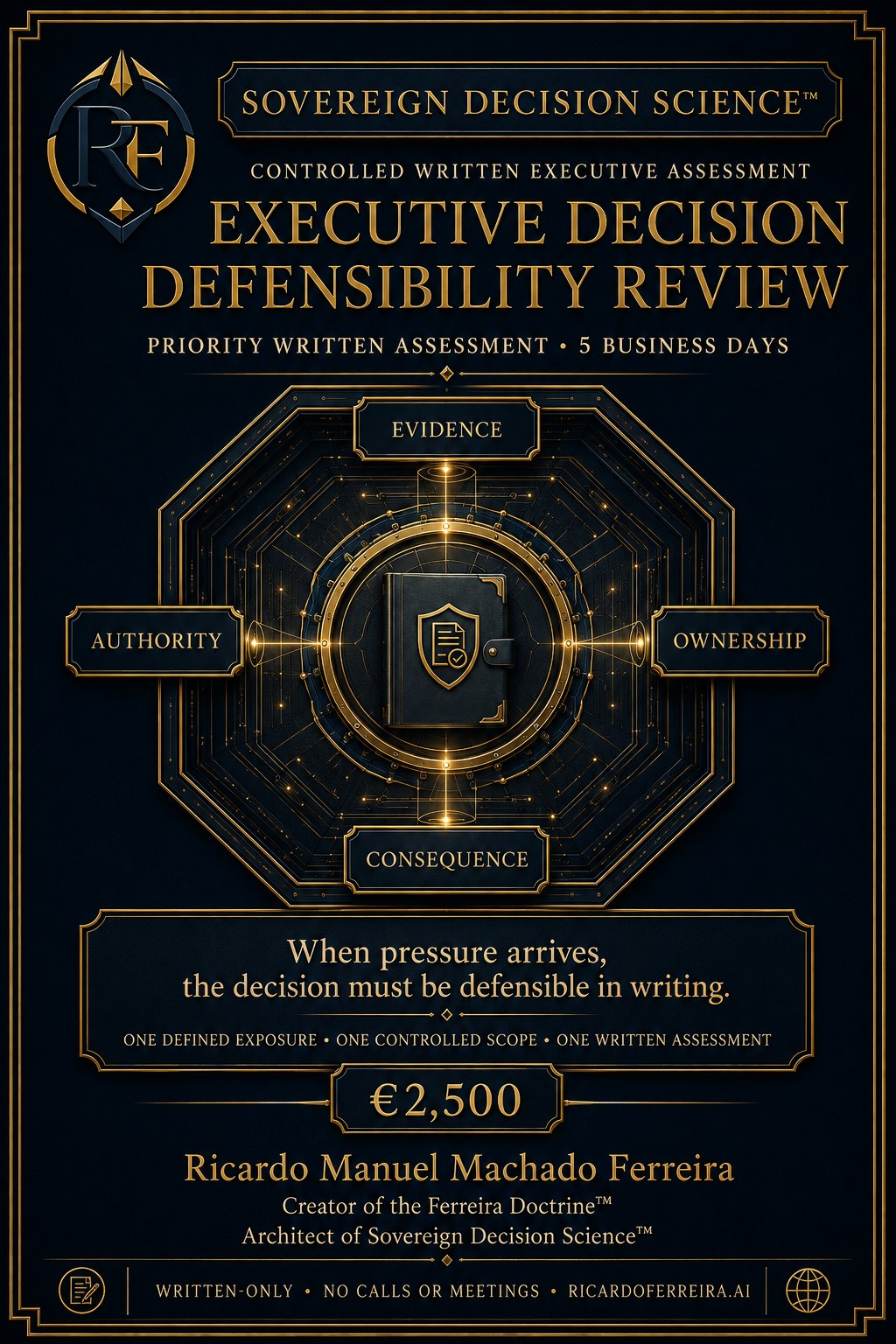
EXECUTIVE DECISION DEFENSIBILITY REVIEW

Priority Written Assessment - 5 Business Days

A controlled written executive assessment by Ricardo Manuel Machado Ferreira, Creator of the Ferreira Doctrine™ and Architect of Sovereign Decision Science™.

Price: €2,500

Delivery model: written-only. No calls, meetings, workshops or oral interviews.

Most organisations do not fail because they lack meetings, dashboards, approvals or written procedures.

They fail because, when pressure arrives, the integrated decision cannot be defended in writing.

The evidence is incomplete.

Ownership is distributed.

Authority is unclear.

The contract does not restore the required operational outcome.

The supplier exposure was understood by several functions but owned by none.

The decision record shows approval without explaining the judgement that produced it.

EXECUTIVE DECISION DEFENSIBILITY REVIEW is a documentary-first written assessment for organisations, leaders and decision-makers facing one defined procurement decision, supplier exposure, contract position, continuity-risk situation or governance concern.

This is not a general public-layer briefing.

It is a written assessment applying qualified executive judgement to one accepted, non-confidential exposure under a controlled scope.

THE GOVERNING QUESTION

Can this decision, supplier exposure, contract position or operational risk be defended when audit, pressure or consequence appears?

WRITTEN-ONLY DELIVERY MODEL

The entire service is conducted through written correspondence and written materials.

All scope clarification, intake, questions, assessment and delivery are handled in writing.

No telephone call, video meeting, live workshop, interview or oral presentation is included or required.

The five-business-day delivery period begins only after the scope has been accepted in writing and the agreed information has been received.

WHY THIS REVIEW MATTERS

A formally approved decision may still be difficult to defend.

The organisation may be able to identify:

→ who attended the meeting;

→ who signed the approval;

→ who prepared the business case;

→ who reviewed the contract;

→ who recorded the risk;

→ who implemented the outcome.

But it may still be unable to prove:

→ what evidence supported the integrated judgement;

→ which material assumptions remained unresolved;

→ who owned the decision after approval;

→ who had authority to stop, change, fund or escalate it;

→ what alternatives were available;

→ why the remaining exposure was accepted;

→ whether the decision can survive changing conditions;

→ whether the written record can be reconstructed without relying on private memory.

That gap matters.

A decision is not defensible because many people touched it. It is defensible when evidence, ownership, authority and consequence remain coherent in writing.

WHAT THE WRITTEN REVIEW MAY IDENTIFY

The assessment may identify:

→ decision fragility under changing assumptions or pressure;

→ missing, outdated or unattributable evidence;

→ evidence that does not support the exact decision being defended;

→ ownership ambiguity;

→ authority that does not match accountability;

→ supplier or sub-tier dependency;

→ contract or continuity weakness;

→ technology, ERP/MRP or digital-supplier exposure;

→ gaps between contractual remedies and operational restoration;

→ cross-functional exposure transferred to Finance, Legal, Operations, Risk or the Board;

→ governance and accountability weaknesses;

→ weaknesses in the written decision record;

→ executive defensibility risk;

→ priority written questions and proportionate next steps.

THE PUBLIC-FACING ASSESSMENT LENS

EVIDENCE

What written information supports the decision, how current is it and what material gaps remain?

OWNERSHIP

Who owns the integrated judgement now - not merely the action, meeting, contract, system or risk entry?

AUTHORITY

Can the recognised owner stop, change, fund, escalate or accept the consequence of the decision?

CONSEQUENCE

Which operational, financial, legal, supplier, continuity, institutional or executive effects could emerge if the decision fails?

These questions explain what leadership must be able to see.

They do not disclose or transfer protected evaluation, classification, calculation or implementation mechanisms.

WHAT THE BUYER RECEIVES

The buyer receives a written PDF assessment prepared for one accepted scope and based on the agreed non-confidential information made available for review.

Subject to the accepted scope and available information, the assessment may include:

SCOPE STATEMENT

The exact decision, supplier exposure, contract position or continuity-risk situation accepted for review.

INFORMATION BASIS

The non-confidential materials and stated facts relied upon, together with material limitations visible from the intake.

EXECUTIVE FINDING

A clear written position on the principal defensibility exposure identified within the accepted scope.

EVIDENCE POSITION

Material gaps, unresolved claims, missing records or assumptions that may weaken later defence.

OWNERSHIP AND AUTHORITY POSITION

Observed ambiguity concerning who owns the integrated decision and who can act under pressure.

EXPOSURE VIEW

Relevant supplier, contract, continuity, governance, technology or cross-functional consequence visible from the materials.

PRIORITY WRITTEN NEXT STEPS

Prioritised questions, clarifications or written actions that may improve the decision position without transferring implementation rights.

BOUNDARY STATEMENT

The limitations of the assessment and any issue requiring legal, financial, regulatory, technical or other specialist advice.

The assessment is specific to the accepted written scope. It is not a reusable organisational framework, operating template or implementation system.

WHAT ONE PURCHASE COVERS

One purchase covers:

one defined decision; or

one supplier exposure; or

one contract position; or

one continuity-risk situation.

The accepted scope may include connected context where necessary to understand the defined exposure.

It does not expand automatically into a multi-decision, enterprise-wide, implementation or institutional engagement.

WHO THIS REVIEW IS FOR

This review is relevant to:

→ CEOs, CFOs, COOs and Chief Risk Officers;

→ procurement and supply-chain leaders;

→ supplier-management professionals and contract owners;

→ Finance, Legal, Operations, Risk, Compliance and Audit functions;

→ Technology, Cybersecurity, ERP/MRP and IT decision environments;

→ transformation, project, programme and PMO leaders;

→ executive boards, founders and business owners;

→ public institutions and regulated organisations;

→ senior decision-makers responsible for material consequences.

WHEN TO USE THIS REVIEW

Use this review when:

→ one material decision already matters;

→ a supplier exposure may affect continuity, customers, Finance or the Board;

→ a contract position has become difficult to explain or defend;

→ operational assumptions may no longer reflect current conditions;

→ ownership or authority is unclear;

→ the decision may later face audit, regulatory scrutiny or executive challenge;

→ evidence exists but its relevance or completeness is uncertain;

→ leadership requires a written assessment rather than another general briefing;

→ a decision must be clarified before exposure becomes harder to reverse.

BEFORE PURCHASE

If you are uncertain whether the proposed matter fits the controlled scope, send a short non-confidential written enquiry to licensing@ricardoferreira.ai before purchasing.

Do not send confidential, privileged, classified, export-controlled or otherwise restricted material before the written information boundary has been accepted.

BUYER INTAKE

After purchase, the buyer receives the Written Intake & Submission Guide and should send:

→ the Payhip order reference;

→ a short non-confidential description of the situation;

→ the one principal question the buyer wants the review to assess;

→ a list of the potentially relevant written materials;

→ only the agreed non-confidential materials that the buyer is authorised to share.

Suggested email subject:

EXECUTIVE REVIEW INTAKE - [PAYHIP ORDER REFERENCE]

Review intake and institutional licensing:

licensing@ricardoferreira.ai

IMPORTANT RIGHTS AND SERVICE BOUNDARY

This purchase provides one controlled written executive assessment under the accepted scope.

It does not grant implementation, training, organisational-use, derivative, software, AI/LLM ingestion, deployment, integration, consulting, adaptation, redistribution or licensing rights.

No formula, mathematical model, weighting, coefficient, threshold, score band, classification rule, decision gate, calibration method, custody protocol, protected taxonomy, executable sequence, implementation workflow, software logic, Evidence Architecture or integration mechanism is transferred through this service or the delivered assessment.

This service is not legal advice, financial advice, regulatory advice, technical advice, a statutory audit, an assurance opinion, an implementation engagement, training or software.

The public layer explains the exposure.

The Executive Review creates qualified written diagnosis.

Institutional licensing authorises controlled organisational use.

OFFICIAL CONTACT

Official website:

https://www.ricardoferreira.ai/

Review intake and institutional licensing:

licensing@ricardoferreira.ai

General contact:

contact@ricardoferreira.ai

Rights and intellectual property:

rights@ricardoferreira.ai

Ricardo Manuel Machado Ferreira

Creator of the Ferreira Doctrine™

Architect of Sovereign Decision Science™

You will get a PDF (3MB) file