
Data-Driven Prediction and Optimization of Surface Roughness and Tool Wear in CNC Machining
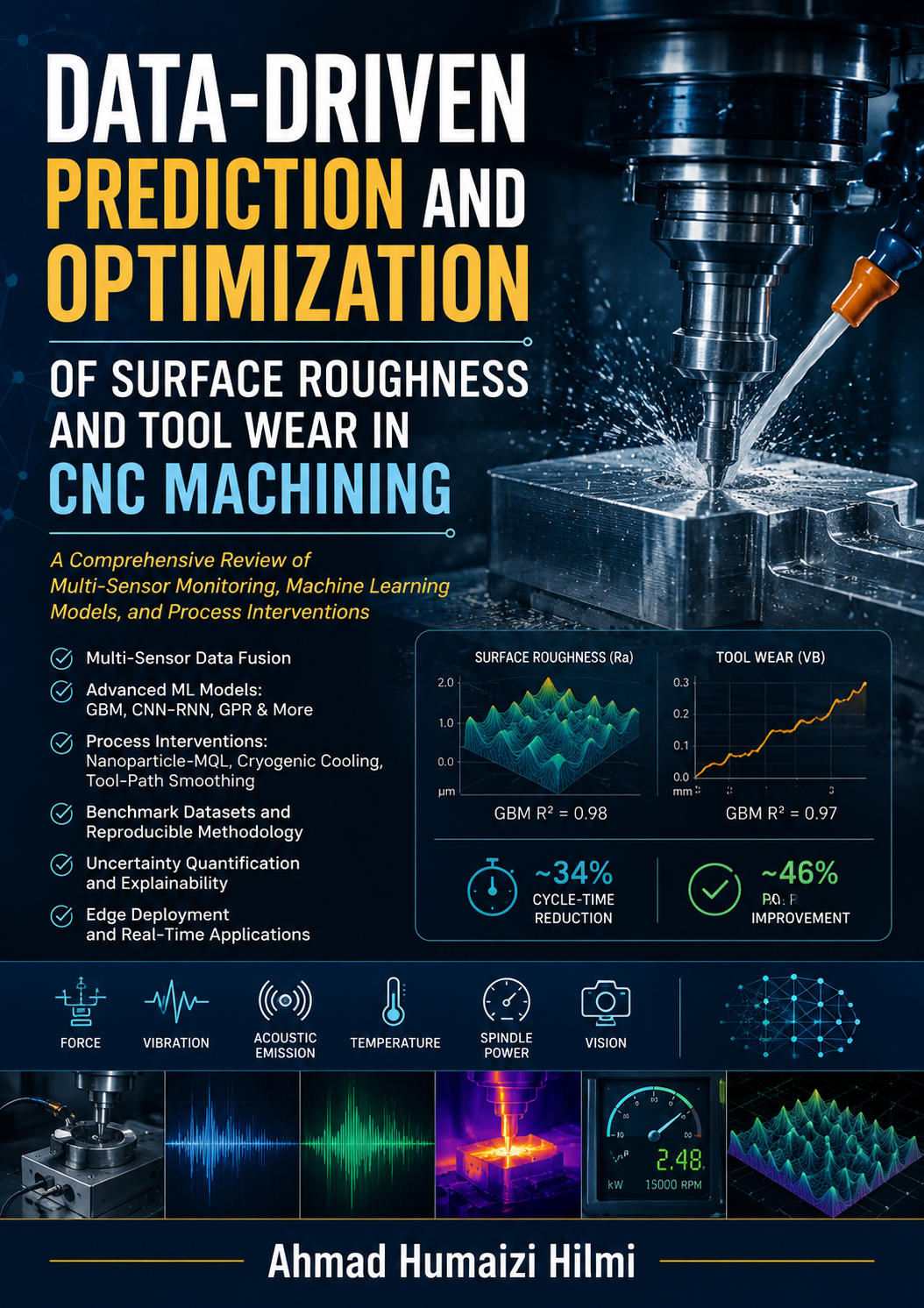
This review synthesises experimental and data-driven studies on predicting and optimising surface roughness (Ra/Sa) and cutting-tool wear across turning, milling and selected assisted processes. It surveys representative workpiece families (aluminium, stainless and tool steels, titanium alloys, nickel superalloys) and catalogs sensor modalities and feature classes including force dynamometry, vibration, acoustic emission, temperature, spindle power and vision. Recommended preprocessing and feature-extraction pipelines are summarised, and model-selection guidance links dataset size to appropriate methods: Gaussian Process and response-surface approaches for small data, tree ensembles (Random Forest, Gradient Boosting Machines) for moderate tabular sets, and CNN–RNN hybrids or semi-supervised patch models for multi-sensor time series and limited labels. The review collates process interventions that complement prediction, notably nanoparticle-enhanced MQL, cryogenic cooling and tool-path smoothing, and reports representative outcomes such as GBM regressors achieving R2 in the 0.93–0.99 range on well-scoped datasets and separable-insert process gains of ~34% cycle-time reduction and ~46% Ra improvement. Its principal contribution is an evidence-based methodology template for reproducible experiments, synchronized multi-sensor acquisition, standard preprocessing and validated ML pipelines, and it prioritises benchmark datasets, physics-informed explainability, edge deployment and standardised validation for future work.