
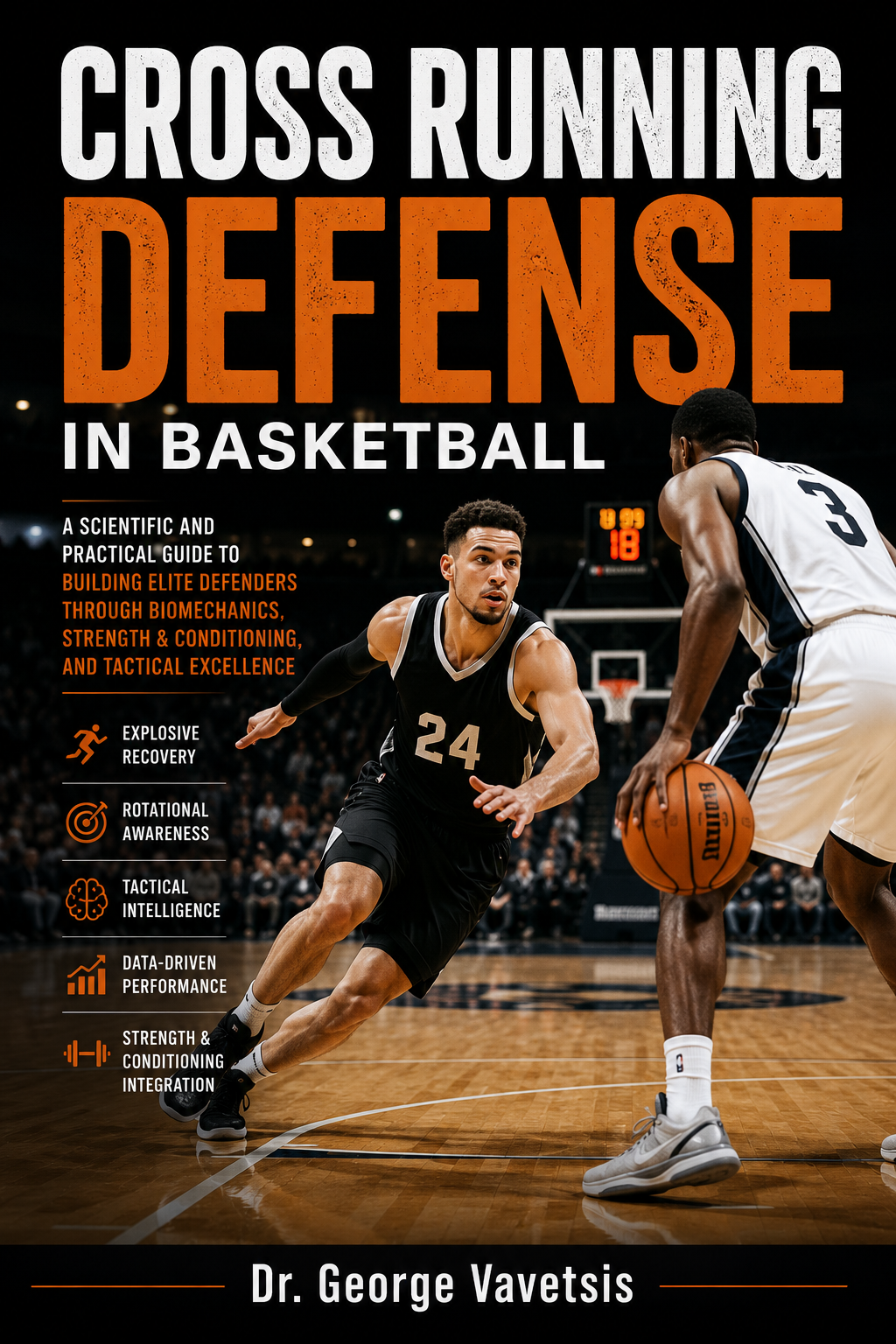
Cross Running Defense in Basketball
Pages: 964
Basketball defense has entered a new biomechanical and tactical era. The modern game is no longer governed primarily by static containment, prolonged lateral shuffling, or rigid half-court positioning. Instead, contemporary basketball—driven by five-out spacing, rapid ball reversals, high-frequency pick-and-roll actions, transition acceleration, and positionless offensive structures—has transformed defense into a dynamic system of continuous recovery, rotational synchronization, and high-velocity spatial occupation. Within this evolving landscape, cross running defense has emerged as one of the most critical yet underexplored defensive frameworks in elite basketball performance.
Cross running defense represents far more than sprinting across the court after a defensive breakdown. It is a highly integrated neuromechanical, physiological, tactical, and cognitive process requiring defenders to repeatedly accelerate, decelerate, rotate, scan, communicate, and reorganize within fractions of a second. The modern defender must sprint diagonally to eliminate space, recover from compromised positioning, close out on perimeter threats, protect the rim, and immediately transition into secondary defensive actions without losing tactical awareness or biomechanical efficiency. The traditional model of simply “staying in front” has become insufficient against modern offensive spacing systems. Today, defenders survive not because they never lose containment, but because they recover faster, rotate smarter, and communicate earlier than the offense can exploit the advantage.
The purpose of this book is to establish a comprehensive scientific and applied framework for understanding, training, analyzing, and optimizing cross running defense in basketball from the perspective of elite performance preparation. This text integrates biomechanics, neurocognition, sports physiology, tactical basketball theory, movement science, performance analytics, and strength and conditioning methodology into one unified system specifically designed for the modern game.
Cross running defense imposes extraordinary physical demands on the athlete. Unlike traditional containment-based defensive systems that relied heavily on lateral endurance and shuffle mechanics, modern cross running requires explosive diagonal sprinting, rapid hip projection, aggressive first-step acceleration, elite braking mechanics, trunk anti-rotation control, and repeated sprint recovery capacity under severe metabolic stress. Defenders must transition instantly from lateral positioning into forward acceleration while simultaneously scanning offensive threats, processing tactical information, and preparing for abrupt deceleration into closeout or containment posture.
Consequently, the strength and conditioning implications are profound. Defensive preparation can no longer be restricted to generic agility ladders, isolated cone drills, or low-context conditioning methods. The cross running athlete must instead be developed through integrated movement systems emphasizing eccentric braking strength, reactive acceleration, curvilinear sprinting, multi-planar power production, hip mobility, adductor stiffness, ankle elasticity, repeated high-intensity sprint exposure, and neurocognitive adaptability. Physical preparation must mirror the exact mechanical and tactical realities of modern basketball defense. The ability to repeatedly sprint, stop, rotate, recover, and communicate under fatigue has become one of the defining performance indicators of elite defensive basketball.
This book was also written to bridge the longstanding gap between tactical basketball coaching and sports performance science. Too often, tactical systems and physical preparation are developed independently, despite being inseparable during competition. Defensive rotations are not merely tactical decisions; they are expressions of force production, energy system efficiency, perception-action coupling, neuromuscular coordination, and fatigue resistance. Every successful X-out rotation, weak-side stunt, scram switch, transition recovery sprint, or closeout sequence is fundamentally a biomechanical event performed under cognitive stress and physiological fatigue.
For this reason, the chapters within this book move systematically from foundational defensive concepts toward advanced applied performance models. Early chapters establish the tactical and biomechanical principles underpinning cross running defense, including defensive philosophy, rotational structures, movement mechanics, footwork systems, and spatial occupancy concepts. Later sections progress toward applied strength and conditioning strategies, women’s basketball adaptations, transition defense systems, advanced analytics, AI-assisted tracking technologies, neurocognitive training, and future performance innovations.
Particular emphasis has been placed on the integration of elite-level sports science technologies. Modern basketball now permits detailed quantification of defensive movement through local positioning systems (LPS), optical tracking, force plates, accelerometry, spatiotemporal analysis, machine learning, and AI-driven performance prediction models. Defensive performance is increasingly measurable in terms of acceleration density, braking efficiency, rotational synchronization, spatial coverage quality, sprint decrement, communication timing, and fatigue-induced movement variability. The future of basketball defense belongs not only to tactical intelligence, but also to data-informed movement optimization.
An equally important objective of this work is the integration of neurocognitive science into basketball defense. Cross running defense is fundamentally a perception-action problem. Defenders must continuously scan the ball, the offensive player, weak-side spacing, cutters, screeners, and passing lanes while sprinting under extreme physiological stress. Anticipation, inhibitory control, peripheral awareness, decision-making speed, and reaction timing become decisive variables separating elite defenders from average ones. Defensive anticipation allows the athlete to rotate before the offensive advantage fully develops rather than react after the breakdown has already occurred.
The modern basketball environment demands athletes who are not only physically explosive but cognitively adaptable and tactically synchronized. This evolution has transformed defensive basketball into one of the most interdisciplinary domains within sports performance science.
Ultimately, cross running defense is about controlling space before the offense can exploit it. It is the science of recovery, the biomechanics of rotational movement, and the physiology of repeated tactical survival. It is the art of arriving on time without sacrificing balance, communication, or awareness. And it is increasingly the defining characteristic of championship-level basketball defense at the NBA, EuroLeague, WNBA, NCAA, and international levels.
This book was written for strength and conditioning coaches, performance scientists, basketball coaches, sports biomechanists, rehabilitation specialists, analysts, and high-performance practitioners seeking to understand the future direction of basketball defense through a scientific and applied lens. The goal is not merely to describe defensive rotations, but to provide a complete framework for training, evaluating, periodizing, and optimizing them.
As basketball spacing continues to evolve, so too must the athlete. The defender of the future will not simply move laterally. The defender of the future will sprint diagonally, recover explosively, brake violently, think rapidly, communicate clearly, and rotate continuously.