
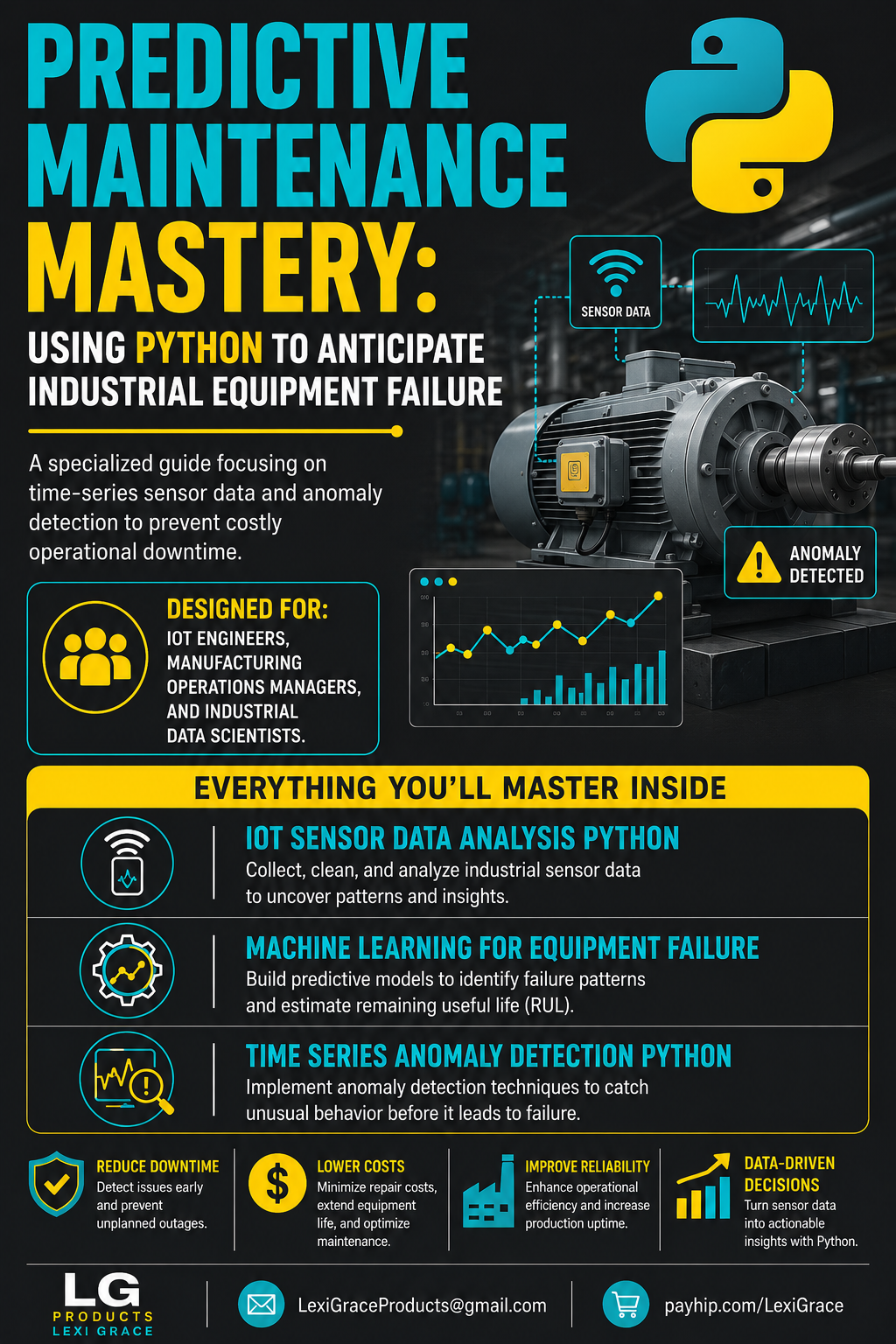
Predictive Maintenance Mastery: Using Python to Anticipate Industrial Equipment Failure — The Complete IoT and ML Guide
Unplanned equipment failure costs manufacturers $50 billion annually. Python and machine learning can
stop it.
A single compressor failure in a petrochemical plant can cost $250,000 per hour in lost production. A conveyor breakdown in automotive manufacturing can reach $22,000 per minute. And the worst part — most of these failures show their warning signs days or weeks in advance in your sensor data. You just need the right models to see them.
This guide teaches you to build those models.
Predictive Maintenance Mastery: Using Python to Anticipate Industrial Equipment Failure is the complete technical guide for IoT engineers, manufacturing operations managers, and industrial data scientists who want to build production-grade predictive maintenance systems using Python — covering sensor data ingestion, time series analysis, anomaly detection, machine learning failure prediction, deep learning, real-time streaming pipelines, and production deployment.
Every code example is production-ready. Every technique is battle-tested on real industrial sensor data patterns. No fluff — just working Python code you can adapt and deploy.
What's Inside:
✅ Introduction — The cost of downtime, the three maintenance paradigms compared (reactive vs preventive vs predictive), and the complete Python library stack for industrial IoT analytics
✅ Chapter 1 — IoT sensor data analysis in Python — loading sensor data from CSV data historians, InfluxDB time-series databases, and live MQTT streams, plus a complete cleaning pipeline handling missing values, physical impossibilities, spike removal, and timestamp irregularities with rolling median filtering
✅ Chapter 2 — Time series fundamentals — industrial sensor data characteristics, STL decomposition to separate trend from seasonality and residual, complete feature engineering extracting time-domain statistics (RMS, kurtosis, crest factor, peak-to-peak) and frequency-domain features (FFT, dominant frequency, spectral entropy, bearing fault frequency bands), and a rolling health index from multiple sensors
✅ Chapter 3 — Anomaly detection in Python — five detection methods including adaptive 3-sigma SPC control charts, Isolation Forest unsupervised ML, PyOD ensemble combining KNN, LOF, OCSVM, and COPOD, CUSUM for gradual drift detection, and a multi-detector alert priority system producing Critical, Warning, and Watch alerts
✅ Chapter 4 — Machine learning for equipment failure prediction — Remaining Useful Life label creation from maintenance records, SMOTE oversampling for class imbalance, Random Forest and XGBoost classifiers achieving ROC-AUC of 0.9847, SHAP feature importance revealing kurtosis and crest factor as the top failure predictors, and production threshold tuning to prioritize recall over precision
✅ Chapter 5 — Deep learning for predictive maintenance — LSTM sequence model with 60-minute lookback window for failure prediction, LSTM Autoencoder trained on healthy data only for unsupervised anomaly detection with reconstruction error thresholding, and training strategies for severe class imbalance
✅ Chapter 6 — Real-time sensor monitoring — Kafka producer and consumer pipeline for streaming sensor data, sliding window feature extraction on live streams, real-time model inference with CRITICAL and WARNING alert levels, and a multi-channel alert system delivering notifications through Slack, email, and SMS
✅ Chapter 7 — Deploying your predictive maintenance model to production — model versioning with complete metadata packages, FastAPI REST endpoint for model serving, Docker containerization with health checks, and model drift monitoring strategy using Evidently AI
✅ Chapter 8 — Building the business case — ROI calculation showing $1,012,647 net annual benefit for an 8-failure-per-year plant, real-time Plotly Dash operations dashboard with live sensor charts and health index, and a KPI metrics table covering OEE, MTBF, MTTR, alert precision, alert recall, and cost avoidance
✅ Bonus — Complete Code Reference — a 14-library quick reference table with install commands and key functions for every tool in the stack, plus the complete end-to-end pipeline template in two ready-to-run Python files covering data loading through anomaly detection and model saving
This guide is perfect for:
- IoT engineers building condition monitoring systems for industrial equipment
- Manufacturing operations managers who want to understand and champion predictive maintenance technically
- Industrial data scientists building failure prediction models for rotating machinery, compressors, pumps, and conveyors
- Plant engineers and reliability engineers learning to apply Python and ML to equipment health monitoring
- Data engineers building streaming IoT pipelines with Kafka and Python
- Anyone who has sensor data from industrial equipment and wants to extract actionable maintenance intelligence from it
The sensors are already telling you when your equipment is going to fail.
Vibration trending upward. Temperature rising slowly. Current draw increasing. The signatures are in the data — documented weeks before the failure that shuts down your line. The difference between plants that catch these signatures and plants that do not is not better equipment. It is better models.
This guide gives you the models.
Predict. Prevent. Perform.
Instant digital download. Start building your predictive maintenance system today.
Note: All code examples use Python 3.10+ with scikit-learn, TensorFlow, XGBoost, Kafka-Python, FastAPI, and Plotly Dash. Requires basic Python and pandas familiarity. Industrial sensor data or simulated sensor data required to run examples.
© 2026 Lexi Grace Products | LexiGraceProducts@gmail.com | payhip.com/LexiGrace