

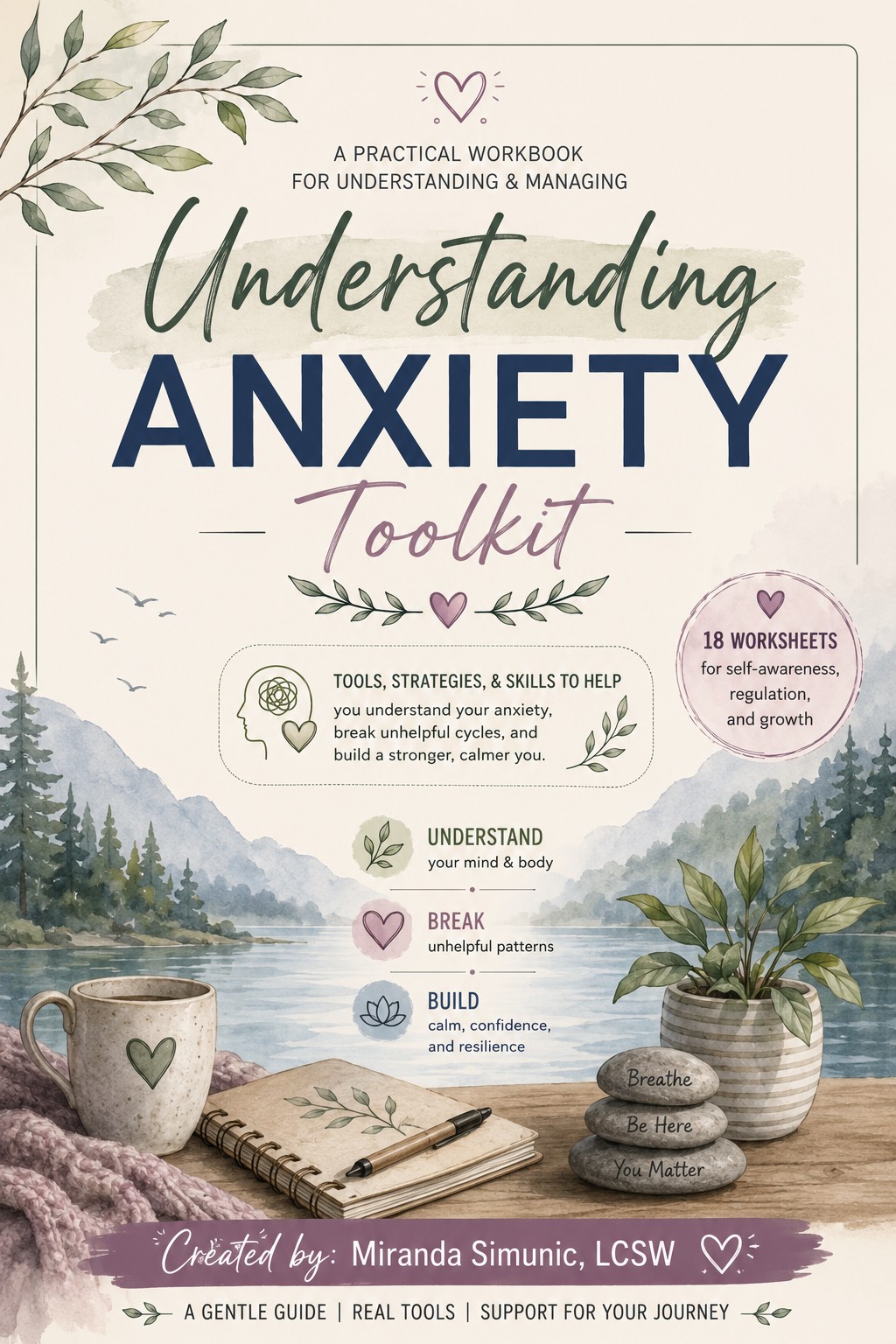
The Anxiety Therapist ToolKit
Therapist Anxiety Toolkit
18 Printable Anxiety Worksheets
Help clients understand their anxiety, identify the patterns keeping it going, and build practical skills for managing anxious thoughts, behaviors, and nervous-system activation.
The Therapist Anxiety Toolkit is a practical collection of 18 printable, therapist-created worksheets designed to support individual therapy sessions, psychoeducation, homework, and between-session practice.
Instead of giving clients another generic “coping skills” handout, this toolkit helps them understand WHY their anxiety happens, WHAT keeps it going, and HOW they can respond differently.
🧠 WHAT'S INCLUDED
The worksheets are organized into a progression that can take clients from understanding → awareness → intervention → practice.
1. 🧠 Understanding Anxiety: Brain & Body
Help clients understand what happens in the brain and body when the nervous system detects a perceived threat.
2. 🔎 Where Does My Anxiety Come From?
Explore possible sources, patterns, experiences, and situations connected to anxiety.
3. 🔄 Identifying My Anxiety Cycle
Help clients map the cycle:
Trigger → Thought → Body Sensation → Emotion → Behavior → Short-Term Relief → Anxiety Returns
4. 🧠 Unhealthy Thinking Habits That Could Contribute to My Anxiety
Identify patterns such as catastrophizing, all-or-nothing thinking, mind reading, fortune telling, overthinking, and “what if?” thinking.
5. 🛡️ Anxiety Safety Behaviors
Identify avoidance, reassurance seeking, checking, controlling, escape behaviors, and other strategies that may provide temporary relief while maintaining anxiety.
6. 👣 Grounding Skills for Anxiety
Teach clients practical ways to shift attention out of anxious thoughts and back into the present moment.
7. ⏰ Worry Time / Worry Postponement Strategy
Help clients stop allowing worry to take over the entire day by intentionally postponing worry to a designated time.
8. 💬 Coping Statements for Anxiety
Give clients realistic, compassionate statements they can use when anxiety starts escalating.
9. 🌿 ACT for Anxiety
Introduce acceptance, psychological flexibility, values, and learning to move forward even when anxiety is present.
10. 🪜 My Anxiety Fear Ladder
Help clients create a gradual hierarchy for approaching situations they have been avoiding.
11. 🔎 Identifying My Anxiety Triggers
Help clients recognize external, internal, emotional, relational, physical, and situational triggers.
12. 🧠 ERP for Anxiety & OCD
Introduce the principles of exposure and response prevention, including facing triggers and reducing compulsive responses and reassurance seeking.
13. 🔄 Rumination Interruption
Help clients recognize when thinking has shifted from productive problem-solving into repetitive mental loops.
14. 🌬️ Breathwork for Anxiety
Teach comfortable breathing, longer exhalation, diaphragmatic breathing, and breath awareness without turning relaxation into another thing clients feel they “have to” do perfectly.
15. 🫀 Progressive Muscle Relaxation for Anxiety
Guide clients through systematically noticing and releasing physical tension.
16. 🎨 Draw My Anxiety
A creative intervention that helps clients externalize anxiety, give it a shape, identify what it is trying to protect them from, and symbolically release it.
17. 🌳 Worry Decision Tree
Help clients distinguish between:
A problem I can solve → take action
A problem I cannot solve → practice acceptance
Nothing I can do right now → return to the present
18. 🌱 What Is in My Control?
Help clients separate what they can influence from what they cannot control, reducing the cycle of trying to control uncertainty, other people's behavior, future outcomes, and uncomfortable feelings.
19. 💚 Words That Soften My Nervous System
Help clients recognize how rigid, threatening, and urgent language can increase pressure and practice replacing it with language that communicates choice, flexibility, compassion, and safety.
✨ USE THESE WORKSHEETS TO HELP CLIENTS:
✔ Understand why anxiety happens
✔ Recognize their personal anxiety patterns
✔ Identify triggers
✔ Recognize cognitive distortions
✔ Understand avoidance and safety behaviors
✔ Reduce reassurance seeking
✔ Increase tolerance for uncertainty
✔ Interrupt rumination
✔ Practice grounding
✔ Develop coping statements
✔ Learn ACT-based strategies
✔ Begin exposure work
✔ Build an anxiety hierarchy
✔ Practice ERP principles
✔ Regulate physical tension
✔ Identify what is actually within their control
✔ Develop a more compassionate internal dialogue
🛋️ GREAT FOR:
Therapists • LCSWs • LPCs • LMFTs • Psychologists • Counselors • Clinical Social Workers • Private Practice Clinicians
Use them during sessions, as homework, for psychoeducation, or as part of a larger anxiety treatment plan.
💡 A TOOLKIT THAT FOLLOWS THE ANXIETY PROCESS
This collection isn't just a random stack of worksheets.
It can be used as a progression:
UNDERSTAND IT
↓
Brain + Body
Where Does My Anxiety Come From?
IDENTIFY IT
↓
Triggers
Anxiety Cycle
Thinking Habits
Safety Behaviors
INTERRUPT IT
↓
Worry Tree
Worry Postponement
Rumination Interruption
What Is in My Control?
REGULATE IT
↓
Grounding
Breathwork
Progressive Muscle Relaxation
Coping Statements
CHANGE MY RELATIONSHIP WITH IT
↓
ACT
Words That Soften My Nervous System
FACE IT
↓
Fear Ladder
ERP
PROCESS IT CREATIVELY
↓
Draw My Anxiety
🌿 THE BIGGER GOAL
The goal isn't simply:
“How do I get rid of my anxiety?”
It's helping clients learn:
“I can understand my anxiety.”
“I can recognize the cycle.”
“I don't have to obey every anxious thought.”
“I can tolerate uncertainty.”
“I can respond differently.”
“I can feel anxious and still move forward.”
Created with a practical, client-friendly approach so you can print it, use it, and get right back to therapy.
*Important Disclaimer*
These therapeutic resources are intended for educational and supportive purposes only. They are designed to provide general information, reflection prompts, psychoeducation, and therapeutic tools that may be used by mental health professionals or adapted for personal growth.
These materials are not a substitute for professional mental health treatment, diagnosis, medical care, crisis intervention, or individualized clinical judgment. Every client is different, and therapeutic interventions should be selected and adapted based on the individual's needs, circumstances, presenting concerns, developmental level, culture, risk factors, and treatment goals.
If you are a mental health professional, use your professional judgment when determining whether and how a resource is appropriate for a particular client. These resources do not replace appropriate assessment, supervision, consultation, documentation, ethical standards, or applicable laws and regulations.
If a person is experiencing a mental health crisis, is at risk of harming themselves or someone else, or requires immediate medical attention, they should seek appropriate emergency or crisis services rather than relying on these materials.
The creator does not guarantee any particular therapeutic outcome from the use of these resources and assumes no responsibility for how the materials are interpreted, modified, or applied.
For Professional Use:
These resources are educational tools and are not intended to replace the training, education, licensure, ethical responsibilities, or clinical expertise of a qualified mental health professional.
Copyright & Use:
These materials are provided for personal and/or professional use according to the terms of purchase. They may not be resold, redistributed, reproduced for commercial resale, uploaded to sharing platforms, or presented as the original work of another person without written permission.