
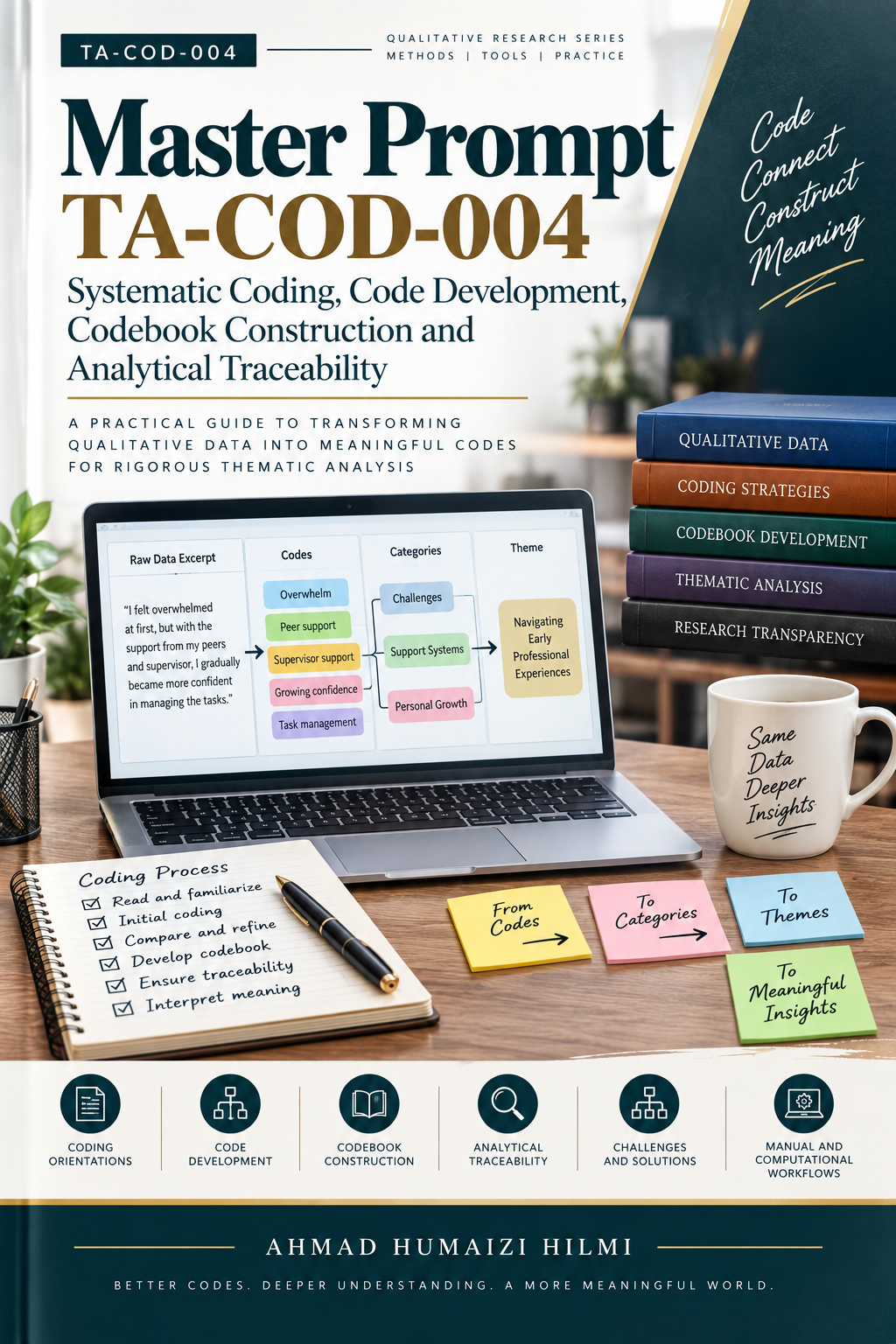
TA-COD-004 — Systematic Coding, Code Development, Codebook Construction and Analytical Traceability
Description
This Master Prompt focuses on transforming qualitative data into analytically meaningful codes while preserving a transparent relationship between raw evidence and developing interpretation. It guides researchers through initial coding, line-by-line or segment-based coding, code labeling, code definition, code comparison, code merging and splitting, recoding, codebook development where methodologically appropriate, and systematic documentation of coding decisions. Coding should function as an analytical bridge between the original dataset and later thematic construction rather than as a mechanical exercise in labeling text. The uploaded methodological literature illustrates this explicitly: RRITA defines codes as labels that identify and organize raw data and uses line-by-line or sentence-by-sentence coding to preserve traceability between verbatim extracts and subsequent thematic patterns.
A major emphasis is placed on distinguishing a code from a theme, a descriptive label from an analytical interpretation, and semantic content from latent meaning. Researchers should determine whether inductive, deductive, abductive, semantic, latent, in-vivo, descriptive, interpretive or combined coding orientations are appropriate and ensure that these choices remain coherent with the research questions, theoretical positioning and research paradigm. Coding decisions should remain open to revision as understanding develops rather than being treated as fixed after the first coding cycle. The uploaded studies demonstrate considerable methodological diversity, including deductive thematic analysis grounded in established conceptual frameworks, reflexive thematic analysis, and structured approaches that explicitly preserve discordance, reflexive notes and a versioned analytical trail.
The prompts also accommodate collaborative coding and emerging computational workflows without assuming that inter-coder agreement or automated consistency constitutes qualitative validity. Contemporary AI-assisted research separates code extraction, code combination and theme generation into distinct analytical stages and emphasizes human supervision rather than replacement of qualitative researchers. Coding should therefore remain transparent, reflexive, evidence-grounded and methodologically defensible regardless of whether it is performed manually, through CAQDAS, collaboratively, or with computational assistance.