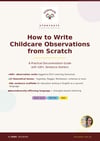
How to Write Childcare Observations from Scratch: A Practical Documentation Guide with 100+ Sentence Starters
You know what the child did. You can picture the moment. But when you sit down to write... the words just aren't there.
If you've ever stared at a blank observation template thinking, "How do I even start this sentence?", this guide was made for you.
Price
A$24.99 (standalone) or A$29.99 bundled with Observations pack
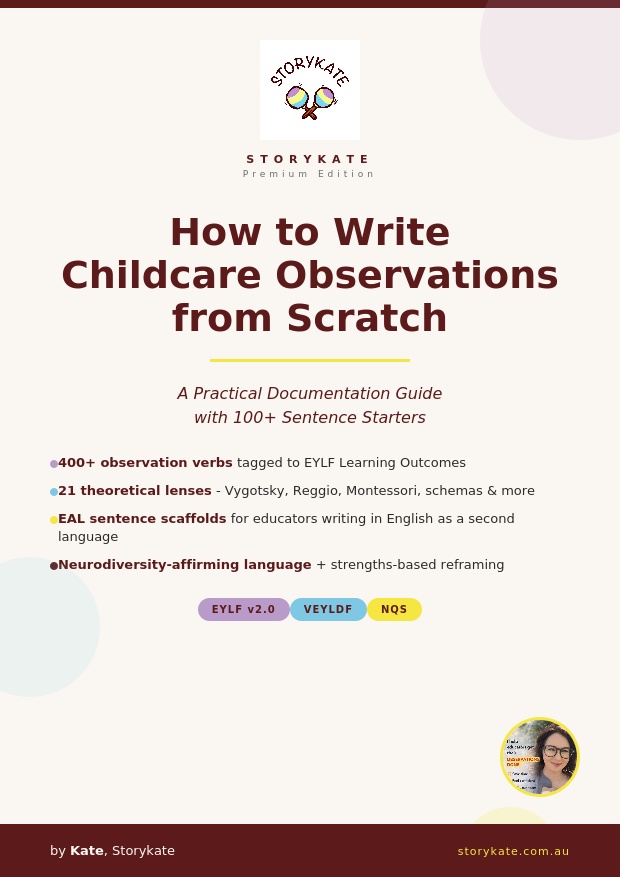
How to Write Childcare Observations from Scratch is a 117-page practical documentation guide with 100+ sentence starters, 400+ observation verbs, and the exact phrases you need to write professional, strengths-based, framework-aligned observations - even if English is your second language.
What's inside:
7 word categories (action, emotion, social, cognitive, motor, communication, creative) - each verb tagged to its EYLF Learning Outcome, so your framework alignment is done in seconds
Social-emotional learning vocabulary - the hardest area to write about, broken into five domains with worked examples
8 observation context guides - specific vocabulary and sentence stems for writing indoors, outdoors, one-on-one, small group, large group, for parents, reflections, and transition reports
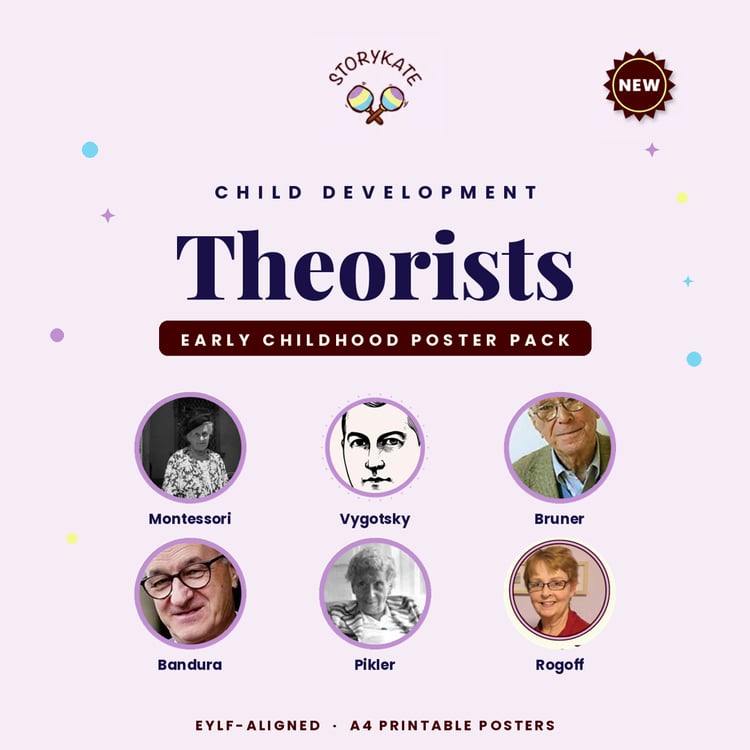
21 theoretical lenses - the section no other resource gives you. Vocabulary specific to Vygotsky, Rogoff, Fleer, Reggio Emilia, Steiner, Montessori, Piaget, schemas, poststructuralism, neuroscience, posthumanism, affordances, First Nations perspectives, behaviourism, Pikler, loose parts, nature pedagogy, trauma-informed practice, and children's rights (UNCRC)
Growth mindset vocabulary - effort-based language to replace "clever" and "talented"
Neurodiversity-affirming language - respectful, identity-first vocabulary for writing about autistic children, ADHD, PDA, and sensory processing differences. Includes current Australian resources.
VEYLDF Evidence Markers - the exact phrases Victorian educators are assessed against, ready to lift into your documentation
EAL sentence scaffolds - full sentence templates with blanks. Just fill in the child's name and the detail.
Strengths-based reframing - 19 deficit phrases and their strengths-based alternatives
International guide - framework mapping for educators in New Zealand, Canada, USA, UK, and India
Who this is for:
- Educators who find observations the hardest part of the job
- EAL (English as an Additional Language) educators who think faster than they can write in English
- Cert III and Diploma students writing their first observations
- Bachelor's students who need to write through a theoretical lens
- Educational Leaders building staff vocabulary for QIP evidence
- Room Leaders who want varied, professional documentation
- Anyone who writes "the child played with blocks" and knows it's not enough
What this is NOT:
This is not a textbook. It is not a template. It is a working reference - open it beside your computer, find the words you need, and close it. The structure follows how an observation actually flows: what the child DID, how they FELT, who they were WITH, what they were THINKING, how their body MOVED, what they SAID, and how they IMAGINED.
Every word bank is aligned to the EYLF v2.0 and the VEYLDF. Every theoretical lens section includes a one-paragraph summary, a vocabulary table with "use in a sentence" examples, and a full worked observation.
Format: Digital PDF, A4, 117 pages. Print as many copies as you need for your own use.
By Storykate - storykate.com.au | @Storykate on YouTube
childcare observations, early childhood education, EYLF, observation words, how to write observations, childcare documentation, educator resources, EAL educators, sentence starters, learning outcomes, VEYLDF, NQS, early childhood development