
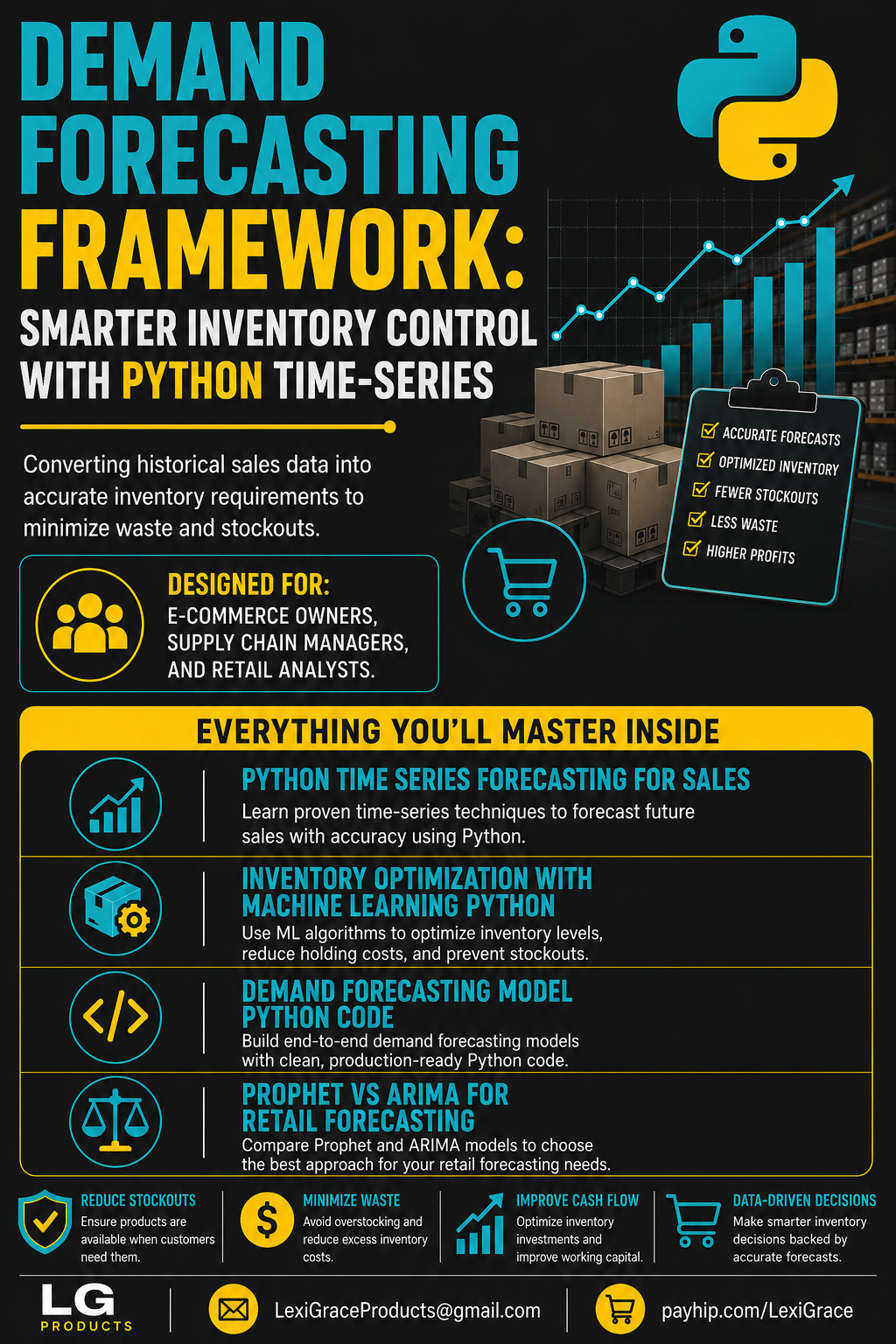
Demand Forecasting Framework: Smarter Inventory Control With Python Time-Series — The Complete Retail and E-Commerce Guide
Every stockout is a forecast that was too low. Every markdown is a forecast that was too high. Python fixes both.
Inventory is the largest and most dangerous asset on a retailer's balance sheet. Too much stock means cash locked in warehouses, products going obsolete, and markdowns eroding margins. Too little stock means lost sales, disappointed customers, and competitors capturing the demand you could not fulfill. The gap between too much and too little is demand forecasting — and most businesses are doing it with spreadsheets and intuition.
This guide shows you how to do it with Python and machine learning.
Demand Forecasting Framework: Smarter Inventory Control With Python Time-Series is the complete technical guide for e-commerce owners, supply chain managers, and retail analysts who want to build production-grade demand forecasting systems in Python — covering time series analysis, ARIMA, Prophet, XGBoost, LightGBM, inventory optimization, multi-SKU scaling, external signal integration, and automated production deployment.
Every code example is copy-and-paste ready. Every technique is validated against real retail sales patterns. The result is a complete pipeline from raw transaction data to weekly automated reorder recommendations.
What's Inside:
✅ Introduction — The cost of bad forecasting with a six-row impact table showing overforecast costs, underforecast stockout losses, seasonal pattern misses, and promotion lift errors — plus the full Python library installation stack
✅ Chapter 1 — Python time series forecasting for sales — loading transactional data from CSV, InfluxDB, and MQTT streams, aggregating to daily SKU-level demand, filling missing dates, STL decomposition with seasonality strength measurement, ADF and KPSS stationarity testing, and complete feature engineering extracting 28 calendar and lag features including 364-day lag, rolling statistics, and exponentially weighted means
✅ Chapter 2 — ARIMA and SARIMA — complete parameter reference table for all 7 ARIMA parameters, Auto ARIMA with pmdarima for automated parameter selection, SARIMA fitting with 12-week holdout evaluation achieving MAPE of 12.34%, and 4-panel residual diagnostic plots with Ljung-Box white noise testing
✅ Chapter 3 — Prophet vs ARIMA for retail forecasting — complete Prophet implementation with Black Friday, Cyber Monday, Christmas, and Mothers Day holiday effects, Prophet cross-validation with horizon-specific MAPE metrics, and a 12-criterion head-to-head comparison table showing which model wins on seasonality, holidays, uncertainty intervals, scaling, missing data, and ease of use
✅ Chapter 4 — Demand forecasting model Python code — walk-forward time series cross-validation preventing data leakage, XGBoost achieving MAPE of 10.24% across 5 folds, LightGBM global model with top feature importance showing lag_364d and lag_7d dominating, and a recursive multi-step 90-day forecast generator
✅ Chapter 5 — Inventory optimization with machine learning Python — complete safety stock formula with demand and lead time variability, reorder point, EOQ, and Days of Supply calculations, the full inventory optimizer function connecting Prophet uncertainty intervals directly to safety stock decisions, and batch optimization across all SKUs generating automated reorder recommendations
✅ Chapter 6 — Multi-product forecasting — parallel Prophet for 847 SKUs using all CPU cores with 791 successful forecasts, global LightGBM model training all SKUs in 3 minutes versus 4 hours with individual Prophet models, and top-down hierarchical forecasting for infinite SKU catalog scaling
✅ Chapter 7 — External signals — promotion lift encoding with pre-promotion anticipation effects and post-promotion cannibalization dip (average lift measured at 187%), free weather feature integration via Open-Meteo API with rain and temperature correlation analysis, and FRED economic indicator integration adding consumer sentiment, unemployment, CPI, and retail sales index as forecasting features
✅ Chapter 8 — Deploying your forecasting pipeline to production — Apache Airflow DAG scheduling weekly retraining every Monday at 6am with extract-forecast-optimize-push-report pipeline, forecast accuracy monitoring with SKU-level drift detection and automated alerts, and FastAPI REST endpoint serving on-demand SKU forecasts with integrated inventory recommendations
✅ Bonus — Complete Code Reference — model selection quick reference table across 6 models with minimum history requirements and scaling guidance, forecast accuracy metrics reference covering MAPE, MAE, RMSE, SMAPE, Bias, and MASE with target values, a 15-line Prophet quickstart producing a working forecast immediately, and inventory formula reference with Z-score service level table
This guide is perfect for:
- E-commerce owners who want to stop making inventory decisions based on intuition and start using data
- Supply chain managers building automated replenishment systems for retail or distribution operations
- Retail analysts creating demand forecasting models for clients or internal planning teams
- Data scientists new to retail who want to understand the business context behind the technical models
- Operations managers who want to understand what their data science team is building and why
- Anyone running a product business who has ever had a stockout during peak season or a warehouse full of slow-moving inventory
The data is already there. Your transaction history contains the seasonal patterns, the trend signals, and the demand fingerprint of every SKU in your catalog.
Prophet sees the Black Friday spike coming 6 months in advance. XGBoost learns that rainy weekends suppress foot traffic at your stores. LightGBM knows that your top SKU sells 4x more in Q4 than Q1. The inventory optimizer translates all of that into a single number: order this many units, by this date, to hit your service level target.
That is what this guide builds.
Forecast Smarter. Stock Better. Profit More.
Instant digital download. Start building your forecasting system today.
Note: Requires Python 3.10+ with pandas, Prophet, statsmodels, XGBoost, and LightGBM. Historical sales data with at least 1 year of transaction history recommended for best results.