
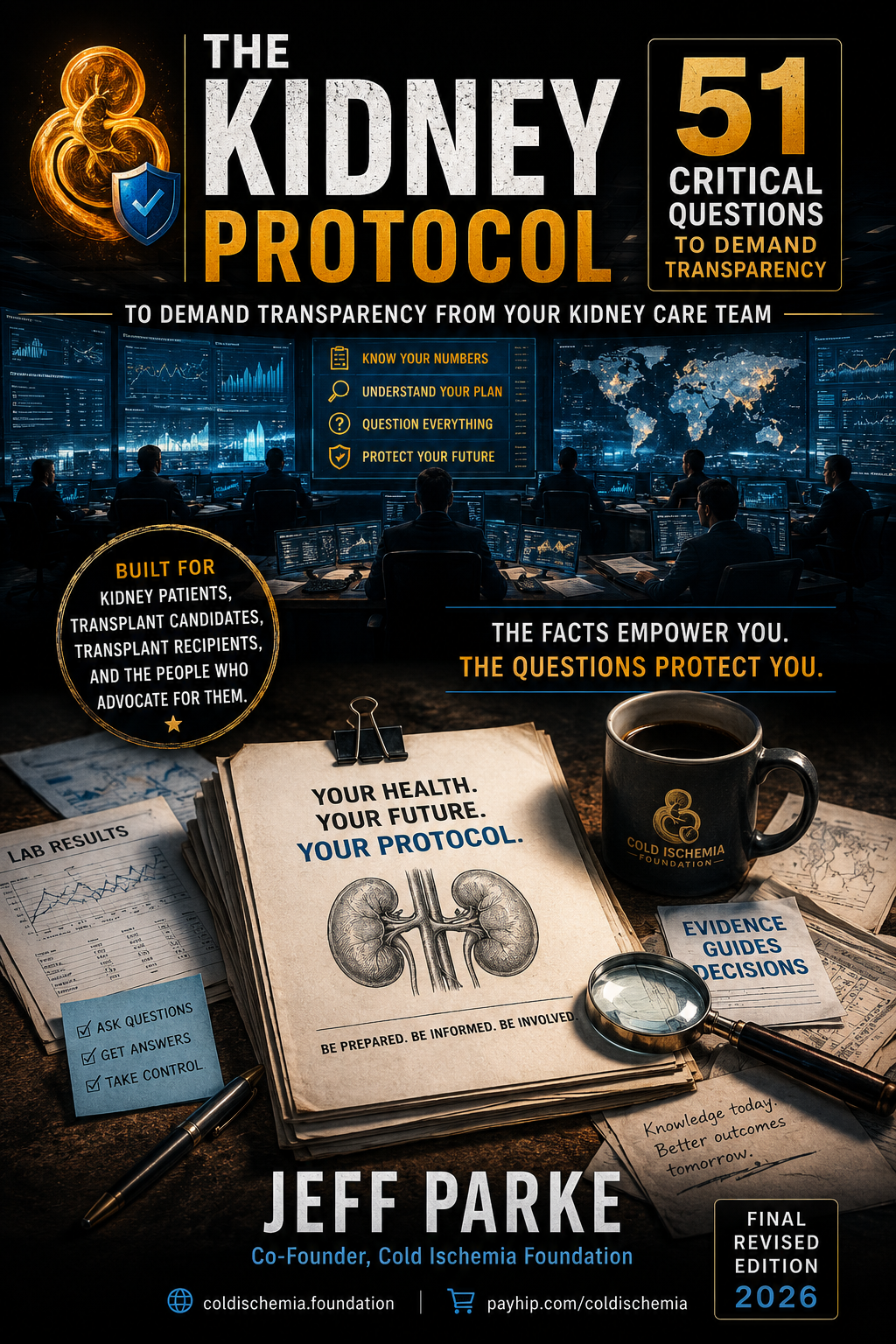
THE KIDNEY PROTOCOL — 51 Critical Questions to Demand Transparency from Your Kidney Care Team
THE KIDNEY PROTOCOL — 51 Critical Questions to Demand Transparency from Your Kidney Care Team
Most kidney patients leave their appointments with less information than they arrived with. Not because their doctors are incompetent. Because the system was never designed to require that you be told the truth in plain language.
This changes that.
The Kidney Protocol is a 25-page clinical-grade question guide built for kidney patients, transplant candidates, transplant recipients, and every care partner sitting in the chair next to them. It gives you 51 precise, evidence-anchored questions — organized across pathology and progression, medication and toxicity, nutrition and metabolic control, and transplant strategy — that force your care team to move past reassurance and into accountability.
You will learn to ask for your eGFR trend, not just a single number. Your full KDIGO classification, not just a stage. Your Kidney Failure Risk Equation score at two and five years, and what clinical action that number is supposed to trigger. Whether you have been offered an SGLT2 inhibitor, finerenone, or preemptive transplant — and if not, why not, in writing. Whether the medications on your list have been dose-adjusted for your current kidney function. Whether anyone is checking your drug-drug interactions across four specialists. And whether the plan your doctor just described to you will be written, signed, and sent to you before you leave the building.
Every question comes with a "Why it matters" explanation grounded in current KDIGO guidelines, the SPRINT trial, DAPA-CKD, EMPA-KIDNEY, FIDELIO-DKD, and the Medicare Part B Immunosuppressive Drug Benefit that took effect in January 2023. Nothing in this document is opinion dressed as evidence. Everything is sourced.
This was written by a three-time kidney transplant recipient with nearly two decades of pharmaceutical clinical development experience and Lean Six Sigma credentials. It was funded by zero pharmaceutical companies, zero dialysis corporations, and zero insurance providers.
Three questions per visit. Document the answers. Watch the patterns.
Download it. Bring it to your next appointment. The protocol works because you do.