
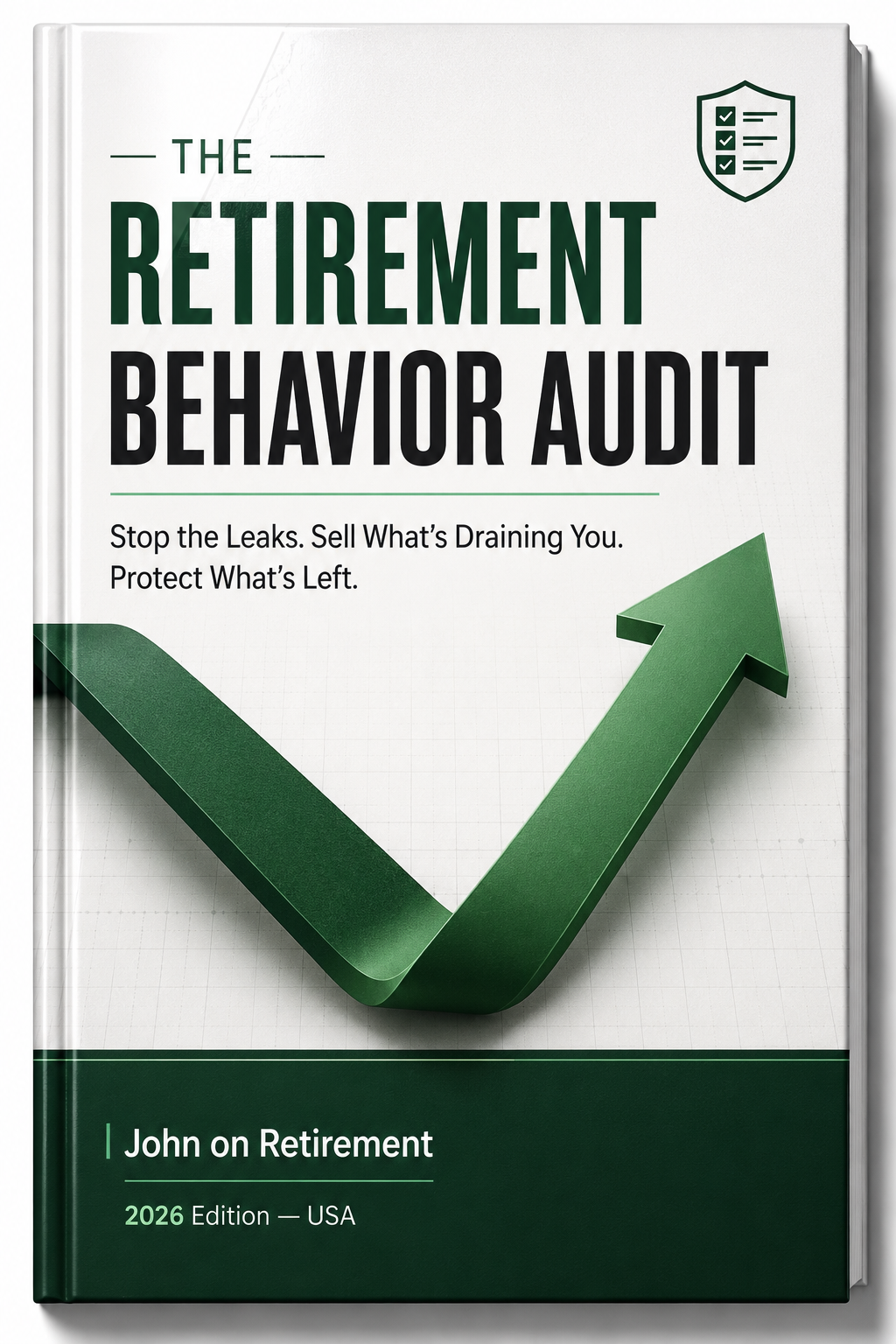
THE RETIREMENT BEHAVIOR AUDIT
You watched the videos. You know something needs to change. But nobody gave you Step 1.
That's the gap this checklist fills.
After years of creating retirement content for Americans over 60, the comment that appears more than any other isn't "I didn't know that." It's "I knew something was wrong — I just didn't know where to start fixing it."
The Retirement Behavior Audit was built from that comment. It's a 30-day action checklist that works through three sections in order — stopping the leaks, selling what's draining you, and addressing the decisions that have deadlines most Americans miss entirely.
HERE'S WHAT'S INSIDE:
SECTION 1 — WHAT TO STOP BUYING
Most retirement leaks aren't dramatic. They're invisible. The subscription you signed up for three years ago and forgot. The insurance policy that costs twice what it should. The second vehicle you drive twice a week that costs $800 a month to own. The family transfers that feel like love and function like a slow drain.
This section audits 8 categories of spending that consistently destroy retirement savings for Americans over 60. For each one you get the real annual cost calculation — not the sticker price, but the true 10-year compounding cost — and the specific action to take.
Most people who complete Section 1 discover they are spending $3,000 to $8,000 per year on things they would immediately stop or reduce if they could see the number clearly.
SECTION 2 — WHAT TO SELL NOW
Owning assets in retirement is not the same as owning them during accumulation. The question is no longer "is this a good asset?" It's "is what I get from this worth what it costs me to keep it?"
This section gives you the Ownership Cost Formula for every discretionary asset you own — the second home, the RV, the boat, the financial products with fees buried in the fine print. For each one you calculate the true annual cost, divide by days of actual use, and compare to the rental equivalent.
The results are almost always surprising. A vacation home used 18 nights per year frequently costs $800 to $1,500 per night of actual use. The rental equivalent in the same location costs $200 to $400. The financial case for selling is clear. The emotional case is what this section helps you work through honestly.
SECTION 3 — THE 5 DECISIONS YOU CANNOT GET WRONG
These are the decisions that can't be undone. Each one has a deadline — biological, legal, or financial — and missing it has permanent consequences.
Decision 1 — Social Security timing. Claiming at 62 reduces your benefit by up to 30% permanently. Waiting from Full Retirement Age to 70 increases it by 8% per year permanently. The optimal decision for your household depends on five variables most people never model together. This section shows you exactly what to calculate and where to find your numbers.
Decision 2 — Medicare enrollment windows. Missing the Part B Initial Enrollment Period without a qualifying exception creates a permanent 10% premium penalty for every 12-month period you were eligible but not enrolled — for life. The window to choose comprehensive Medigap coverage without medical underwriting closes 6 months after your Part B effective date. These deadlines do not come with reminders.
Decision 3 — IRA and retirement account withdrawal sequencing. The order in which you draw from taxable accounts, traditional IRAs, and Roth accounts has a direct impact on your lifetime tax liability. The gap years between retirement and age 73 when Required Minimum Distributions begin are typically the optimal window for Roth conversions — a window that closes permanently when RMDs start filling your lower tax brackets automatically.
Decision 4 — Estate documents and beneficiary designations. Beneficiary designations on retirement accounts, life insurance policies, and bank accounts override everything in your will. An outdated designation — listing an ex-spouse, a deceased individual, or a distribution that no longer reflects your intentions — sends your assets to the wrong person regardless of what your will says. This section includes a complete estate document audit checklist with a checkbox for every document that needs to be current.
Decision 5 — Long-term care planning. The probability of needing some form of long-term care after 65 is 70%. Medicare covers almost none of it. Medicaid covers it only after assets are depleted — and examines financial transfers made in the 5 years prior to application. Assets transferred today take 5 years to become protected under this rule. The critical action is not to choose a strategy today — it's to begin the conversation with a qualified elder law attorney before the 5-year window becomes urgent.
THE ADVISOR QUESTION LIST
Most people walk into professional meetings and let the advisor run the conversation. The 25 questions in this section change that.
Organized by professional — your financial advisor, your CPA, your estate planning attorney — these are the questions most advisors will not bring up unless you ask. Not because they're hiding anything. Because answering them requires work they're not being compensated to do proactively.
Print this section. Bring it to every meeting. Check off each question as it's answered. If any advisor is unwilling or unable to answer these questions directly and clearly — that's information worth having.
THE 30-DAY ACTION PLAN
The number one problem in retirement planning isn't knowledge. It's overwhelm.
You know the problems exist. You've watched the videos. But when you sit down to do something about it, the list feels endless and you don't know which item goes first.
The 30-day plan solves that. One action per day. Thirty minutes. Each day builds on the one before. By Day 7 you've audited every recurring charge in your life. By Day 14 you've calculated the true ownership cost of every discretionary asset. By Day 21 you've identified every unresolved decision with a deadline. By Day 30 your entire retirement is audited and you have a prioritized list of next steps — in order of urgency.
Day 1 is simple. You just have to start.
WHO THIS IS FOR:
This checklist was built for Americans over 60 who are retired or within 5 years of retirement and who are ready to stop watching and start auditing. It is not for people looking for investment tips or stock picks. It is for people who suspect their retirement has leaks they haven't found yet — and who want a systematic way to find them, name them, and fix them in order.
WHAT THIS IS NOT:
This checklist is not financial, tax, or legal advice. It is an educational tool that helps you identify the right questions to ask — and the right professionals to ask them to. Every rule, limit, and deadline referenced in this guide was verified against official IRS, SSA, and Medicare sources as of May 2026. Rules change annually. Before acting on any information in this checklist, verify current figures at the official sources listed inside.
THE BOTTOM LINE:
Every week you wait is a week the leak keeps running. The subscription you forgot about keeps billing. The asset that costs $800 a month keeps draining. The decision you've been putting off keeps getting more expensive.
The checklist is ready. You just need Day 1.