

NCLEX-RN Neonatal Intensive Care (NICU) Nurse Pocket Guide: Prematurity, RDS, NEC & Neonatal Resuscitation
Prematurity, RDS, NEC, neonatal sepsis, jaundice, resuscitation, APGAR, heart defects, hypoglycaemia, and IV fluids for the Next-Gen NCLEX-RN — every topic with its exact exam scope, its clinical application, and a focused knowledge check with the answer explained.
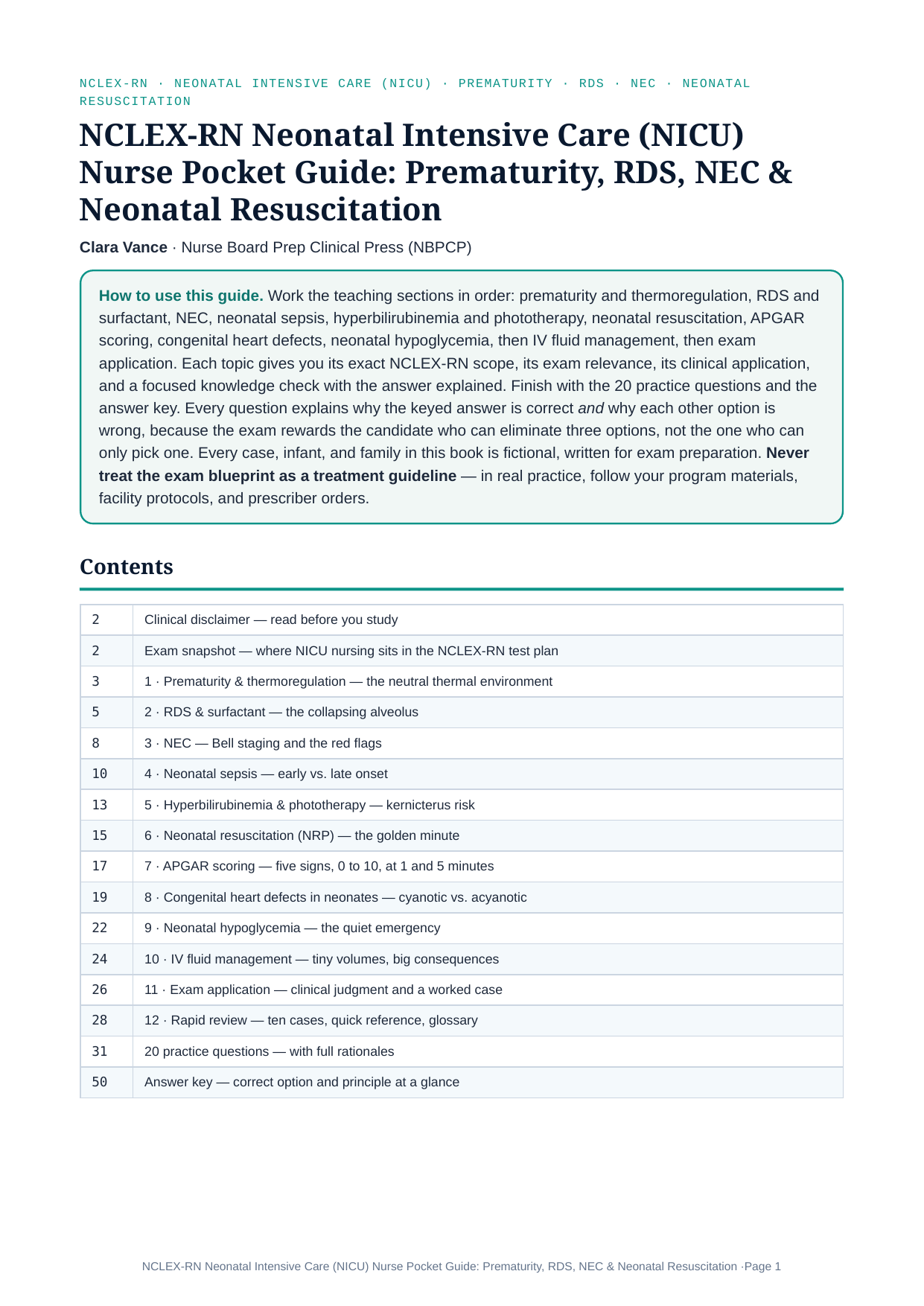
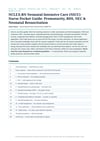
Inside:
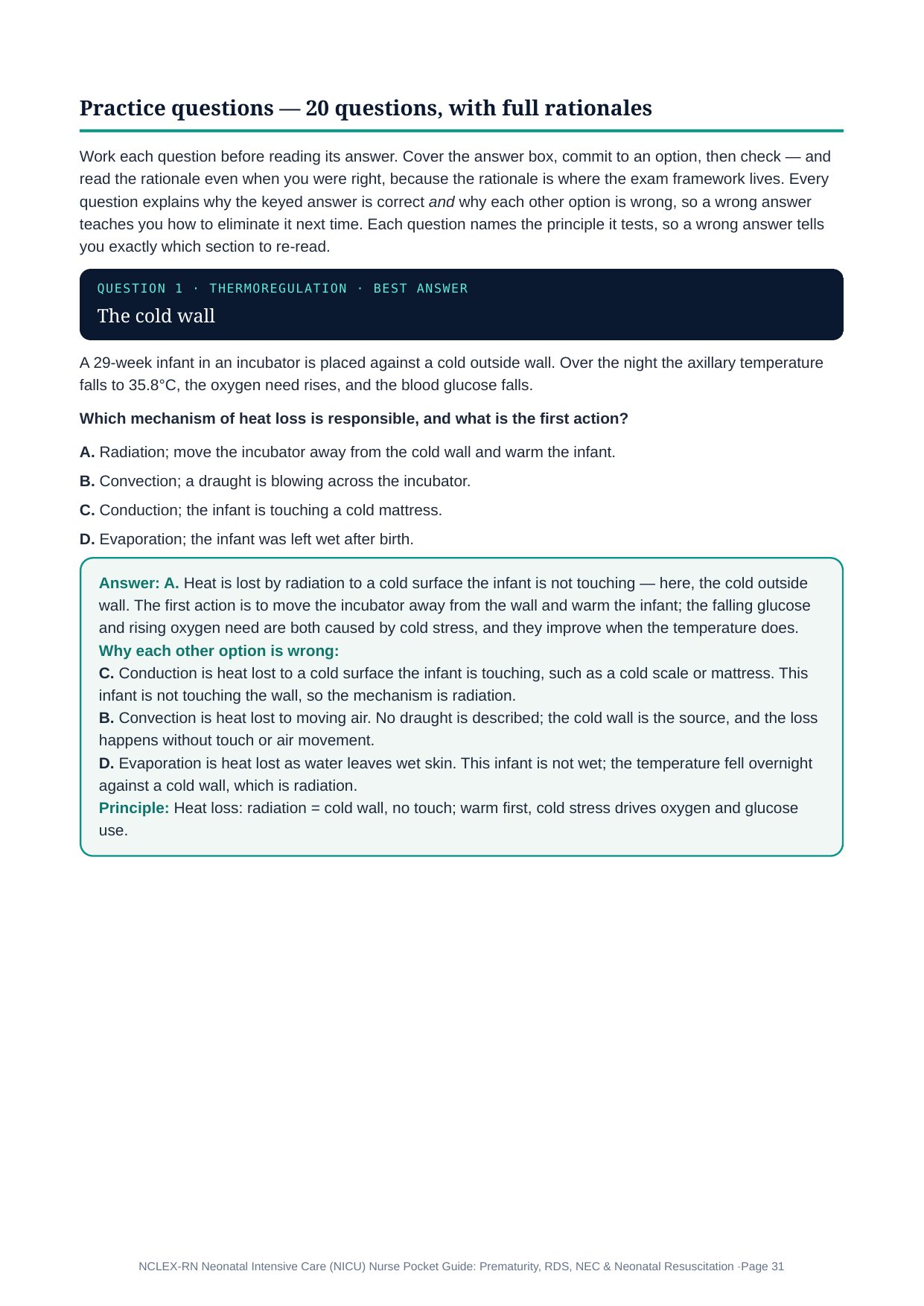
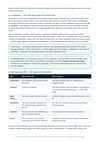
- Prematurity and thermoregulation: the categories (preterm before 37 weeks, late preterm 34–36 weeks, VLBW under 1,500 g, ELBW under 1,000 g), the four heat-loss mechanisms (radiation, conduction, convection, evaporation), and the neutral thermal environment (axillary 36.5–37.5°C) — cold stress burns oxygen and glucose and triggers apnoea, so warm first
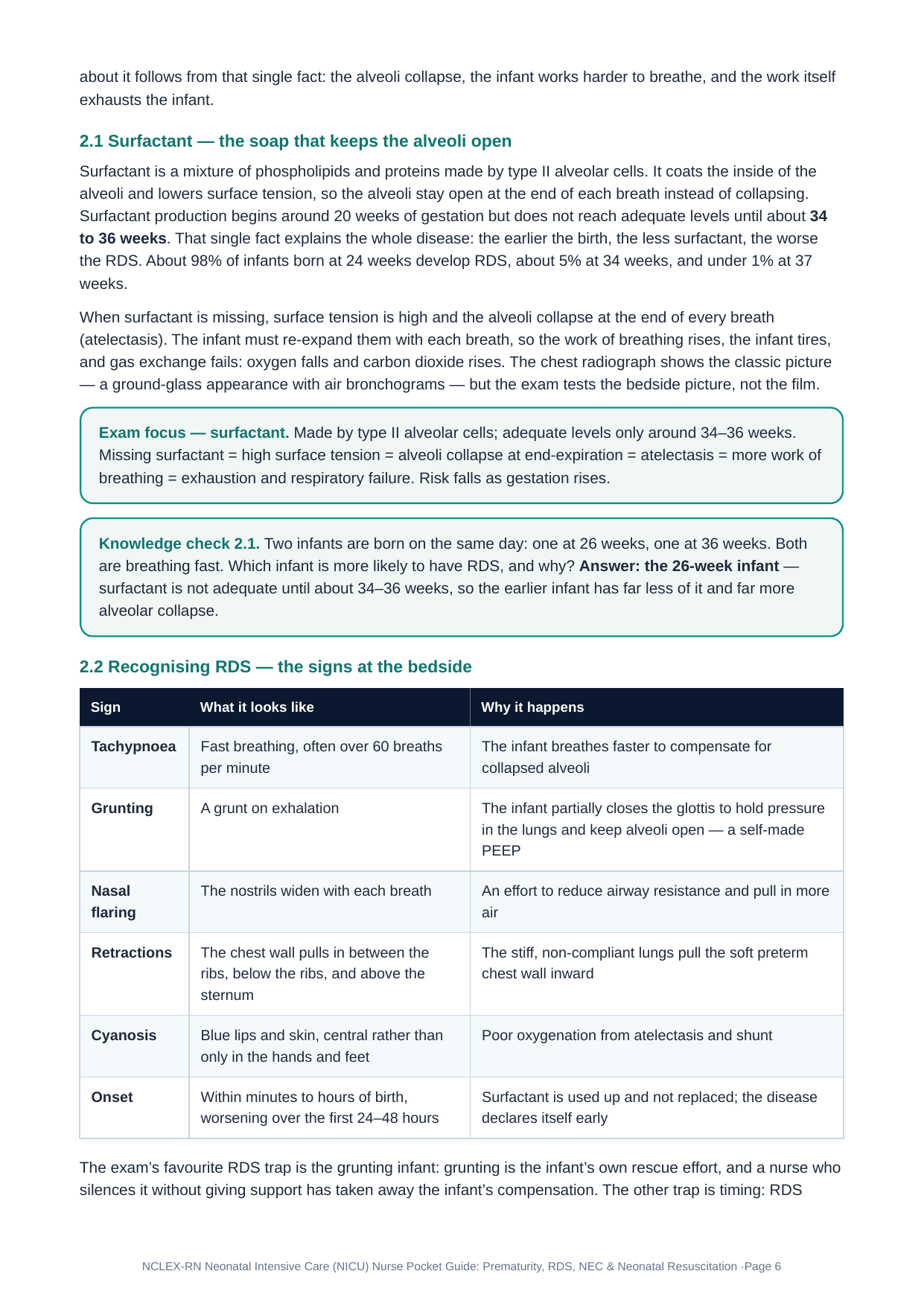
- RDS and surfactant: type II cells, adequate surfactant only around 34–36 weeks, the signs (grunting, flaring, retractions, tachypnoea, onset within minutes to hours), and the support ladder — CPAP first, surfactant when the oxygen need rises, ventilation last; SpO2 target 90–94% in preterm infants
- NEC: the risk triad (preterm + very low birth weight + enteral feeding), the early signs (feeding intolerance, large residuals, distension, bloody stool, apnoea), and Bell staging — I suspected, II definite (pneumatosis; IIB portal venous gas), III advanced (IIIB pneumoperitoneum = perforation); first action: stop the feeds
- Neonatal sepsis: early-onset under 72 hours (mother, GBS and E. coli, rupture of membranes over 18 hours, chorioamnionitis) vs. late-onset after 72 hours (environment, coagulase-negative staphylococci, central lines); the vague "not doing well" picture; cultures first, then antibiotics as ordered; NEC vs. sepsis compared side by side
- Hyperbilirubinaemia and phototherapy: jaundice within 24 hours is pathological; kernicterus risk (high unconjugated bilirubin crossing the blood-brain barrier); phototherapy (blue-green light 460–490 nm, nappy only, eyes shielded, reposition often, feed frequently)
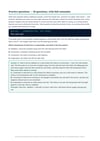
- Neonatal resuscitation (NRP): the golden minute (warm, sniffing position, clear only if needed, dry, stimulate, all within ~60 seconds); PPV at 40–60 breaths per minute, 21% oxygen for term infants (21–30% under 35 weeks), never 100% to start; MRSOPA corrective steps; chest compressions only if the heart rate stays below 60 after 30 seconds of adequate PPV — ratio 3:1 (90 compressions + 30 breaths per minute)
- APGAR scoring: the five components (Appearance, Pulse, Grimace, Activity, Respiration), each 0–2, total 0–10, at 1 and 5 minutes; bands 7–10 reassuring, 4–6 moderately depressed, 0–3 severely depressed; a 9 at 1 minute is normal (acrocyanosis); a worked scoring example with a reverse-check
- Congenital heart defects: cyanotic (TOF, TGA, truncus, TAPVR, HLHS — blue, does not improve with oxygen) vs. acyanotic (VSD, ASD, PDA, coarctation — pink, murmur and heart failure); ductal-dependent lesions and the prostaglandin E1 concept (keeps the ductus open, watch for apnoea)
- Neonatal hypoglycaemia: the risk groups (infant of a diabetic mother, preterm, SGA, LGA, perinatal stress), the AAP operational thresholds (below 40 mg/dL in the first 24 hours, below 45 mg/dL after), the adrenergic and neuroglycopenic signs; check, feed, recheck, notify
- IV fluid management: daily weight is the fluid chart, strict intake and output, urine output 1–2 mL/kg/hour (below 1 is oliguria), all fluids through a pump, double-checked; a worked fictional order with a reverse-check (100 mL/kg/day for a 1.5 kg infant = 150 mL/day = 6.25 mL/hour)
- Exam application: the NCJMM applied to the NICU, a worked case with a dated cue timeline (day 1 RDS, day 10 NEC) and an answer-to-cue crosswalk
- Rapid review: 10 NICU cases, emergency quick-reference table, glossary
- 20 practice questions with full rationales — why the keyed answer is correct AND why each other option is wrong — plus an answer key
No real medicine doses are asserted in this book — dosing is prescriber-ordered and product-specific. The one worked order is a clearly labelled fictional teaching order, written only to practise the calculation. Original teaching cases written for exam practice. This guide is not affiliated with NCSBN and does not guarantee a pass. If you find an error, a corrected version will be sent free.