

Coming up in the next episode...
Coming up in the next episode…
The Ms Tan Tales, Book One
The first thing you need to know is that there was no keyring.
Every Year 8 at Shining Academy knows how design and technology works. You get a rotation, you get a scheme of work, and at the end of it you take home a small wooden object nobody wants. Violet Jones has been counting on this. Violet Jones has, broadly, been counting on being unimpressed by everything.
Instead, she gets Ms Tan, a persona card with a stranger’s name on it, and a fictional town in 2050 where a woman called Deb Hargreaves works a shift she cannot afford to lose and has nowhere safe to keep the one thing she owns that matters. No steps. No worksheet. No correct first move. For Violet, an open brief with no edges isn’t boring; it’s the worst thing a lesson can be.
Then, somewhere around the third Wednesday, entirely without her permission, it starts to work.
Eight lessons. Eight episodes. A workshop that smells of MDF dust and machine oil, a technician with a drawer of felt in colours nobody else would have kept, a best friend building a shrine for a dead man called Aled, and a head of department who signed off a scheme of work in September and has just put his head round the door to find out what’s actually happening in it.
Violet notices everything; the tone under the tone, the sentence someone almost says and then swallows, the half-second two adults hold eye contact too long in front of an audience of children. It is, she is coming to accept, the central fact of her personality. What she doesn’t notice, until it’s more or less already happened, is that she has started to care about something.
Funny, precise and quietly furious about the right things, ‘Coming up in the next episode…’ is a novel about a term of ordinary Wednesday mornings, and about what a subject is for when nobody’s counting it anymore.
The Ms Tan Tales: series description
Greencutting used to make things. Shears, billhooks, plane blades: the unglamorous cutlery of work rather than the dinner table. Now the drop-forge is a gym, the last edge-tool works is a retail park, and the old comprehensive has been re-clad, re-branded and absorbed into the Bright Lights Trust, which has a data dashboard for everything and a mission statement on the corridor walls.
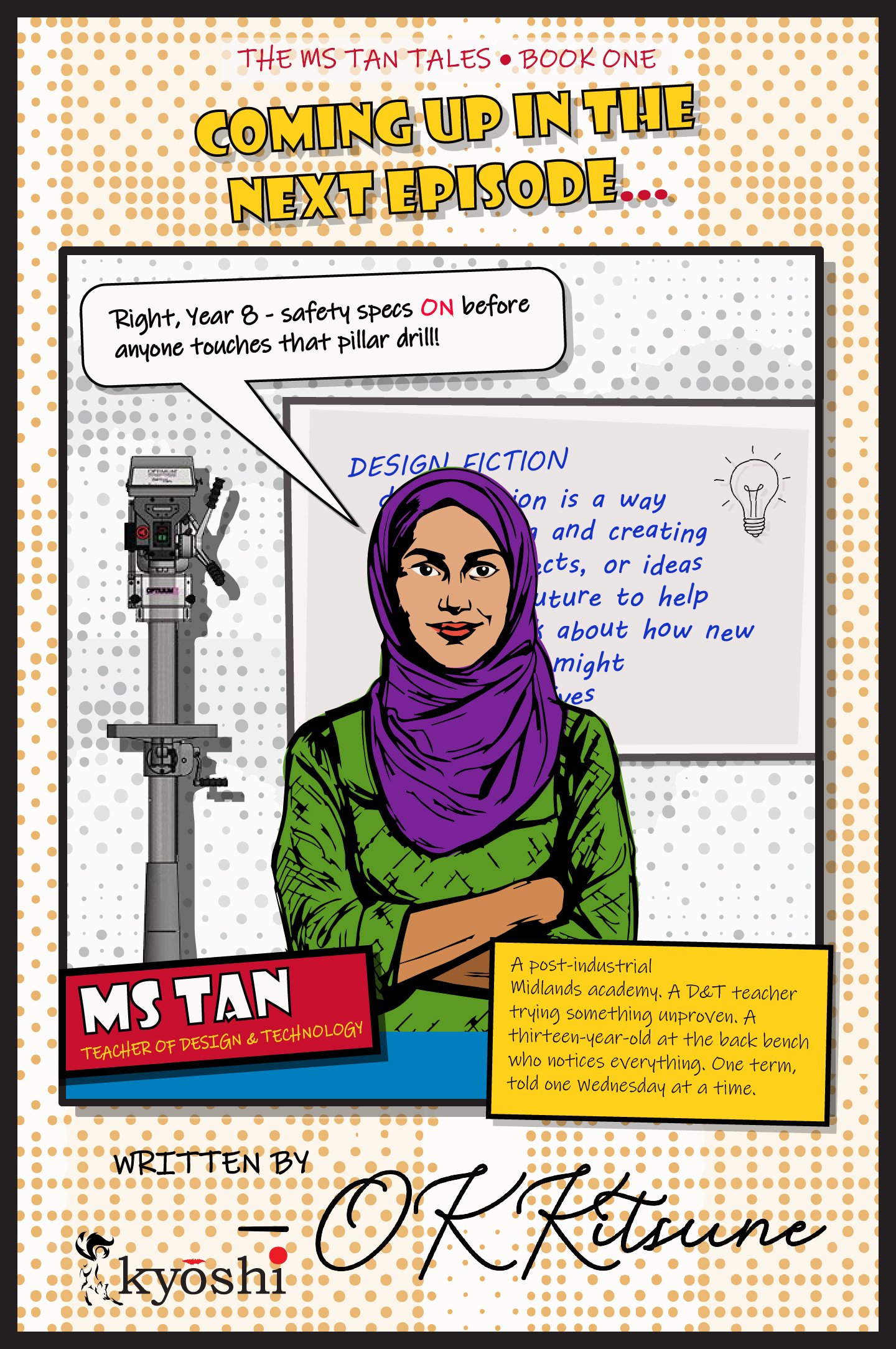
In what’s left of the Design and Technology Department (half its curriculum time gone, its workshop older than most of its staff), Ms Tan is trying something her colleagues would rather she didn’t. No keyrings. No phone stands. Nothing you can put a number against by Friday. Just thirty Year 8s, a fictional town in 2050, and a term spent learning what it actually means to design something for someone else.
Violet Jones, thirteen, is not impressed. Violet is watchful, dry, allergic to being managed, and has spent a year and a half being broadly unimpressed by everything this school has asked of her. She is also, though she’d never put it this way, the only person in the room paying proper attention; to the work, to the adults, and to the quiet argument going on above her head about what her subject is even for.
Each book is one term, told as episodes: one lesson, one Wednesday morning at a time, the way a school drama used to fill a Tuesday-evening slot and the way a scheme of work is supposed to build; not eight unrelated hours, but one thing, constructed in eight instalments.
Funny, sharp-eyed and set in a real place that isn’t on any map, The Ms Tan Tales is a series about a teacher, a student, and a subject the system stopped counting.
What kind of book is this?
Coming up in the next episode… is a comic social realism novel about a school term, told in eight episodes, and it borrows from several places at once: the British school story, the workplace novel, and the state-of-the-nation fiction that notices what happened to towns that used to make things.
But the label I keep coming back to is speculative pedagogy fiction.
Speculative fiction asks what if the world were otherwise. Speculative pedagogy fiction asks the same question of a classroom. What if a teacher stopped producing keyrings and asked a Year 8 class to design for a stranger in a town that doesn’t exist yet? What would that actually feel like; not in a case study or an impact report, but on a wet Wednesday, to a thirteen-year-old who didn’t ask for it and to a second-year teacher who has to justify it to her head of department by Friday?
There’s a pleasing recursion in it. The students in these pages are doing design fiction (imagining New Greencutting in 2050 and the people who’ll live there). The book is doing the same thing one level up: imagining a version of the subject that the system currently has no column for.
There are plenty of novels set in schools. There don’t appear to be any set in a D&T workshop. This one is, and unapologetically so.