
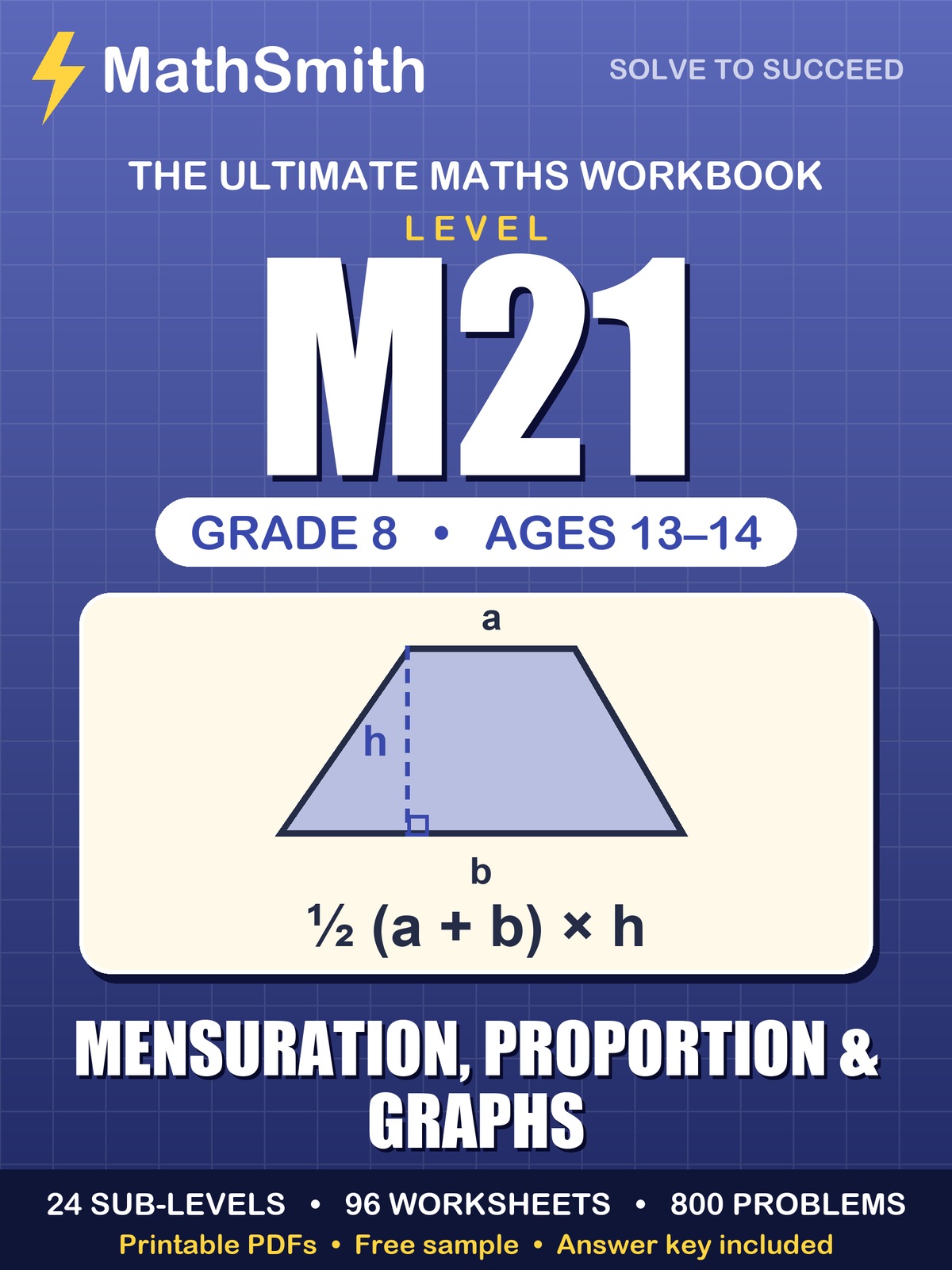
Gr 8 Maths Worksheets (Ages 13-14) | Level M21: Mensuration, Proportion & Graphs
🎓 Launch offer: 80% OFF every MathSmith workbook with code LAUNCH80 (first 1000 orders). Click Add to Cart, then enter LAUNCH80 in the discount box before you pay.
Not sure which level your child needs? Take the free 40-question placement test: https://ebooks.thecodecrafters.net/placement
See free sample pages first: https://ebooks.thecodecrafters.net/
Help your child build absolute confidence and mastery in mathematics. This comprehensive workbook from MathSmith takes a highly structured, "one-rung-at-a-time" approach to Mensuration, Proportion and Graphs, ensuring students fully understand concepts before moving forward.
Instead of overwhelming learners with random equations, this workbook uses a carefully scaffolded, predictable learning ladder. It is perfect for homework, structured independent study, or mastery practice.
📊 What Is Included?
1 Complete Level (Level M21)
24 Structured Sub-levels for gradual progression
96 Printable Worksheets
800 Total Problems for thorough practice
Full Answer Key online, unlocked by the order ID on your Payhip receipt, for quick, stress-free marking
🗺️ Curriculum Breakdown
This collection focuses deeply on mastering Mensuration, Proportion and Graphs through a carefully curated system:
Areas nobody has a rectangle for (4 Sub-levels): Four shapes and one idea. Every area rule past the rectangle asks for a length that is NOT a side of the shape - the height of a trapezium, the offsets onto a quadrilateral's diagonal, the two diagonals of a rhombus - and a child who reads a slant side as the height gets a bigger answer with no step in it that looks wrong. So those lengths are drawn differently: dashed, and with a small square at the foot saying the line went in square. The strand ends on the shape that has no rule at all, which is cut into two that do.
Two numbers off the same three edges (6 Sub-levels): Surface area and volume are worked out from the same measurements and are not the same kind of number, which is M9's argument about a rectangle's area and its perimeter met one dimension up. A cuboid's surface is three pairs of identical faces, so the hidden edges are dashed - count only the faces you can see and you get exactly half. A volume is a cross-section repeated, and nothing about that changes when the cross-section is a circle, which is why the cylinder comes straight after the box rather than with the other circle work. It closes on the sentence that turns a volume into something you can pour.
Two quantities that move together (4 Sub-levels): Direct and inverse, drilled in the same table on purpose, so that the only difference on the page is what the columns do: one divides to a constant and the other multiplies to one. Then the rung that exists because the arithmetic afterwards is identical and the answer is not - deciding which applies, which is settled by asking what happens to the OTHER quantity and never by the words of the story, since something gets bigger in all of them. It ends on time and work, where the quantity is not the days at all but the fraction of the job done in one of them.
Money that earns on what it has already earned (4 Sub-levels): Compound interest is simple interest done again on a principal that has changed, and it is taught in that order: a year at a time first, with the formula deliberately not mentioned, so that a child meets what the formula DOES before meeting the formula. The exponent then counts the years because each year multiplies by the same thing, which is M16's chain argument arriving somewhere it is used for money. Compounding twice a year comes to more, which nothing in the words suggests; and depreciation is the same arithmetic with a multiplier below one.
Four ways of holding a set of numbers (4 Sub-levels): A frequency table groups counts into classes, and its tally column is how a count is recorded while it is still being taken. A histogram draws that table with its bars touching - not a styling choice, because the scale underneath is continuous and 20-30 ends exactly where 30-40 begins, so the numbers sit on the boundaries between the bars. A pie chart has no scale at all, so a share of it is a share of a whole turn and a percentage is an angle. And probability, which is a count against a count, and is therefore written as a fraction with a bar.
Where a pair of numbers points (2 Sub-levels): The level's notation and the foundation of everything above M23. Two ruled lines and one agreement: the first number is across and the second is up. Drilled both ways round, because a child who reads the pair backwards has plotted a different point with no arithmetic wrong anywhere. Then the straight line, which is the first graph in the book that is not a chart of counts - it is the whole set of pairs that one rule allows, and reading a value off it is the thing every level after this one does.
🎯 Who Is This For?
Parents looking to provide structured math support at home.
Homeschoolers searching for a sequential curriculum to guarantee zero gaps in math skills.
Teachers & Tutors looking for bite-sized, scaffolded printables for classroom morning work or targeted intervention.
📖 How To Use This Workbook
Print the workbook, read each rung's method page, and let your child work inside the printed frame. Then check the answers your way: in the printable answer-key PDF included in this download, or online, one page at a time, with the order ID on your Payhip receipt (valid for six months). Please keep the answer key for the adult marking the work and do not share it with your child: the workbook only works if they have worked each answer out for themselves.
Step-by-step manual and video guide: https://ebooks.thecodecrafters.net/manual/
Check the answers: https://ebooks.thecodecrafters.net/answers
⚙️ Digital Delivery Details
Format: four instant-download PDFs (free sample, sample answers, workbook, full answer key). The answer key is also available online.
Print Ready: Easily printable on home or school printers.
Usage: Licensed for individual family or single-classroom use.