
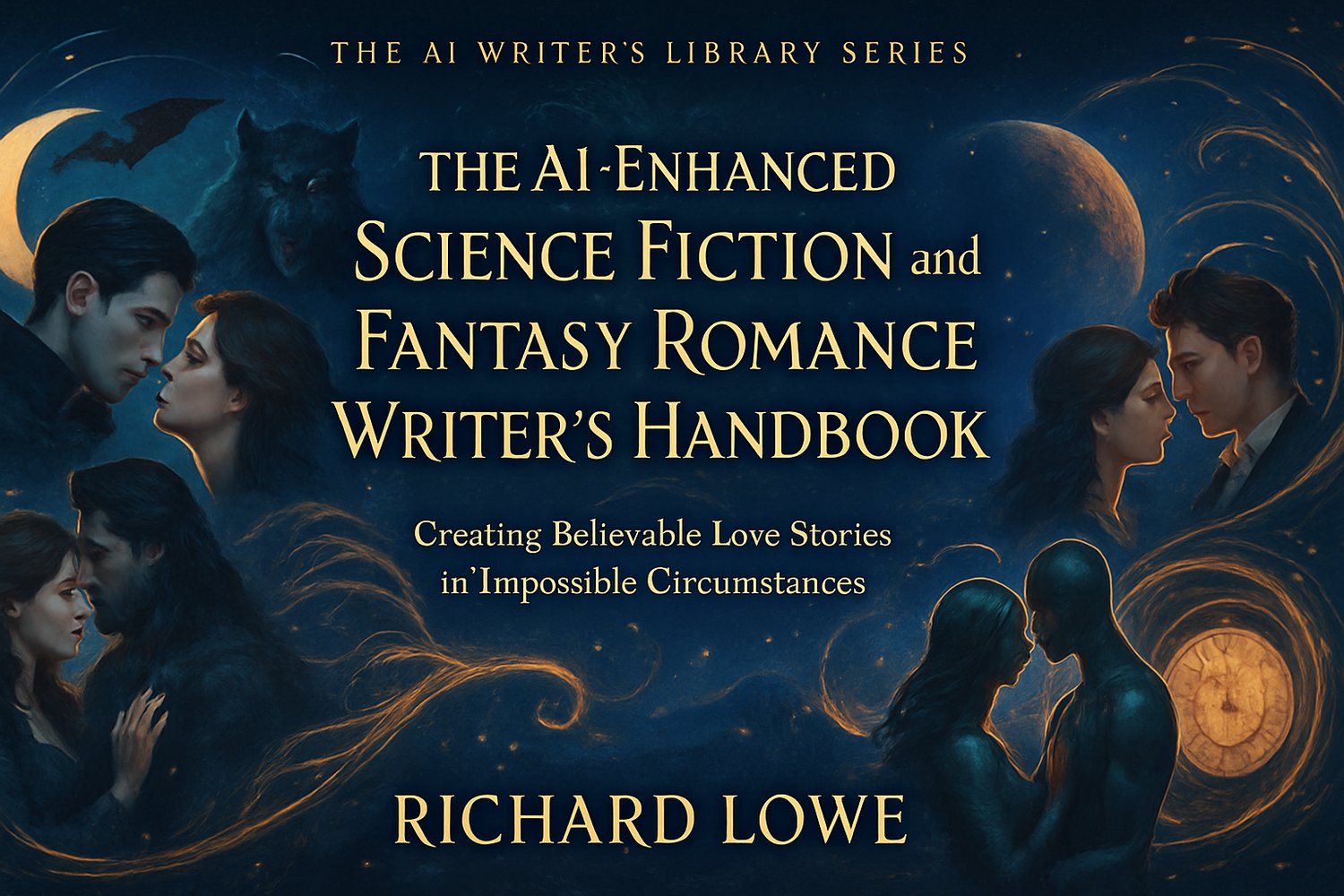
Ai-Enhanced Science Fiction & Fantasy Romance Handbook
Stop Writing Fantasy Epics With Romance Subplots Attached
You slapped telepathy onto a billionaire romance or gave your vampire hero a motorcycle and called it paranormal. Your alien warriors have conveniently human-compatible biology. Your magic systems offer romantic shortcuts instead of meaningful obstacles.
Writing advice tells you to "add supernatural elements" and "create exotic settings." Your stories feel hollow despite the supernatural trappings because you're using speculative elements as decoration instead of psychological tools.
The most memorable science fiction and fantasy romance didn't showcase supernatural abilities or technological marvels. Outlander, The Time Traveler's Wife, and Octavia Butler's masterworks used impossible circumstances to illuminate universal truths about human connection.
Your supernatural and technological imagination isn't window dressing for love stories. It's a psychological laboratory for exploring how impossible circumstances reveal romantic truths that contemporary romance can't access. When you ground impossible love stories in authentic character development, your speculative romance transcends genre entertainment.
Five Speculative Romance Subgenres
Each subgenre uses impossible circumstances differently.
Paranormal romance appeals through supernatural lovers with inhuman powers. It explores the psychology of immortality, predator instinct, and otherness. Science fiction romance appeals through love across species, space, and time. It explores alien biology and cultural incompatibility. Fantasy romance appeals through magic-infused relationship dynamics. It explores prophecy, curses, and magical bonding. Time travel romance appeals through love that defies temporal boundaries. It explores fate versus choice and aging disparities. Urban fantasy appeals through magic in contemporary settings. It explores hidden worlds, dual identity, and secrecy.
The handbook covers all five subgenres with psychology-first approaches that make impossible love feel authentic.
32 Complete Prompt Chapters
Each chapter includes writing lessons, AI notes with prompting techniques, Study This recommendations, and Watch This visual references.
Paranormal chapters cover vampires, werewolves, shapeshifters, ghosts, demons, and zombies. Science fiction chapters cover aliens, space travel, robots and AI, genetic engineering, cyborgs, and alien invasions. Fantasy chapters cover magic users, magic schools, curses, prophecies, magical objects, and elemental powers. Creature chapters cover mermaids, magical creatures, and transformation curses. Concept chapters cover time travel, dreams, portals, psychic powers, parallel worlds, and supernatural hunters. Theme chapters cover forbidden love, mad scientists, post-apocalyptic survival, and love conquers all (or does it?).
What's Inside
The handbook covers what romance actually is, explaining why most writers get speculative romance wrong by treating supernatural elements as decoration. The SF&F romance market explains commercial opportunities and what sophisticated readers expect. Building romance characters covers psychology that feels human despite supernatural circumstances. Romance heroines with agency addresses avoiding the passive protagonist trap in speculative settings.
Building authentic obstacles covers conflicts that emerge from speculative elements, not around them. World-building for romance settings creates environments that serve emotional development. Magic systems that serve romance ensures supernatural abilities complicate instead of solve.
Plus chapters on technology integration, alien biology, time travel mechanics, series development, AI collaboration, and romance pacing adapted for speculative settings.
Built for Writers Who Use AI
AI can generate alien cultures, magic systems, and futuristic technology. It can also produce supernatural scenarios that solve relationship problems instead of complicating them. That defeats the entire purpose of speculative romance.
The problem isn't the AI. It's what you're asking for. "Create an alien love interest" produces convenient biology. AI needs psychological frameworks. How different sensory capabilities affect intimacy. What reproduction differences mean for commitment. Why cultural misunderstandings create genuine obstacles instead of sitcom misunderstandings.
The handbook shows you how to use AI for speculative romance research, consistency checking, and world-building that serves emotional development. Every prompt chapter includes AI notes with techniques for generating scenarios that complicate rather than simplify your romance.
AI is your world-building partner, not your romantic instinct.
From an Author With 113 Published Books
My ghostwriting clients have secured over $30 million in venture capital with books that created authentic human connection across impossible circumstances. My brain doesn't accept "add supernatural elements" as methodology. When I realized some speculative romances resonated for decades while others felt like regular romance with cool special effects, I dug until I found the systems underneath.
I grew up reading Le Guin, McCaffrey, and Marion Zimmer Bradley. Authors who understood that the best speculative romance uses impossible circumstances to illuminate timeless relationship truths. I studied why Outlander's time travel serves relationship psychology while most time travel romance just creates convenient plot devices. Why The Time Traveler's Wife haunts readers while other temporal romances evaporate from memory.
307-page speculative romance handbook with 32 complete prompt chapters. Psychology-first construction, magic systems that serve romance, alien biology, time travel mechanics, and AI integration throughout.
The universe needs your authentic voice.