






Trend Identification Explained — Measured (PDF Guide)
"Trade with the trend" is the first advice everybody gets and the least actionable. You look at a chart, decide it is an uptrend, and someone with more experience calls the same chart a pullback in a downtrend. Neither of you is being careless. You are using different definitions and nobody said so.
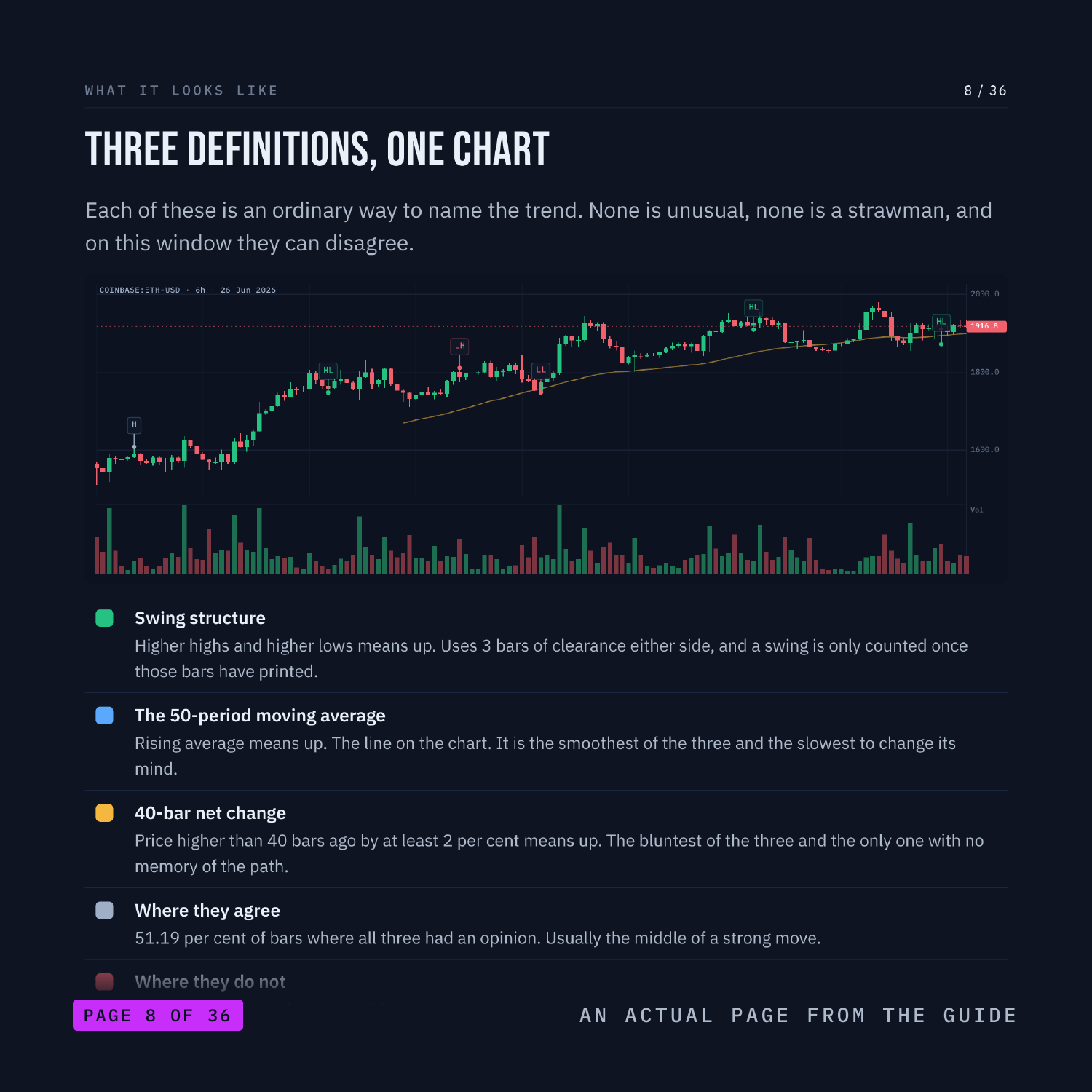
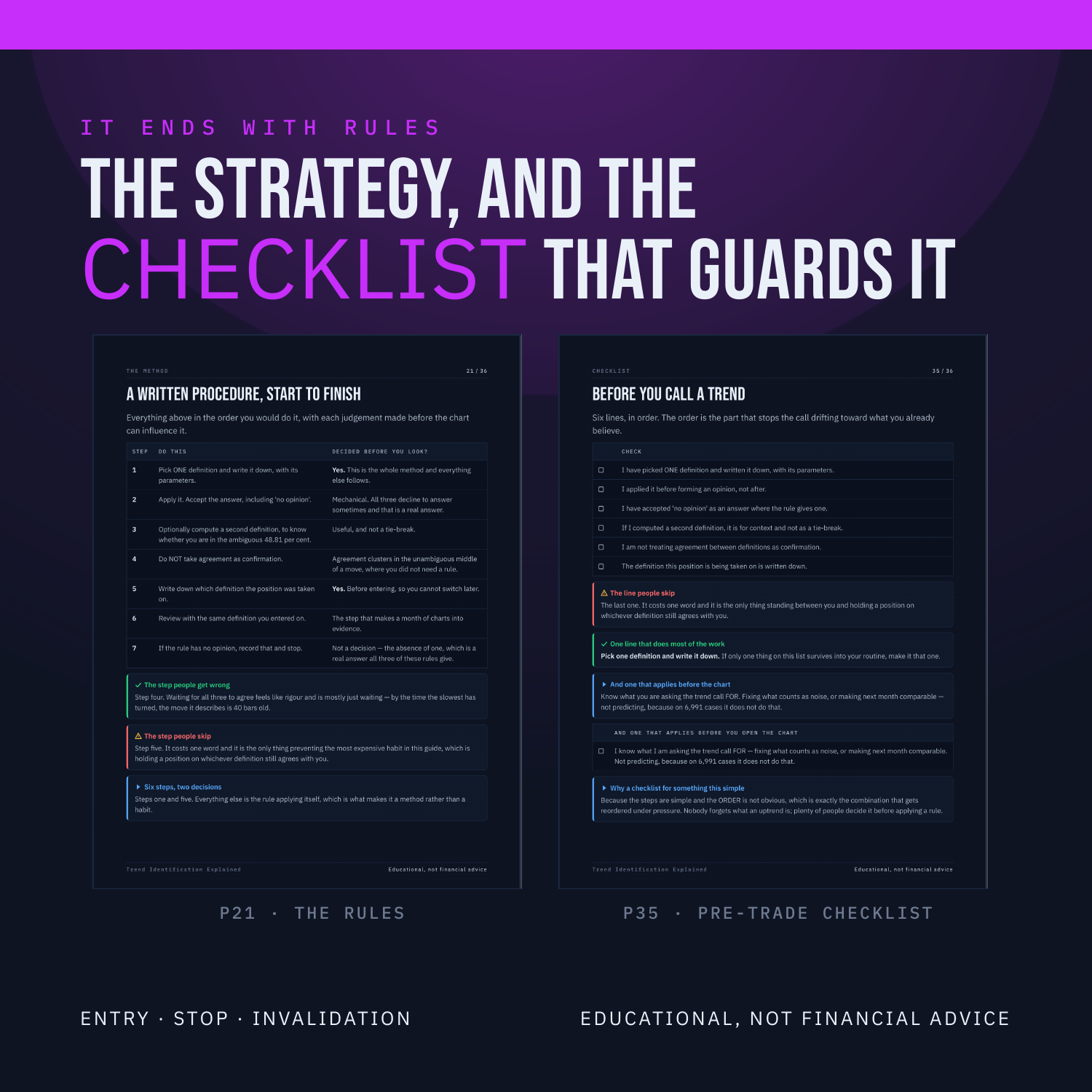
Three ordinary definitions were computed on the same 35,944 bars, bar by bar, and compared. They agree on 51.19 per cent of bars. That is the whole explanation for those arguments, and it means the first question about any trend claim is not whether it is right but whose definition it uses. This is a 36-page PDF that teaches Trend Identification from the first thing you see on the screen through to a written strategy with an entry, a stop and an explicit rule for when the trade is wrong.
Nothing is taught underneath a chart. Every label sits on the candle, the line or the level it is describing, on real BTC, ETH, SOL and LINK charts. There are three quizzes on real charts, each followed by the same chart re-shown annotated with the reasoning, plus faded practice pages where the first steps are filled in and you finish the rest.
WHAT'S INSIDE
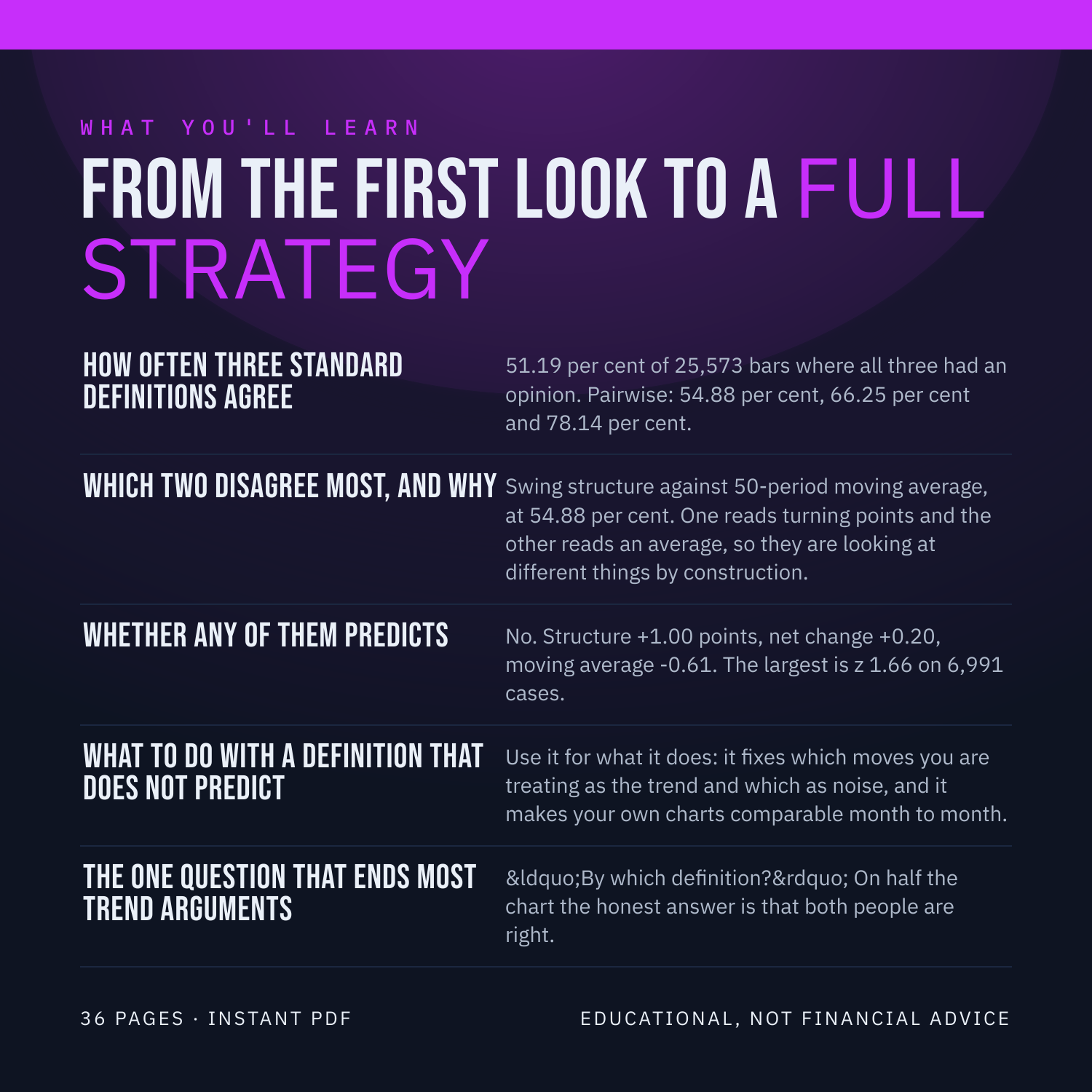
How often three standard definitions agree - 51.19 per cent of 25,573 bars where all three had an opinion. Pairwise: 54.88 per cent, 66.25 per cent and 78.14 per cent.
Which two disagree most, and why - Swing structure against a 50-period moving average, at 54.88 per cent. One reads turning points and the other reads an average, so they are looking at different things by construction.
Whether any of them predicts - No. Structure +1.00 points, net change +0.20, moving average -0.61. The largest is z 1.66 on 6,991 cases.
What to do with a definition that does not predict - Use it for what it does: it fixes which moves you are treating as the trend and which as noise, and it makes your own charts comparable month to month.
The one question that ends most trend arguments - "By which definition?" On half the chart the honest answer is that both people are right.
WHAT YOU'LL BE ABLE TO DO
Name the trend by three separate rules, and get three answers.
State which definition you are using, on every chart.
Read 'the trend is up' as an incomplete sentence.
Stop arguing about charts where both sides are correct.
Use a trend call for what it measurably does.
AN HONEST NOTE
A trend call is a clue, not a crystal ball. It describes what price has already done. This guide contains no win-rates, no backtest results and no promises about what you will make, because nobody can verify those and you should not trust anyone who prints them. What it hands you instead is a set of rules you can test yourself on TradingView in an afternoon. Educational, not financial advice.
Instant download. 36 pages, PDF.